
Prime Minister Narendra Modi on Tuesday said the "wounds and pain of centuries are healing" as India marked the formal completion of the Ram temple in Ayodhya, and used the occasion to draw a broader national roadmap aimed at achieving the goal of a developed India by 2047.
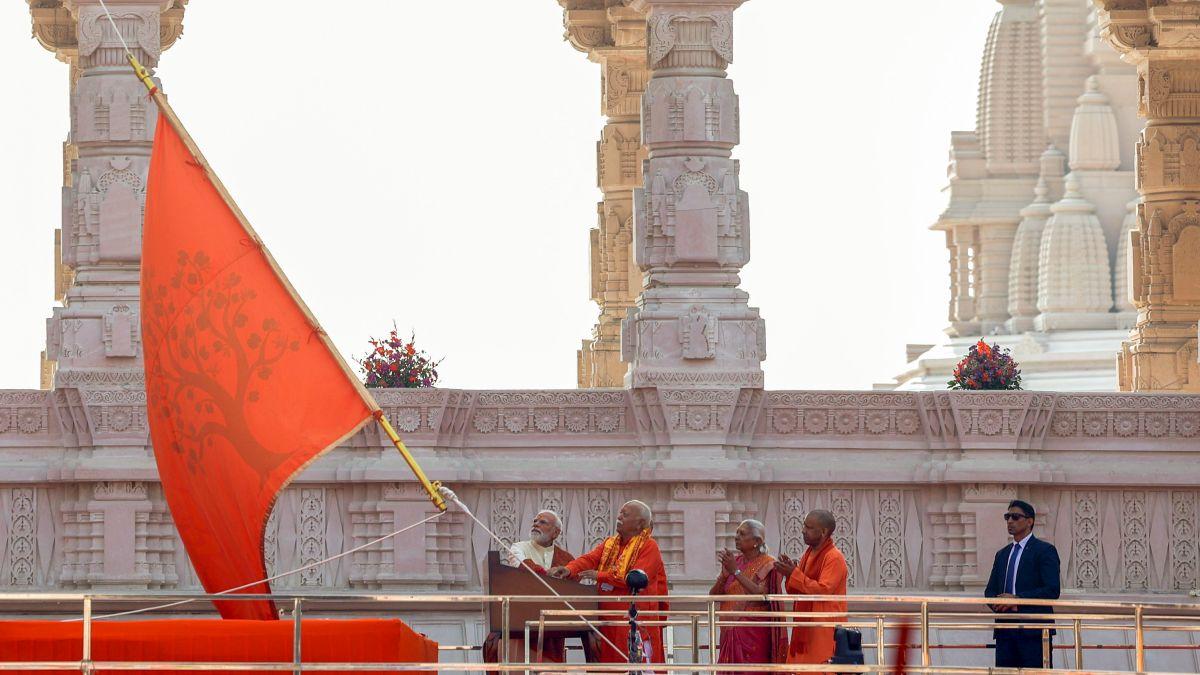
Addressing a gathering after hoisting a saffron flag atop the Ram temple to mark the ceremonial completion of its construction along with RSS chief Mohan Bhagwat, Modi said the moment symbolised a cultural resurgence for the nation.
"Today, the entire nation and the world are immersed in Ram. Centuries-old wounds are healing, centuries-long pain is finding closure, as the resolve that burned for 500 years finally reached its fulfilment," Modi said.
Calling the flag-hoisting "a unique and divine moment", the prime minister said the sacred flag atop the Ram temple would stand as a testimony to the fact that "truth ultimately triumphs over falsehood".
Congratulating all the Ram devotees and those who contributed to the temple's construction, Modi said Ayodhya had always been the land where ideals transformed into conduct.
Recalling the journey of Lord Ram, Modi said, "Ram left as a prince but returned as 'Maryada Purushottam'. The wisdom of sages, the guidance of mentors, the friendship of Nishad Raj, the devotion of Shabari, and the commitment of countless others shaped him. A developed India will need this same collective strength too."
The prime minister also said that India must look beyond the present and plan for future generations.
"Those who think only of today are unfair to the coming generations. The country existed when we were not here, and it will still remain when we won't be here," Modi said.
The journey to a developed India by 2047 requires awakening the Ram "within us", Modi said.
"Ram is not a person but a value, a discipline and a direction," he noted.
Reiterating the need to free the country from the "mentality of slavery", Modi said India must take pride in its civilisational identity.
"Macaulay sowed the seeds of uprooting India from its roots 190 years ago. We gained Independence but not freedom from inferiority," he said, adding that the next 10 years should be dedicated to reversing this mindset.
Modi also said that colonial-era distortions led to the belief that India borrowed democracy from abroad.
"India is the mother of democracy. It is in our DNA," he said, citing a thousand-year-old inscription in Tamil Nadu that documents democratic practices.
Modi said this mindset influenced even national symbols, prompting the recent redesign of the Navy's flag.
"It was not just a design change; it was a change in thinking," he said.
On Ayodhya, Modi said the city is once again emerging as a model blend of antiquity and modernity.
"The Ayodhya of the Treta Yuga gave humanity its moral code. The Ayodhya of the 21st century is giving the world a new model of development," Modi said, highlighting the city's new airport, upgraded railway station and improved connectivity.
The prime minister also said that nearly 45 crore devotees have visited the temple since its consecration, bringing "significant economic transformation" to the region.
Pointing to India's economic progress, Modi said: "After 70 years of Independence, India became the world's 11th largest economy. But in the last 11 years, we have become the fifth largest. The day is not far when we will become the third largest."
Invoking the metaphor of Ram's chariot in the battle against Ravan, he said India's development journey too required patience, truth, good conduct, strength and compassion.
"We need a similar chariot to accelerate the journey of a developed India," he said.
The vision of Ram Rajya must guide India's future, the prime minister said, adding, "This is possible only when national interest comes before self-interest, and remains supreme."
According to officials, the flag-hoisting marked the formal completion of the Ram temple complex, nearly six years after the Supreme Court's landmark 2019 verdict that allotted the entire 2.77-acre disputed site for the Ram Mandir.
According to an official statement, the saffron flag measuring 22 feet x 11 feet is made of parachute-grade cloth with a thick nylon hoisting rope, and is mounted atop a 161-foot spire.
The flag bears symbols of the Sun, representing Lord Ram's Surya Vansh, Om, and the Kovidara tree, described as the state tree of Ram Rajya.
Temple officials said the idol of Ram Lalla is located in the 'Garbhagriha' on the ground floor, a climb of 32 steps from the Singh Dwar on the eastern side.
The complex includes five mandaps -- Nritya, Rang, Sabha, Prarthana and Kirtan -- and features restored heritage structures such as the ancient Shiv Mandir at Kuber Tila and the historic Sita Koop.
The Ram temple project began after the Supreme Court's unanimous judgment dated November 9, 2019.
Following the ruling, the Centre constituted the Shri Ram Janmabhoomi Teerth Kshetra Trust, announced by Prime Minister Modi on February 5, 2020.
The foundation stone for the temple was laid on August 5, 2020, and the 'Pran Pratishtha' of the Ram Lalla idol took place on January 22, 2022.
The Ram Darbar was opened to devotees on June 14, 2025.







 © 2025