

'What we are witnessing is a massive anti-incumbency wave that has cut across all social and political divides.'

Key Points
- Anti-incumbency wave, leadership concerns, and internal divisions within Left parties contributed significantly to electoral outcome.
- Congress-led UDF delivers one of its strongest performances, benefiting from unity and minority consolidation.
- BJP expands presence with three seats, signalling emerging third force in Kerala's largely bipolar political landscape.
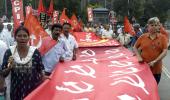
The ruling Left Democratic Front (LDF), led by the Communist Party of India- Marxist, suffered a decisive defeat in the Kerala assembly elections, five years after scripting history by retaining power for a second consecutive term.
With the loss in Kerala, the Left has lost its last bastion.
The United Democratic Front (UDF), led by the Congress, surged ahead with a commanding lead, winning 102 seats.
The ruling LDF was reduced to 35 seats from the 99 it secured in the 2021 elections.
Of the 21 ministers in the Left government, including the CM, only seven were elected; 13 lost, and one did not contest. And three out of the nine Left dissidents won.
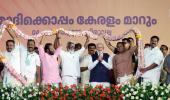
The Bharatiya Janata Party, meanwhile, reopened its account in the Kerala assembly and expanded its footprint.
Political observers said the scale of the defeat points to more than routine anti-incumbency.
"What we are witnessing is a massive anti-incumbency wave that has cut across all social and political divides. This is not just about minority consolidation; it is a broad-based landslide against the LDF," said M G Radhakrishnan, a political observer based in Thiruvananthapuram.
The verdict could be the Left's worst electoral setback in Kerala, comparable to the 1977 post-Emergency election, he added.
"The 2021 victory of the LDF was an exception shaped by extraordinary circumstances -- particularly the pandemic -- when voters tend to rally behind incumbent governments perceived as strong and stable," Radhakrishnan said.
"With those conditions gone, Kerala has reverted to its traditional pattern of voting out incumbents," he added.
The CPI-M has remained relevant in Kerala even as it was voted out of power in West Bengal and Tripura.
Even in 2011, when it lost to the UDF, the margins were slender.
At the centre of this setback is Chief Minister Pinarayi Vijayan, whose leadership style has come under scrutiny.
Though the Left government made advances in infrastructure and welfare expansion, analysts argue these were overshadowed by perceptions of centralised decision-making and arrogance.
The concentration of power around Vijayan also appears to have created a leadership vacuum within the party, leaving no clear second line.
The electoral verdict has also had a devastating impact on LDF allies.
Only three constituents -- CPI-M CPI, and the Rashtriya Janata Dal -- managed to retain a presence in the assembly, with others drawing a blank.
"As for smaller parties within the LDF, many have effectively been wiped out and are unlikely to survive independently," said J Prabhash, former pro-vice-chancellor of Kerala University.
The Congress-led UDF put in one of its best-ever performances, surpassing its 2001 tally of 99 seats.
"Interestingly, internal divisions -- once a hallmark of the Congress -- were largely absent in the UDF this time and instead appeared within the CPM and CPI. That shift also played a role in weakening the Left," said Prabhash.
"Alongside this, there was minority consolidation driven by fears about the BJP's rise and concerns over the Left's perceived 'soft Hindutva' positioning. Issues like Sabarimala also contributed," added Prabhash.
Kerala fiscal crisis concerns
With the UDF's victory, all eyes are on who will emerge as the chief minister.
The names of Leader of Opposition V D Satheesan, senior leader Ramesh Chennithala and Congress General Secretary (Organisation) K C Venugopal have been doing the rounds.
Satheesan seems to have the upper hand as he played a key role in the UDF's victory.
The BJP won three seats in the Nemom, Kazhakkoottam, and Chathannoor assembly constituencies.
"The BJP's emergence as a three-seat presence is significant. While Kerala remains largely bipolar for now, the BJP has clearly become a factor that cannot be ignored," Prabhash said.
The task is cut out for the next government, which will have to deal with rising debt and find solutions for the high unemployment and unfinished infrastructure projects.
Outstanding public debt of the state at the end of 2024-2025 (FY25) was Rs 3.1 trillion against Rs 1.57 trillion in FY16.
"Kerala today faces a serious fiscal crisis. Over the last five years, the state has gone 'from debt to debt,' reflecting a deepening cycle of borrowing and financial stress," said K P Kannan, development economist.
"The state's own revenue has declined significantly over time, while committed expenditures, such as pensions and interest payments, consume a disproportionately large share of income," Kannan added.
"This has pushed the state further into debt, compounded by off-Budget borrowings and inefficiencies in tax collection. Strengthening revenue collection -- without raising taxes -- by curbing evasion will be critical," Kannan explained.
The focus should be on restoring fiscal discipline, Kannan added, improving public services, and creating employment -- particularly through sectors such as manufacturing, energy, and public goods provision.
"Above all," said Kannan, "The government must rebuild public trust by being transparent, realistic, and people-oriented in its approach."
Feature Presentation: Ashish Narsale/Rediff








 © 2026