
'Shock, confusion, and paralysis reigned.'
'Pakistan was caught in a most embarrassing situation. It could neither claim credit for the operation nor admit to a dismal intelligence failure and lack of army preparedness.'
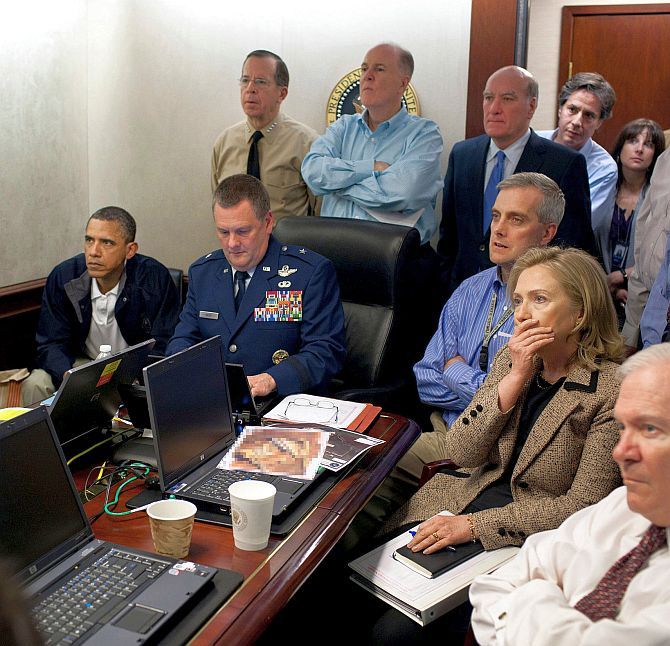
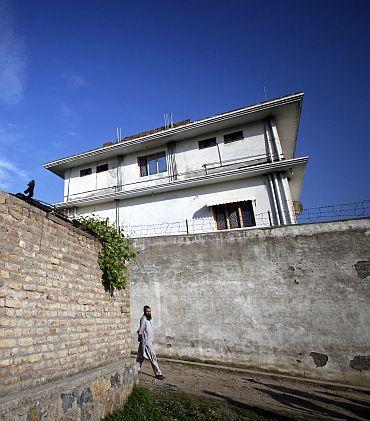
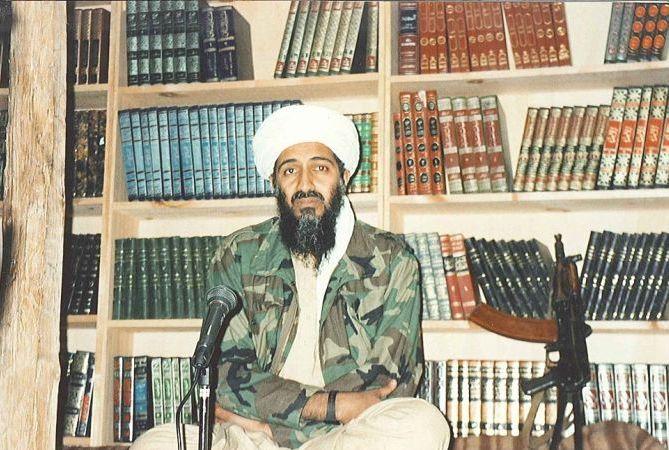
As a team of US Navy Seals dropped down on Osama bin Laden's hideout in Pakistan's Abbottabad in the early hours of May 2, 2011 -- killing the terrorist after a decade-long pursuit -- the leaders of the nation engaged in a meeting to reach a power-sharing consensus between the two coalition parties, unaware of the events that would put it in the 'most embarrassing position' hours later.
The Zardari Presidency: Now It Must Be Told, a new book by Farhatullah Babar, a close aide and spokesperson of then Pakistan president Asif Ali Zardari, has revealed the aftermath of the secret US operation that eliminated Laden while Pakistan was left confused, humiliated, and caught in its inability to fix responsibility for the cataclysmic event.
'The defence forces and intelligence agencies were unaware of what was unfolding in the cantonment in Abbottabad. Meanwhile, in Islamabad, the two coalition partners, PPP and PML-Q, were engrossed in wrangling over a power-sharing formula, just as US Navy Seals were eliminating Osama bin Laden,' Babar writes in a chapter titled 'Zardari and the Osama bin Laden Fiasco'.
It appeared 'most extraordinary' to Babar when next morning at 6.30 am he was summoned by Zardari's aide-de-camp to the president's house along with then foreign minister Hina Rabbani Khar and then foreign secretary Salman Bashir.
A few hours later, at 9 am Pakistan time, then US president Barack Obama announced to the world that the most-wanted terrorist had been taken out in Pakistan -- this thought, when juxtaposed with the previous night's 'wrangling over power-sharing', was 'unsettling' to Babar.
'I also couldn't help thinking that no one in the nuclear-armed country boasting of the world's top intelligence network had the faintest idea -- literally no one -- not the President, Prime Minister, Army Chief, or the ISI. These thoughts were unsettling. A sense of guilt and shame was overpowering.'
Even as national and international media were getting restless for an official reaction, it took more than 14 hours for the Pakistan government to respond as it was caught in a 'clear case of complicity or incompetence'.
'Shock, confusion, and paralysis reigned. It took more than 14 hours to formulate an official response. Pakistan was caught in a most embarrassing situation. It could neither claim credit for the operation nor admit to a dismal intelligence failure and lack of army preparedness. It was a clear case of complicity or incompetence,' Babar writes.
The official response claimed that the operation was made possible through intelligence-sharing with the US, a claim that looked 'hollow and unconvincing'.
For weeks after, intelligence and military leadership were not ready to 'swallow the spectacular humiliation' as they tried unsuccessfully to claim that the top army leadership had even cooperated in its execution, Babar writes.
'By the end of the first day of the raid on 2 May, it appeared that a decision had been taken to vigorously defend the ISI and military leadership against allegations of complicity or failure,' the book reads.
If the Laden fiasco weren't enough to raise questions about Pakistan's intelligence apparatus, the Tehrik-i-Taliban Pakistan and al-Qaeda launched a deadly attack on the PNS Mehran airbase in Karachi two weeks later, destroying two P3-C Orion surveillance aircraft.
According to Babar, the bin Laden and PNS Mehran fiascos presented an opportunity for an intelligence overhaul, however, it would not be
Mentioning the 9/11 report and the report on the 2008 Mumbai attack, Zardari noted that investigations in both cases 'focused on improving procedures and systems, not on punishing individuals'.
In 2013, the Abbottabad inquiry commission submitted its report on the raid that essentially made the president and Pakistan ambassador to the US Husain Haqqani 'scapegoats'.
'Even if no punitive actions were taken, the national humiliation could have been mitigated to some extent by holding the intelligence agencies accountable and reforming the intelligence network,' Babar said.
Apart from the fallout of Laden's killing, the book by Rupa Publications offers an account of Zardari's 'battles with Pakistan's deep state, the judiciary, and even his own allies.
In more than 500 pages, Babar chronicles Zardari's forays in foreign policy, including his attempts at peace between India and Pakistan, and mediation between Iran and Saudi Arabia.
In an interview with journalist Karan Thapar on November 22, 2008, Zardari made a startling announcement that Pakistan was ready to talk about 'No-First-Use' (NFU) of nuclear weapons with India.
Zardari's offer of NFU talks was 'a bold initiative for ushering in peace' without giving up the nuclear option, but important State functionaries criticised him on State television, dismissing the offer of NFU 'as highly irresponsible and unworkable'.
Within four days of the interview, an armed attack in Mumbai by terrorists of Pakistani origin killed 166 people.
'It brought the two countries the closest to war in years and dashed all hopes of peace,' Babar wrote. 'The warmongers shattered Zardari's dream of peace with India by offering talks on No-First-Use.'









 © 2025