

'...yet struggles to convert that human capital into domestic productivity.'
At his rally in Samastipur on October 24, Prime Minister Narendra Modi had said the National Democratic Alliance had delivered the Internet to every village at the lowest cost across the world.
'This chaiwala has made it possible for young people to make reels from every village. The day is not far when young men will be able to set up startups in every village.'
'1 GB data is now cheaper than a cup of tea,' he said.
The riposte was almost instant. Within hours Jan Suraaj leader Prashant Kishor replied: 'Bihar ke logon ko naukri chahiye. Data nahin, beta chahiye (Bihar wants jobs. It wants its sons back home, not cheap data).' The jab was about the lack of jobs in Bihar, which was driving young men away from the state.
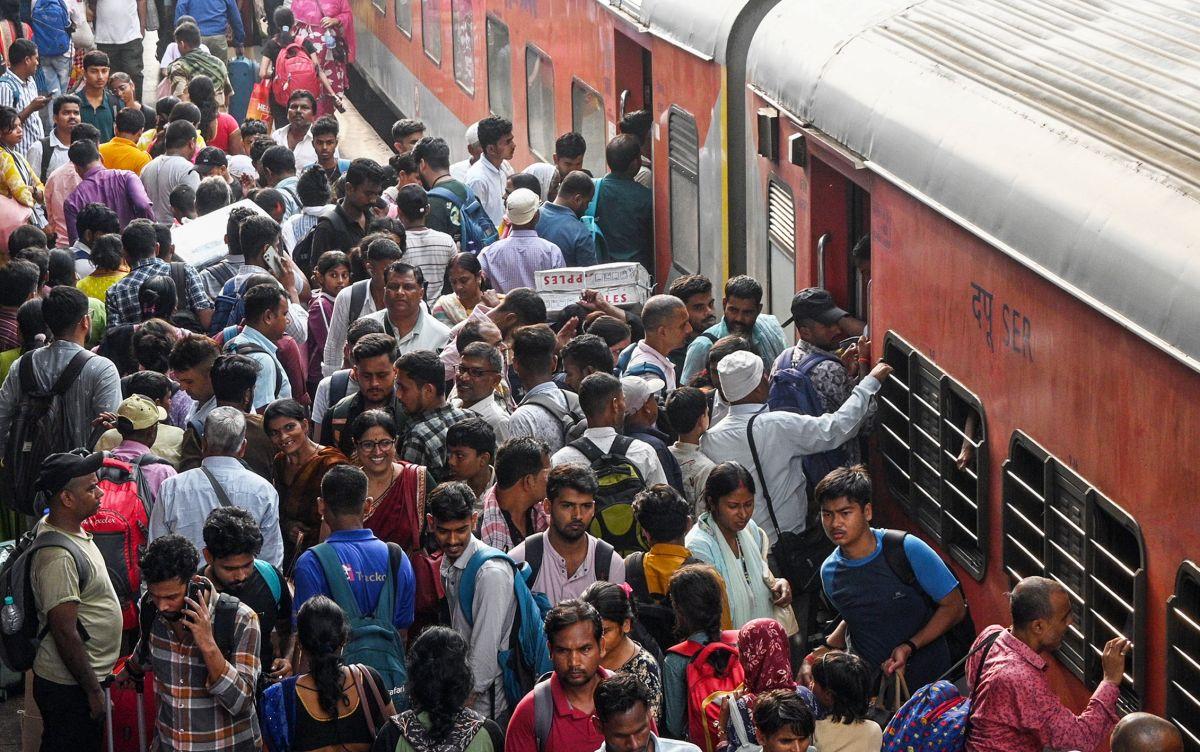
Migration is a recurring theme in the political cut and thrust all over Bihar.
Possibly because it finds it embarrassing, the state government has made no systematic effort to find out how many leave Bihar every year to look for work and which districts are the biggest contributors to this relocation.
The last reliable data was from the 2011 Census, which revealed around 7.4 million migrated from Bihar to other places in India, next only to Uttar Pradesh at 12.3 million.
A K Jha, who recently retired after teaching political science at the L N University Darbhanga for 41 years, says he happened to visit Goregaon in Mumbai on a vacation and found Maithili being spoken in many parts of the urban agglomerate.
When he investigated the matter, he found that most of the housekeeping staff in the region was from Madhubani.
"They were mostly young men between 18 and 30. They took me to their dwelling. That is a grandiose description of how they lived: They had an arrangement with building supervisors. I found bed-rolls neatly rolled up at the foot of pillars in the basement garages of housing societies.
"They would spread the bedrolls and sleep between the pillars at night and during the day they would clean and wash cars and do other odd jobs.
"They would eat from nearby food carts. They managed to earn Rs 16,000 to Rs 18,000 per month. Some of this sum they would send home. I told them they could have done the same job back home. They said they would not be paid as much. There is also societal peer group pressure," he says.
For most people in Bihar, Professor Jha adds job means a government job.
N K Singh, chairman of the 15th Finance Commission and a former IAS officer of the Bihar cadre, says nearly 73,000 workers moved abroad in 2023.
Roughly 7.2 per cent of Bihar's population reside in other states. More than half all households rely on income earned elsewhere.
"This is a demographic paradox. Bihar supplies labour to the world, yet struggles to convert that human capital into domestic productivity."
The answer is industrialisation. But that is slow in coming. Part of the problem is the dearth of large land parcels, although the government is steadily building up a land bank to create industrial estates and economic zones and has announced many employment-linked incentives to industry.
Speaking to Business Standard, Bihar Industries Minister Nitish Mishra said the Bihar Industrial Area Development Authority was aiming to acquire 15,000 acres, covering all the 38 districts in Bihar.
Investing entities are eligible for land at Rs 1 an acre if they provide employment to 1,000 persons or above.
But other ministers concede there are challenges. Acquisition of land in Bihar is not only more costly than in other states but also more difficult because of fragmented landholdings.
"In Haryana, the number of people the state government will have to pay to acquire land might be one or two per acre. In Bihar, it could be 36, even as many as 51 people per acre," says Roads Minister Nitin Nabin.
Mishra says if returned to power, the NDA government's priorities will be to provide extensive skilling opportunities and employment-intensive industry.
According to Nabin, the largest number of migrants join construction.
"Once we start building satellite towns, construction opportunities will be available in Bihar. No one will have to go out to look for work."
Both the contesting formations have made employment their priority.
Prince Kumar, who works in a midsize hotel in Delhi, says he sees little hope of returning to Patna anytime soon.
"The government has done everything it can for the extremely poor. The extremely rich don't need the government. It is people like us who are in-between who can't go back yet. There's nothing for us there," he says.
Feature Presentation: Aslam Hunani/Rediff







 © 2026