
It was significant that the ceremony took place at 24, Akbar Road, the party's former national headquarters, and not at its new office in Kotla Road.
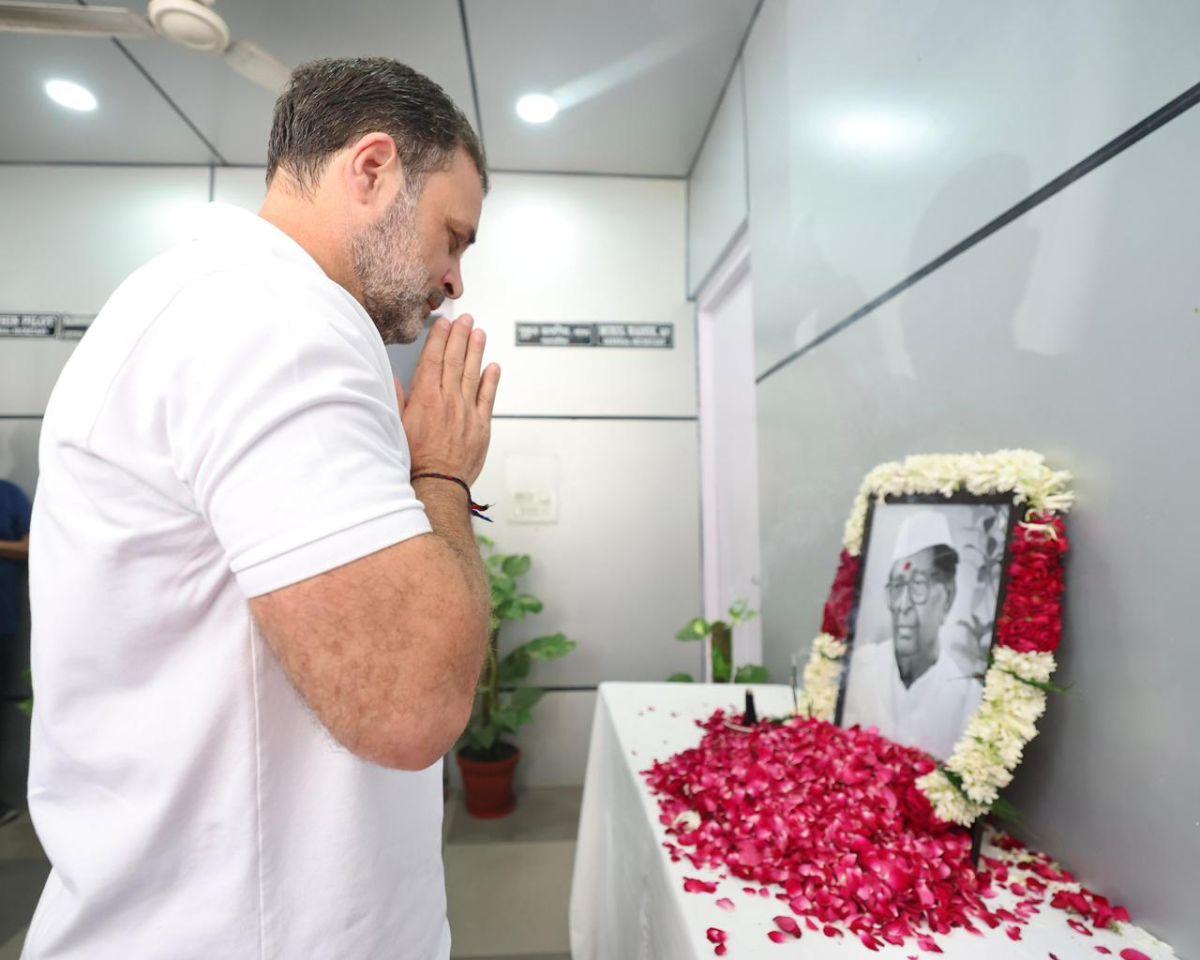
At 24, Akbar Road, where irate Congress workers had roughed him up more than a quarter century back after he was ousted as the party's president, and his contribution to the empowerment of backward classes largely forgotten in later years, Congress leader Rahul Gandhi led the way on October 24, 2025 morning to remember former party chief Sitaram Kesri on his 25th death anniversary.
The Congress' rediscovery of Kesri is reminiscent of the time when in 2020 the party's leadership honoured the memory of former prime minister P V Narasimha Rao in the year of his birth centenary after years of ignoring his place in the pantheon of party's notable leaders.
It also comes at a crucial juncture as Kesri hailed from Bihar, which is poll-bound, and belonged to a caste that is on the list of Other Backward Classes in the state.
After V P Singh announced in August 1990 his government's decision to implement the Mandal Commission report, it was Kesri as minister for social justice and empowerment in Rao's government who implemented the report.
Rahul Gandhi, who in recent years has spearheaded the Congress' demand for a caste census and championed the politics of social justice, paid floral tributes to a black-and-white portrait of Kesri, along with other party leaders, and Kesri's grandson, Rakesh, who is a businessman.
It was significant that the ceremony took place at 24, Akbar Road, the party's former national headquarters, and not at its new office in Kotla Road.
For it was at 24, Akbar Road on March 14, 1998, that the Congress Working Committee ousted Kesri as Congress president. Pranab Mukherjee and some others had engineered that coup.
Some party workers jeered at Kesri and even tugged at his dhoti as he left the party office in his car, which had been damaged.
Kesri was Congress president from 1996 to 1998, with Sonia Gandhi succeeding him.
At another CWC meeting held a year later to expel Sharad Pawar and others when they raised the issue of Sonia Gandhi's 'foreign origin', party workers manhandled Kesri again as they suspected that he supported the rebels.
Kesri had to return home to change his torn clothes. Author Rashid Kidwai has written in his book 24 Akbar Road that 'Kesri died a disturbed and disillusioned man. He could not reconcile himself to his unceremonial removal. There was much that he wanted to say, but he suffered an asthma attack and then slipped into a coma. Kesri's end came on October 24, 2000. He was eighty-one. His faithful dog Ruchi died the same evening.'
Kesri, a freedom fighter, was elected president of the Bihar Congress in 1973 and treasurer of the All India Congress Committee in 1980. He served as AICC treasurer for a decade.
Over the past few years, Prime Minister Narendra Modi has brought up the incident of Kesri's insult in his speeches to attack the Congress' 'dynastic' politics, and as evidence of that party's 'disrespect' for a leader who hailed from the marginalised sections.
On October 24, 2025, during his speeches in Bihar, Modi again spoke of the incident.
'Kesri hailed from a backward class and rose to become Congress president. But at the instance of the parivaar (Nehru-Gandhi family), he was humiliated. He was locked inside a bathroom before being kicked out on the streets and his top party post was also stolen,' Modi said.
However, there have also been occasions when the PM has spoken about Kesri's stint as party treasurer to ridicule the Congress.
At a public meeting in Kanpur in 2017, he spoke about how the Congress managed its accounts.
'Na khata, na bahi, jo Sitaram Kesri kahein wahi sahi,' he had said.

But if Modi took potshots at the Congress for its rediscovery of Kesri, Congress General Secretary Jairam Ramesh posed questions for the PM for his efforts to appropriate the legacy of Karpoori Thakur, a socialist leader and an icon of backward-class assertion.
On Friday, October 24, the PM launched his poll campaign after visiting Thakur's ancestral village.
In this context, Ramesh said it was an acknowledged fact that the Jana Sangh, from which the BJP emerged, had brought down Karpoori Thakur's government in Bihar in April 1979, when Thakur introduced reservation for the OBCs.
'Is it not a fact that Karpoori Thakurji was subjected to the vilest abuse by RSS and Jan Sangh leaders then?' Ramesh asked.
He also said that the PM, on April 28, 2024, called those demanding a caste census 'urban Naxals' and that both in Parliament (July 20, 2021) as well as in the Supreme Court (September 21, 2021) his government categorically rejected a caste census?
At his public meeting in Samastipur, the PM took exception to the 'stealing of the epithet Jannayak' (people's hero), of late used for Rahul Gandhi by Congress workers, when it was largely associated with Thakur.
The Union government conferred the Bharat Ratna posthumously on Thakur in January 2024, as it did on P V Narasimha Rao.
Feature Presentation: Aslam Hunani/Rediff






 © 2025