
Pilot groups have accused the AAIB of portraying the pilots as responsible for the incident, with vague and selective presentation of cockpit conversations.
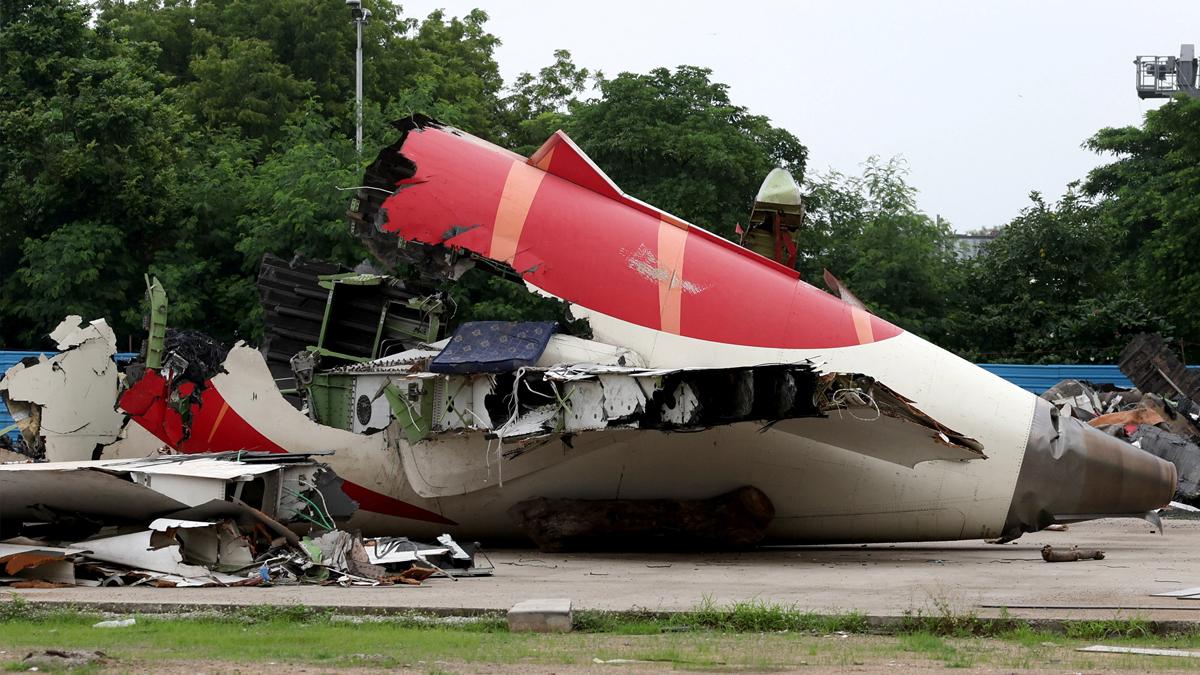
The Aircraft Accident Investigation Bureau's (AAIB) preliminary report on the June 12, 2025 crash of an Air India Boeing 787-8 -- which killed 260 people and injured 68 -- has sparked strong reactions from pilots and their representative bodies.
They claim the report raises more questions than it answers and appears to shift blame onto the flight crew while downplaying potential technical or systemic failures.
The tragedy, which unfolded shortly after take-off from Ahmedabad on a flight bound for London Gatwick, involved 229 passengers, 12 crew members, and 19 people on the ground.
The aircraft crashed into multiple buildings after takeoff, catching fire and killing all but one person on board.
Allegations of Bias in the Report
Pilot groups have accused the AAIB of portraying the pilots as responsible for the incident, with vague and selective presentation of cockpit conversations.
One key exchange -- where one pilot reportedly asked, 'Why did you cut off?' and the other responded, 'I did not' -- is paraphrased rather than quoted verbatim.
"The report does not specify which pilot said what or when the exchange occurred. Selective use of cockpit dialogue appears to subtly pin the blame on the flight crew," alleged a senior pilot, questioning why the full transcript was not released.
"There's no transparency. No context is provided."
Fuel Switch Controversy and Boeing's Role
Central to the controversy is the unexpected movement of both engine fuel control switches from RUN to CUTOFF position moments after takeoff.
The report describes this as a 'transition', a term criticised by pilots and aviation experts for being vague.
Importantly, the report mentions a 2018 Special Airworthiness Information Bulletin (SAIB) from the US Federal Aviation Administration (FAA), warning that the locking feature on fuel control switches could be disengaged on certain Boeing aircraft -- including the switch model (part number 4TL837-3D) used in the crashed 787-8 (tail number VT-ANB).
However, the FAA did not deem this condition serious enough to issue a formal airworthiness directive at the time.
Critics argue that by only briefly referring to this SAIB and focusing on the crew's actions, the report diverts attention from possible design or manufacturing issues, as well as the responsibilities of Air India and its maintenance providers.
Crash Timeline and Key Technical Observations
According to the AAIB report:
The aircraft took off at 08:08:39 UTC with 54,200 kg of fuel and a total weight of 213,401 kg -- within permissible limits.
The Ram Air Turbine (RAT), a backup power source deployed during main power failure, was seen emerging shortly after takeoff.
At 08:08:42 UTC, the aircraft reached 180 knots IAS.
Immediately thereafter, the Engine 1 and Engine 2 fuel switches moved from RUN to CUTOFF, one second apart.
The engines began to lose thrust, and the aircraft started descending even before clearing the airport perimeter wall.
One pilot declared a 'MAYDAY' at 08:09:05 UTC. Seconds later, the aircraft crashed.
Yet, despite these detailed timings, the report does not clarify the exact moment the RAT deployed -- a key indicator of when power loss occurred. This omission has been flagged as significant by aviation professionals.
Experts Question the Scenario
Some former pilots speculate that the crash may have resulted from:
A mechanical failure, possibly disengaging the fuel switch locks, followed by the pilots attempting a 'hot relight' by switching them back to RUN -- a standard emergency procedure.
An intentional act, wherein one pilot shut down both engines, prompting the other to react too late due to limited altitude and time.
However, pilot associations have pushed back strongly against the suggestion of pilot suicide.
Strong Reactions from Pilot Unions
The Airline Pilots Association of India (ALPA-I) has criticised the investigation process, alleging secrecy and bias.
ALPA-I demanded the inclusion of line pilots in the investigation to ensure a fair and informed analysis.
The Indian Commercial Pilots Association (ICPA) condemned what it called 'reckless insinuations' of pilot suicide.
'Pilots undergo rigorous psychological screening and operate under the highest standards of professionalism. Floating suicide theories without evidence is irresponsible and disrespectful,' ICPA said in a statement.
Lack of Clarity and Transparency
Pilots and experts say the report leaves several critical questions unanswered:
- When exactly did the RAT deploy?
- Why did the fuel switches move to CUTOFF -- was it mechanical, accidental, or deliberate?
- What is meant by the term 'transitioned' used in the report?
- Why wasn't the complete cockpit voice recording or transcript included?
- Who asked whom about the fuel switches being turned off?
Investigation Team and Scope
The investigation is being led by Sanjay Kumar Singh (Investigator-in-Charge), supported by Jasbir Singh Larhga (Chief Investigator) and others.
Subject Matter Experts, including experienced pilots, engineers, aviation psychologists, and flight recorder specialists, have been engaged.
According to the AAIB preliminary report, as accredited representative of the National Transportation Safety Board (NTSB), USA, technical advisers from Boeing, GE and the Federal Aviation Administration assisted in the investigation.
Still, many in the aviation community argue that the preliminary report avoids critical design and system safety questions -- and risks being perceived as protecting the manufacturer and airline at the cost of pilot reputation and public safety.
As the investigation continues, the need for transparency, objectivity, and technical accuracy remains urgent -- not just for accountability, but to prevent another tragedy.
Venkatachari Jagannathan can be reached at venkatacharijagannathan@gmail.com
Feature Presentation: Ashish Narsale/Rediff






 © 2025