

'Why would a highly qualified doctor with a promising future choose to wage war against his own country?'

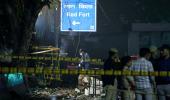
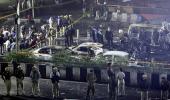
The Red Fort blast, which shook Delhi on November 10, has opened an unsettling new chapter in India's counter-terrorism landscape.
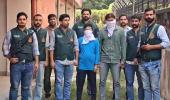
Investigations by the National Investigation Agency and the Delhi police have uncovered what appears to be a terror module involving young medical professionals from Kashmir and other states -- a pattern that challenges long-held assumptions about radicalisation.
The explosion, which killed 15 people, was followed by the arrests of several individuals including Dr Muzammil (an assistant professor at Al-Falah University), and the identification of Dr Umar Mohammed Nabi, who died when his i20 vehicle exploded near the Red Fort.
Multiple doctors are now under NIA scrutiny, and intelligence agencies are examining whether educational institutions played any role in facilitating extremist networks.
Authorities are also investigating potential Pakistan-linked radicalisation pathways, both online and offline, and the alleged role of operatives connected to Pakistan's Inter-Services Intelligence.
Against this backdrop, Shesh Paul Vaid, retired director general of police, Jammu and Kashmir, in this two-part interview with Prasanna D Zore/Rediff, offers a detailed analysis of what these developments mean for India -- and for Kashmir's young, educated generation.
You have supported the cancellation of medical degrees of doctors accused in the Red Fort blast case. What should be the guiding principle for such an extreme measure, to ensure that it is fair and not misused?
One must be fair to every citizen of India. If an individual is involved in terrorism and is convicted by a competent court, there should be no ambiguity (in cancelling such a person's degrees). The government has, for now, suspended the degrees of those accused.
Ultimately, once the courts deliver their verdicts, those convicted of terrorism should not be permitted to hold medical degrees. Otherwise, how will the public trust the medical fraternity?
A few individuals have brought disrepute to an entire profession -- particularly to Muslim doctors. India has, by some estimates, over one lakh Muslim doctors who serve society with dedication. Their reputation has been tarnished by the actions of a handful.
So the basic rule, you believe, is that degrees should be cancelled only after conviction.
That is the legal and ethical position.
Isn't it also the duty of the government and society to reassure citizens that not all Muslim doctors are terrorists? Is it fair to paint an entire community with the same brush?
No one is painting Muslim doctors as terrorists. There are countless patriotic Muslims in this country. As I mentioned, more than a lakh Muslim doctors are serving society honourably. No one in government is making sweeping accusations.
In fact, arrests have involved individuals of different faiths. Just yesterday (November 16), a Hindu woman from Anantnag Medical College was taken in for questioning and later released. The law should not spare anyone -- Hindu, Muslim, Christian, Sikh -- involved in a criminal or terror act.
We are now seeing highly educated individuals -- doctors, engineers, PhD scholars -- being arrested in terror cases. Why is radicalisation spreading among those who are well educated?
Earlier, the belief was that only madrasa-educated, unemployed young men turned to terrorism. That assumption no longer holds true. In this case, we see highly educated doctors with rational, analytical minds, earning respectable salaries -- Rs 4 lakh to Rs 5 lakh a month as assistant professors at Al-Falah University.
If, despite education and professional success, such individuals embrace terrorism, something is seriously amiss.
We must examine the root causes.
Why would a highly qualified doctor with a promising future choose to wage war against his own country? Why would he go so far as to become a suicide bomber?
This calls for a comprehensive, preventive strategy against Islamic radicalisation -- a challenge not only in India but across Europe and America as well.
Countries like The Netherlands, Poland, Germany, France -- even Turkey, Dubai and Saudi Arabia -- have adopted strong measures. India must do the same.
During your tenure as DGP, how did you deal with radicalisation of youth in Kashmir? And what would you recommend today, especially since this module seems to have escaped the intelligence dragnet?
Islamic radicalisation is India's greatest challenge.
I cannot claim complete success, but like many colleagues, I made my contribution. I engaged families -- mothers, sisters, peer groups -- because they can influence impressionable youth.
Beyond Kashmir, however, India has lakhs of madrasas. What are governments -- central and state -- doing to mainstream these institutions with scientific and Constitutional education?
Many madrasas still teach doctrines incompatible with Indian civilisation, culture, and Constitutional values. Some instill hostility towards the nation and its people.
These are strong statements, but they reflect realities that must be confronted.
If the government is aware of this, why is no action taken against such madrasas?
That is a question society must ask. If Indonesia, Singapore, Dubai and Saudi Arabia can reform their religious education systems, why can't India? Is it political hesitation -- a fear of losing vote banks? Hard decisions are required.
But we have had a government in place for 11 years that does not depend on the Muslim vote bank.
The government led by Prime Minister Narendra Modi has taken many steps to strengthen national security. But this remains an area of concern. Engagement with Muslim religious leaders is essential. They must reflect on what is being taught to their youth: Should they be encouraged to hate their country or harm fellow citizens?
You have alleged that Al-Falah University appears to be a hub of extremist activity.

Serious lapses occurred. Without NAAC accreditation, without University Grants Commission approval, how were these courses run? How were postgraduate medical degrees awarded without Medical Council sanction?
In Jammu and Kashmir, our own government medical college could not run postgraduate courses until the Medical Council's approval came through. Yet Al-Falah University managed all this without scrutiny. These are critical questions for the authorities.
Some suspects studied in institutions funded by religious donations, like the Vaishno Devi temple. Should such institutions revisit their admissions and oversight systems?
There must be safeguards to prevent misuse. Proper mechanisms are essential.
Do the cases of Dr Muzammil and Dr Umar Nabi indicate a larger pattern, or are they rare instances being interpreted as a trend?
This is a larger phenomenon. I do not know how many such modules exist across India. Pakistan's ISI uses both online and offline radicalisation to target educated individuals. We must remain extremely cautious.
You mentioned that DNA sampling, phone checks, and questioning families are standard procedures worldwide. Why do these steps often get seen as 'harassment' in Kashmir, and how can that perception be corrected?
It is a cultivated sense of victimhood. These procedures are standard everywhere. If my child were involved, naturally the police would search my home, seize devices, check finances, and collect DNA samples with court approval. This is normal, lawful investigation.
The 2,900 kg of explosives -- including 360 kg of ammonium nitrate -- in the Faridabad module were discovered because officers noticed a suspicious poster. What does this say about the intelligence work needed today?
It shows how alert and dedicated our intelligence officers are. They prevent 99 plots we never hear about. The adversary needs to succeed just once. Our agencies work 24/7, 365 days a year. The credit for this case goes to the J&K police officers who uncovered the module.
After incidents like this, public anger sometimes spreads to the entire Kashmiri and Muslim community. How should this be handled?
Generalisation is wrong. Police and government must state clearly that not all Kashmiris are terrorists. Many Kashmiris serve India with honour; 60% to 70% of the J&K police are Kashmiri Muslims.
What message would you give parents, educators and community leaders in Kashmir and across India as we confront this new phase of radicalisation?
My message is simple: Remain vigilant, stay involved, and do not dismiss early signs of behavioural change.
Families are the first line of defence. Educational institutions must teach Constitutional values, critical thinking, and national responsibility. Community leaders must discourage divisive rhetoric and foster integration.
India has the capability and resilience to tackle this challenge, but society and State must work together.
Radicalisation cannot be fought by government alone; it must be fought within families, classrooms and communities.
- Part II of the Interview: Terror Module: 'Pakistan's Handlers Shifted Strategy'






 © 2026