
'Saudi-Pak defence pact is to anchor the defence and security of Saudi Arabia and not Pakistan, per se, with Islamabad being the junior partner.'

"We must avoid a sweeping presumption that Saudi Arabia, the US and China are all arrayed against us on the Pakistani side, as it would be a self-fulfilling prophecy," says Ambassador Mahesh Sachdev who spent more than 20 years of his 35-year diplomatic career dealing with the Arab world.
Fluent in Arabic, the distinguished foreign service officer served as India's ambassador to Algeria, Norway and Nigeria. He has an MPhil in nuclear physics from IIT-Kanpur and is a life member of the Mensa Society.
In an e-mail interview with Rediff's Archana Masih on the Saudi Arabia-Pakistan defence pact, Ambassador Sachdev emphasises that India should assess the agreement objectively, calibrate its response in accordance with its national interests and avoid overreaction or premature action.
How would you compare Saudi Arabia's relations with Pakistan -- and with India? What are the key differences and similarities?
After Independence, both India and Pakistan laid claim to the British India's extensive legacy links with Saudi Arabia. Both were only partially successful as the UK remained engaged with the kingdom, which drew close to Washington following the commercial exploitation of the world's largest crude reserves by the United States oil majors.
The Indo-Pak competition for Saudi Arabia escalated in the mid-1970s after the oil boom made Riyadh its epicentre. The Pakistani leadership was keen and responsive to Saudi expectations, leading to a golden period in the 1980s, when Pakistan stationed nearly 20,000 troops to protect the kingdom, and its manpower was the largest there.
Pakistan also leveraged two shared assets with Saudi Arabia, viz Sunni Islam and ties with Washington. But soon thereafter, the Saudi leadership concluded that Islamabad had largely failed to deliver the needed military and economic requirements.
Slowly, the Pakistan-India contest for Saudi Arabia started to resemble the 'Hare and Tortoise' fable, with the Saudis appreciating the competence of Indian manpower and the value of our goods and services.
India's large and growing crude requirements also pulled in the Saudis. Saudi Arabia's relations with Pakistan have become more transactional, providing financial help to bail out its moribund economy, for instance.
Against this backdrop, in terms of various socio-economic matrices, Pakistan today is no match to India in Saudi Arabia: For instance, trade is 24 times lower ($1.74 bn vs $41.87 bn).
While the two diasporas are nearly equal (2.6 mn vs 2.7 mn), Indians, as a rule, are preferred for competence and non-interference.
At the same time, Islamabad has been able to preserve a modicum of privileged bilateralism with Riyadh in case of dire exigencies on either side. This is what the recently signed Strategic Mutual Defence Agreement (SMDA) seeks to institutionalise.
Incidentally, this is perhaps the fifth bilateral defence agreement in the public domain entered into since Pakistan came into existence.

How will the Saudi-Pakistan defence agreement impact India's strategic security, especially in view of another Operation Sindoor-like military operation?
The precise contents of the SMDA are not in the public domain, and most of the gaslighting on this development has come from Pakistani sources, who are prone to imprecision and deliberate exaggeration of Saudi commitment to Pakistan's defence.
While the Saudis have celebrated the SMDA signing with an audiovisual extravaganza, there has been little insight into the rationale of the agreement.
Taken literally, any alleged (Indian) aggression against Pakistan would trigger the collective defence mechanism, and the Saudis would be expected to assist Pakistan.
However, a few practical aspects should be borne in mind:
Firstly, the import of the SMDA is to anchor the defence and security of Saudi Arabia and not Pakistan, per se, with Islamabad being the junior partner.
Secondly, while Saudi Arabia, in nearly a century of its existence, has had wars with neighbours such as Yemen and Iraq, it has never sent its armed forces to fight abroad. Despite earlier bilateral defence agreements, Pakistani armed forces have rarely participated in any of these wars.
Thirdly, in similar 'co-religionist vs friend' conflicts such as Turkey-Greece, Iraq-Iran, Riyadh has largely been militarily inert. Its defence assistance has largely been in cash, sometimes in military hardware given discreetly.
At the same time, under Crown Prince Mohammed bin Salman's decade-long tenure, Saudi Arabia has charted a new, more assertive course.
However, early adventurist forays (military intervention in the Yemeni civil war, Jamal Khashoggi assassination, etc.) have been counterproductive and shown the limits of the kingdom's power.
Subsequently, Saudi diplomacy has been more mature and incremental. It is therefore likely that in case of a clear Pakistani link to a Pahalgam-type terror incident, Riyadh would 'understand' Indian compulsion for a Sindoor-type operation, provided the same is short and avoids a wider conflict.
Will the assurance/belief that Saudi Arabia will provide military aircraft and weapon systems to Pakistan embolden the latter in future military conflicts with India?
This is a hypothetical question better left unanswered. Historically, too many wars have been based on such miscalculations, and the possibility of the hotheads in Pakistan misreading Saudi support cannot be ruled out.
Tilted towards Saudi interest focus on Saudi Arabia will not fight India for Pakistan.

Given concerns that America's military presence may no longer offer the protection it once did, is the new arrangement likely to include nuclear assistance to Saudi Arabia and Gulf countries?
What forms of nuclear-related support could Pakistan potentially offer?
To my best assessment, the SMDA has the US nod-and-wink. Hence, it must be taken as the 'US+1' protection for Saudi Arabia and not the 'US-1.'
All three sides have their own reasons for not being open about Washington's involvement. The US is still quite possessive about its Pax Americana over the Gulf and the Middle East and is unlikely to have allowed SMDA if it did not serve Washington's regional interests.
If this is accepted, any extension of the Pakistani nuclear umbrella can only be with Washington's approval. But then, the US and Israel have very sharp red lines about nuclear proliferation, particularly in the geostrategic Middle East region.
If two decades of no-holds-barred campaign can be waged against Iran's perceived nuclear ambitions, how can Pakistani nuclear capability be allowed to extend to the region?
How does this shift the balance of power in the region?
Two years since October 7, 2023 have been very disruptive for the long-frozen balance of power in the region. While Hamas' initial attack on Israel was probably intended to prevent Saudi Arabia from joining the Abraham Accords, Israel used this as a trigger for a full-throated campaign to subdue its opponents and shift the regional balance of power decisively in its favour.
The Gulf Cooperation Council (GCC) countries apprehend that this ongoing aggressive Israeli military campaign would create a winner-takes-all, extreme geopolitical architecture which would eventually destabilise them.
Through SMDA, Washington has seemingly put some guardrails to ensure the maintenance of the GCC stability and security.
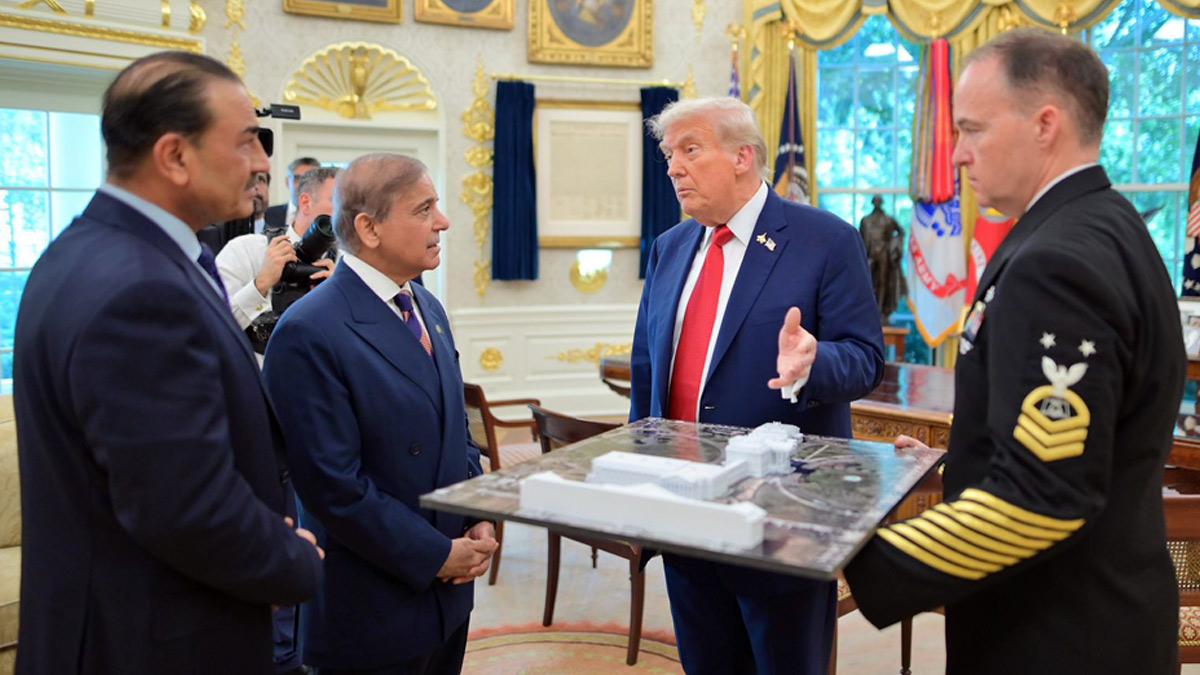
What does Pakistan's all-weather friendship with China, General Munir's recent bonhomie with President Trump and now Pak's deepening strategic partnership with the most important Islamic country mean for India's security calculus?
Pakistan's 'all-weather friendship' with China is unlikely to be affected by Pakistani flirtations with the Trump administration and SMDA with Saudi Arabia; each has a largely different locus.
While the first is aimed at India, the second has a Gulf focus. Of these three factors, only the Munir-Trump bromance is a new development.
The aforementioned three factors would, on the whole, cast a negative shadow on India's security. Its severity would depend upon several factors, such as the evolution of our ties with the US and China, Gulf stability and whether GHQ Rawalpindi continues to promote terrorism in India.
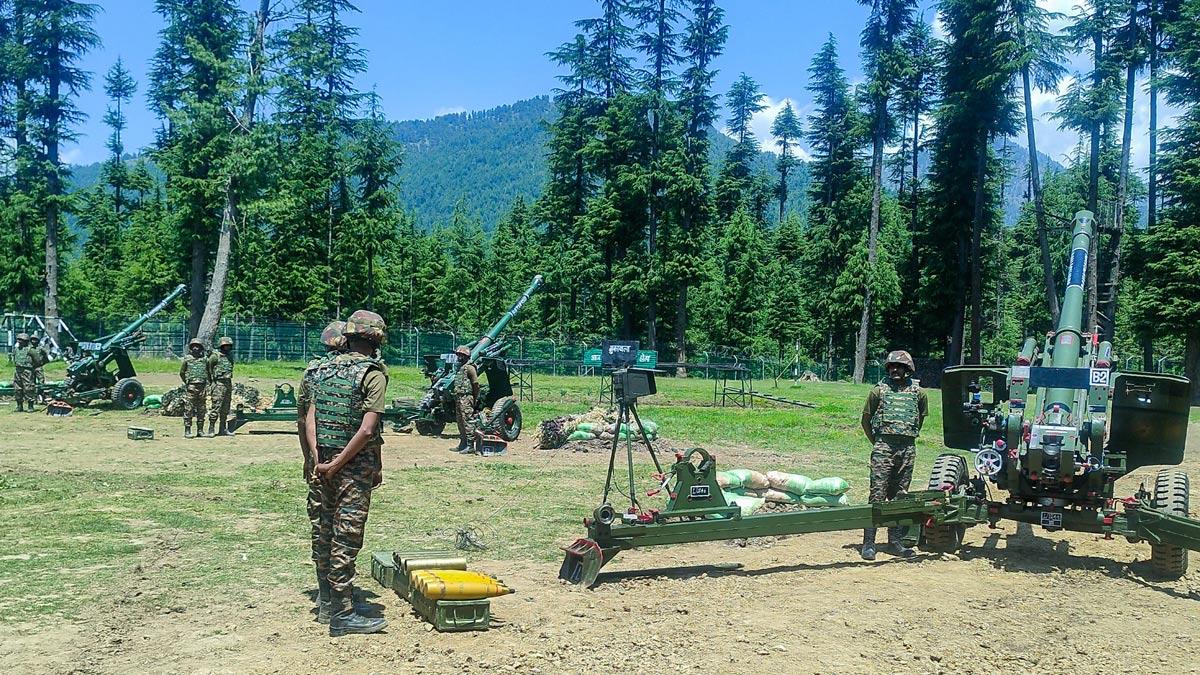
How must India deepen its defence and maritime engagement to safeguard its interests?
The evolving threats to India's defence and security are serious, but manageable.
Firstly, Pakistan has its own socio-economic and defence-related vulnerabilities vis-a-vis India.
Secondly, our considerable economic strength and defence capabilities are sufficiently dissuasive for those straddling on the other side of the India-Pakistan hyphenation.
Thirdly, there is a need to avoid a sweeping presumption that Saudi Arabia, the US and China are all arrayed against us on the Pakistani side, as it would be a self-fulfilling prophecy.
Last but not least, India needs to assess the developments objectively in their correct perspective, keeping our comprehensive national interest supreme and calibrating our response to the stimuli.
Any overreaction or pre-emption would be counterproductive.
Feature Presentation: Aslam Hunani/Rediff






 © 2025