
'Trump's sons, and the son of Trump's Mideast envoy Steven Witkoff, are in the crypto business and recently signed deals with Pakistan's crypto council.'
'It may not be coincidental that not long before the Trump-Munir meeting, the head of Pakistan's crypto council met with Trump's White House crypto policy czar.'
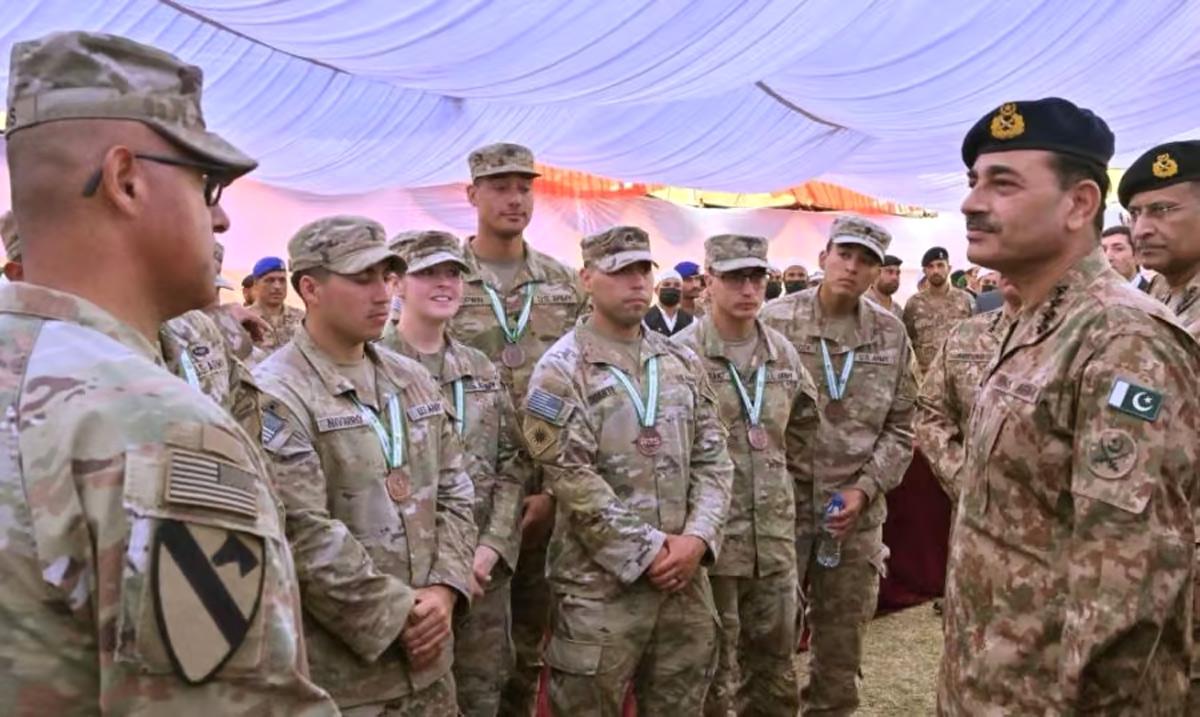
"That Trump would meet with Munir for so long -- two hours, according to the ISPR readout -- and especially at a moment when Trump was deliberating over how to approach the Israel-Iran war says something about the importance he gave to the meeting," South Asia Specialist Dr Michael Kugelman tells Rediff's Archana Masih in the concluding part of his interview.
- Part 1 of the Interview: 'Impact Of War On India Could Be Dramatic'
What were your primary takeaways of the lunch meeting with Field Marshal Asim Munir and President Trump?
For me, there were four key takeaways.
First, it was the first time a US president hosted a Pakistani army chief who was not also a head of State at the White House. so a new and striking precedent has been set.
Second, that Trump would meet with Munir for so long -- two hours, according to the ISPR readout -- and especially at a moment when Trump was deliberating over how to approach the Israel-Iran war says something about the importance he gave to the meeting.
Third, the meeting marked a case of the US taking its frequent privileging of its relations with Pakistan's generals over its civilians to a very dramatic level.
Fourth and most important, the meeting was a great case study of how the Trump administration prizes personal ties, family links, and business interests, and views these as a driver of US diplomacy and bilateral relations.
Trump's sons, and the son of Trump's Mideast envoy Steven Witkoff, are in the crypto business and recently signed deals with Pakistan's crypto council.
It may not be coincidental that not long before the Trump-Munir meeting, the head of Pakistan's crypto council met with Trump's White House crypto policy czar.
Munir may not have gotten the meeting with Trump because of all these prior engagements, but I'm sure it helped -- and it ensured the meeting stayed on Trump's agenda, even with everything he had going on.
What will Pakistan's demands be? Stealth fighters? Financial aid? Mediation on Kashmir and the Indus Water Treaty?
Pakistan would gladly welcome any and all of that. But I suspect it would settle for the restoration of security aid.
The generals have been seeking that outcome since the day that Trump, early in his first term, suspended most security aid to Pakistan.
Rawalpindi has projected itself as an important counterterrorism partner, seemingly angling for a new counterterrorism alliance with Washington, one that it wants to focus on (in part) helping the US track down Islamic State-Khorasan fighters that threaten or target the US.
In return, Pakistan would want the US to start sending arms and money to the Pakistani military once again.
But as much as the Trump administration wants to work with Pakistan on limited counterterrorism objectives, a new alliance -- and the restoration of assistance -- may be a hard sell.
What does this mean for India? What concerns does it raise for India considering Trump has lost no opportunity to offer to mediate on Kashmir since Op Sindoor?
It's important not to overstate the possibilities of US-Pakistan convergences or cooperation related to the recent Israel-Iran war.
At the end of the day, Pakistan backs Iran. It isn't about to provide Tehran with military support, but it threw its full diplomatic and moral support to the Iranian regime in the war.
It doesn't recognise Israel. The US had no need for Pakistani military assistance in the war, and if Pakistan were asked it would likely decline. And Pakistan likely lacks the leverage to mediate with Iran.
The US-India relationship has some work to do to smooth out some tensions, but these play out on a separate track from anything involving the Israel-Iran war or the Pakistan factor related to it.
I'd actually argue the US and India were more or less on the same page with the war: Both appeared to have supported Israel's initial strikes on Iran, and both preferred the war end sooner rather than later.
India's position on the war (quite similar to its position on the war in Ukraine) of not condemning Israel's strikes while also calling for deescalation lines up quite nicely with that of Washington.

Does Trump's recent obsession with having mediated peace between two nuclear armed countries risk internationalising the Kashmir issue?
It's already been internationalised. When the US president publicly offers to mediate on Kashmir -- an offer he also made during his first term -- it's automatically in the global sphere.
I'd also argue that the recent India-Pakistan conflict internationalised Kashmir, because Islamabad used the conflict to launch a fresh global campaign to bring attention to Kashmir.
It was one of the core themes of the two Pakistani delegations that visited Brussels, London, Moscow, Paris, and Washington in recent days.
So the genie has already been let out of the bottle. Of course, given everything going on in the world -- including this very troubling new war in the Middle East -- the international community won't have a large attention span, and the Kashmir issue is unlikely to get much traction.
This will be to Pakistan's disappointment -- and especially as previous Pakistani efforts to internationalise Kashmir haven't really resonated with the world.
How does this India-Pakistan thaw post the ceasefire impact India's war against terror emanating from across the border?
I wouldn't categorise it as a thaw. The conflict is over, but the ceasefire is tenuous and tensions haven't been this high in decades.
The scale and intensity of hostilities last month -- not since 1971 were they so great --coupled with the punitive steps taken by India (from stopping all trade to holding the Indus Waters Treaty in abeyance) make it very difficult to move away from the serious strain in ties.
India is playing a long game, trying to raise the costs to Pakistan of not cracking down on anti-India terrorists in Pakistan.
But so long as tensions with India remain so deep, it's hard to imagine Pakistan acting in ways that India would like to see -- especially given that Pakistan has viewed these violent actors as a critical asset to counter India.
Feature Presentation: Aslam Hunani/Rediff






 © 2025