

'Remittances are our largest single source of foreign exchange -- bigger than any export category.'
'At the first sign of real trouble, that money will move. There will be a run.'

When Prime Minister Narendra Modi took the stage at a Bharatiya Janata Party rally in Hyderabad on the evening of May 10, he asked Indians to stop buying gold for a year. He asked them to cut fuel use, carpool, work from home, skip foreign holidays, postpone destination weddings abroad, and even reduce how much cooking oil they use at home. 'Patriotism,' he said, 'is not only about the willingness to sacrifice one's life on the border. In these times, it is about living responsibly.'
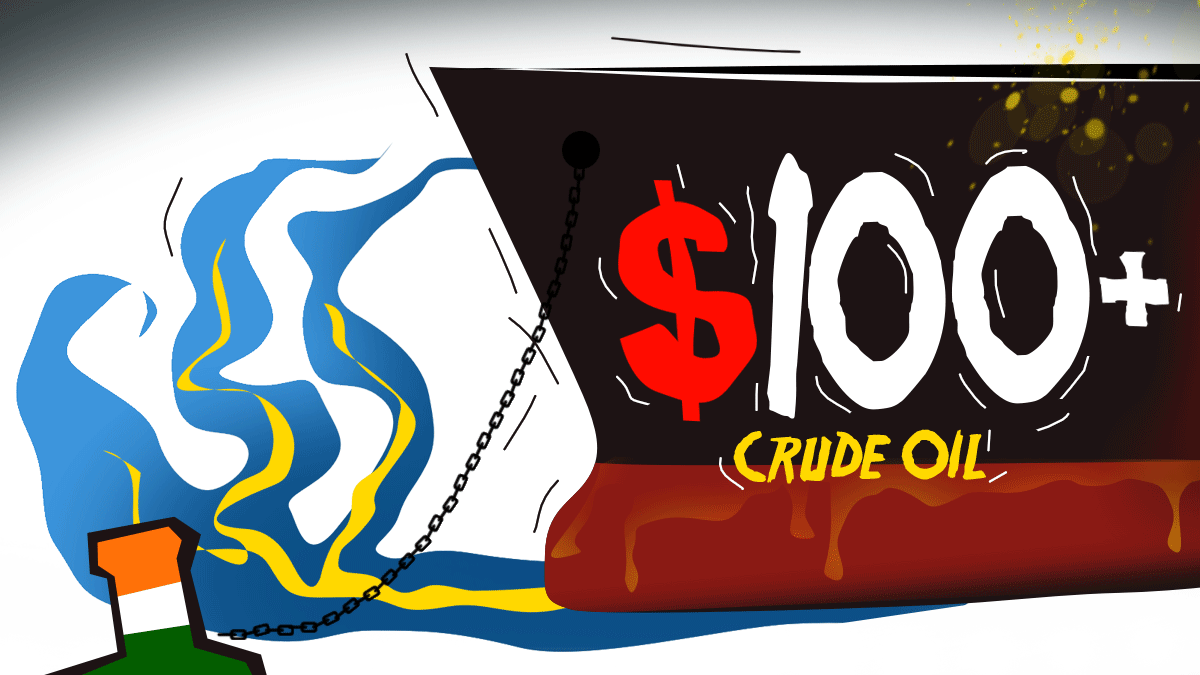
The backdrop to that speech was not hard to read. Crude oil, already trading above $100 a barrel for more than 45 days because of the Iran war, had touched a 52-week high of $126 a barrel at the end of April.
India, the world's third-largest oil importer after China and the United States, spent roughly $175 billion on crude and petroleum products in the financial year ended March 2026 -- about 22 per cent of its total import bill.
Gold came second: Indians imported $72 billion worth of the metal in the same period, second in the world only to China.
Meanwhile, India's foreign exchange reserves, which hit a record $728 billion in February, had shed more than $40 billion in just four weeks as the Reserve Bank of India sold dollars to steady the rupee, which hit a fresh record low of 95.63 to the dollar on Tuesday morning.
The IMF has projected a current account deficit of $84 billion for India in 2026.
Key Points
- 'The Indian rupee will cross 100 in the next few weeks.'
- 'We're importing over $100 billion worth of goods from China, a lot of which could be avoided.'
- 'If the West Asia conflict drags on for months, India would eventually be forced to take harsh measures like import restrictions, fuel rationing, tighter dollar controls or higher taxes.'
The jewellery and gems sector, which contributes roughly 7 per cent of India's GDP and employs nearly five million people -- from diamond cutters in Surat to gold artisans in Jaipur -- reacted immediately to Modi's remarks.
Shares in Titan and Kalyan Jewellers fell as much as 11 per cent the day after Modi's speech on May 10 when markets opened for trade.
Lost in the political noise -- Congress leader Rahul Gandhi was quick to point out that Modi was about to leave on a seven-day overseas tour to the UAE, Sweden, The Netherlands, Norway and Italy even as he asked citizens to avoid foreign travel -- was a more fundamental question: How fragile is India's external position, really?
And is the government, through Modi's unusual appeal, finally signalling what it has long been reluctant to say?
Mohan Guruswamy has spent decades thinking about exactly these questions. A senior economist and former adviser to then finance minister Yashwant Sinha, he has watched India's balance-of-payments arithmetic with a scepticism that official data has done little to dispel.
In this interview with Prasanna D Zore/Rediff, Mr. Guruswamy explains why Modi's austerity appeal is a distress signal, not a pep talk and the scenario that is likely to unfold in the weeks ahead.
'NRI deposits -- roughly $100 billion -- will move out at first sign of trouble'
Prime Minister Modi asking Indians to stop buying gold for a year, reduce fuel consumption and postpone foreign travel -- does that sound to you like an economic emergency warning dressed up as a patriotic appeal?
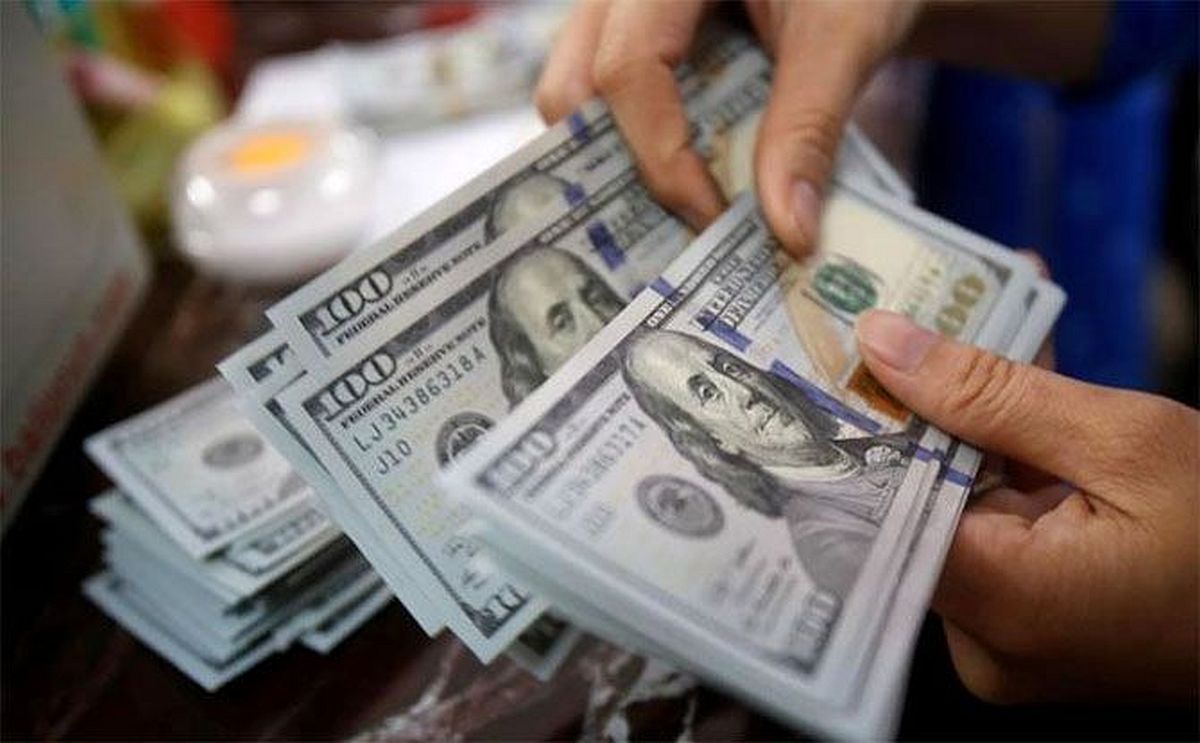
I wouldn't say there is a serious foreign exchange crisis imminent, but we have been on this road for a long time. We run a trade deficit of nearly $100 billion every year. We've been making up for it through remittances -- this year we received about $130 billion in remittances, which is what keeps us out of a current account deficit. But that cushion may not hold.
What could happen now is a current account deficit opening up again after a gap of a few years. Middle Eastern trade is going to come down because of the conflict, and European and American trade is also contracting -- Trump's tariffs and the general slowdown in global commerce will hit us.
Meanwhile, gold imports are running at $89 billion to $90 billion, possibly touching $100 billion. Oil imports are about $120 billion. Both have to be paid for in dollars. And your exports are not going up. So there will be a gap, and when there is a gap there is pressure on the rupee-dollar parity.
The RBI has been selling dollars to defend the rupee, which is adding to the strain. The underlying problem -- the trade balance -- isn't being dealt with.
And then there's China: We're importing over $100 billion worth of goods from them, a lot of which could honestly be avoided.
You mentioned a possible return to the current account deficit. How large could it get, and what does it mean for interest rates and the broader economy?
If the current account deficit widens, you have to keep borrowing money to bridge it, which puts upward pressure on interest rates.
And when interest rates rise alongside a widening deficit, you get pressure on the parity -- your import bill goes up, your export competitiveness comes down. The two feed each other.
How do you see this playing out for the rupee?
It (the rupee-dollar parity) is being sustained by the RBI (by selling dollars). You can't keep that up indefinitely.
And there is another danger that people aren't talking about enough: NRI deposits, which are roughly $100 billion. That is hot money. These are people who borrow from their banks abroad at 3-4 per cent interest and deposit the money in India at 5-6 per cent. They make a tidy arbitrage.
But at the first sign of real trouble, that money will move. There will be a run -- people wanting their deposits back.
So is there a scenario where India faces a genuine economic crisis -- if oil stays above $100 and the rupee keeps sliding?
The biggest single danger is if remittances come down. Remittances are our largest single source of foreign exchange -- bigger than any export category. And now they come from two directions: The Gulf, where millions of Indian workers are based, and increasingly from the United States.
For the first time, NRIs in America are actually sending money back home in significant quantities. These are people on short-term work visas -- they go for jobs and remit regularly. If that flow dries up because of the West Asia situation or a slowdown in the US, we are looking at a very difficult period.
- ALSO READ: 'Worst Gulf Crisis For Migrants In 50 Years'
'How can you have high growth rates when the savings rate isn't rising?
If even 10 per cent of Indians take Modi's advice and stop buying gold, what happens to the jewellery industry -- to the workers it employs?
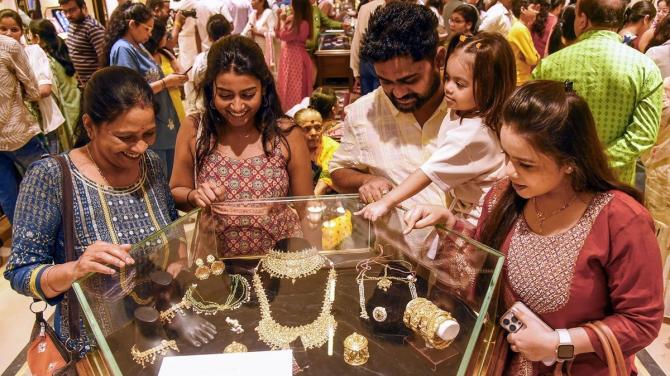
The jewellery business is labour-intensive even though the value addition is low. About 95 per cent of a gold ornament is gold and stones -- labour accounts for only about 5 per cent of the value. But the sheer number of people involved is large.
Think of Surat and the diamond-cutting trade, the gold jewellery workers in Jaipur. These are people earning Rs 400, Rs 500, Rs 700 a day -- some up to Rs 1,000. They are the new middle class, the people buying motorbikes and refrigerators. They will feel it. The middle market will see real discomfort.
Moody's has just cut India's growth forecast from 6.8 per cent to 6 per cent. Is this the first serious international signal that India's economic story is more fragile than the government admits?
The economic story has been weak ever since COVID, demonetisation and hasty implementation of GST, and the government has been playing games with the figures ever since. A lot of the official data nowadays is fudged.
How can you have high growth rates when the savings rate isn't rising? When the investment-to-GDP ratio isn't increasing? Nobody in the government answers that.
Foreign analysts have been flagging this for some time. The government won't acknowledge it -- how can they admit they've been cheating the people?
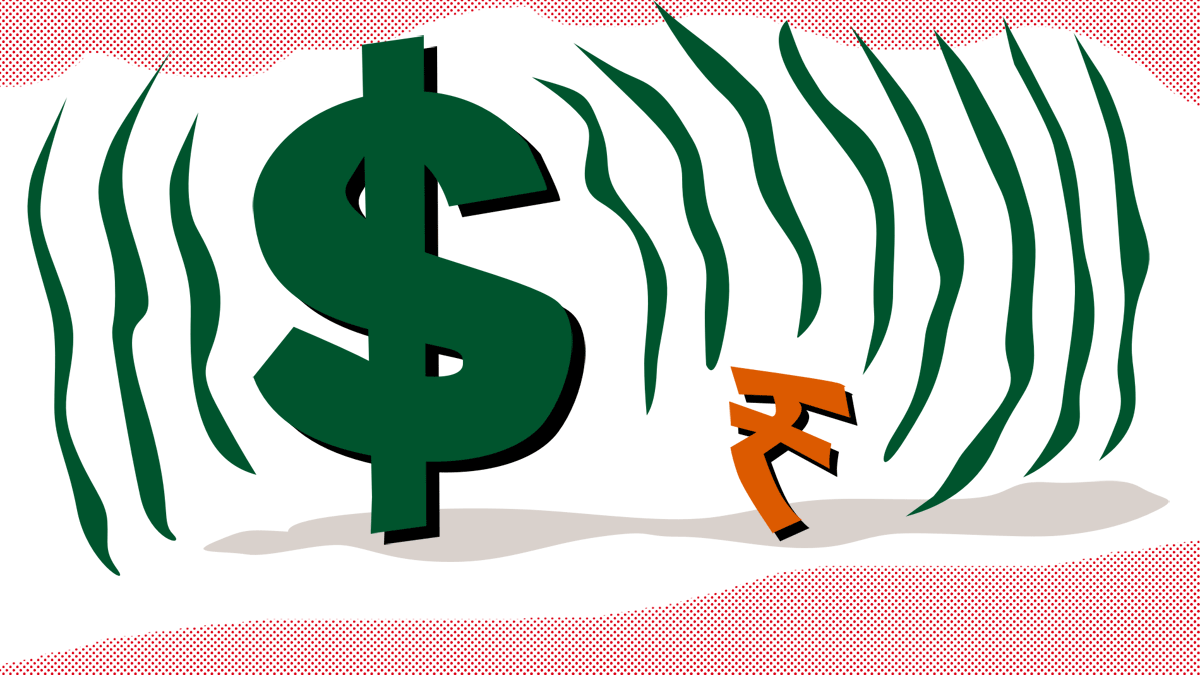
If the Strait of Hormuz crisis continues, could India face a situation where dollars become genuinely scarce? The rupee is already close to 96. Do you see it crossing 100?
It'll cross 100 in the next few weeks, yes.
And what does that do to ordinary households?
The cost of everything goes up. Medicine costs, pharma, electronics -- mobile phones, computers -- everything goes up. Everything that has an imported component in it will be more expensive.
'The fact that the prime minister is suddenly saying these things, and that Uday Kotak is saying these things, and they are all saying them at the same time -- that is orchestrated'
Many Indians know 1991 only as a history lesson. Are there early signs now of a balance-of-payments crisis developing along similar lines?
No, I don't think we're heading for a 1991-style collapse. We are not that badly off. But the constant pressure on the rupee-dollar parity is draining. The deeper problem is the demographic one.
India needs to grow at 8-9 per cent for the next 25-30 years if it wants to become a genuine middle-income country. If growth rates stay subdued and the population starts ageing -- our median age is in the mid-30s today, but it will move towards 40 -- then the window closes. We lose the demographic dividend.
Uday Kotak has warned of an oil shock. Do you think fuel prices -- petrol, diesel, LPG -- are going up?
All will go up, yes.
Will that trigger panic? Higher inflation first, or a falling rupee, or financial market turmoil?
There won't be sudden panic because we have been on this slow road for a while. Inflation isn't arriving overnight -- it has been building. But there is something else going on here. The fact that the prime minister is suddenly saying these things, and that Uday Kotak is saying these things, and they are all saying them at the same time -- that is orchestrated. That is the nature of our managed media. They are all speaking on cue.
Are they trying to soften the blow that's coming?
Partly, yes. Everything is coordinated now. There is no free press, no free media in any meaningful sense. Most outlets are owned by one large corporate group or another. You have exceptions -- a few small, privately held publications -- but the mainstream is corporate, and there is unanimity.
India has $658 billion to $690 billion in forex reserves. How quickly could that erode in a prolonged crisis?
You have to be careful about that headline number. About $150 billion to $200 billion of it is NRI deposits -- you cannot rely on that money in a crunch, it will move. Then you have a trade deficit of $100 billion to $120 billion a year that has to be provided for -- you need at least three months' import cover as a floor.
Foreign institutional investors have already stopped coming in the way they were; that money has turned from an inflow into a gap. And FDI, which was running at $70 billion to $80 billion, has stopped almost completely. These were the pillars of the capital account. They are gone or going. If all these things act up together, you are in serious trouble.
'India would eventually be forced to take harsh measures like...'
Is there a risk of ordinary Indians losing faith in the rupee if global uncertainty deepens?
The ordinary Indian is so removed from international transactions that his direct exposure to foreign currency inflation is quite limited. But faith in the government is a different matter.
Petrol prices are the trigger -- add Rs 2 a litre and you see a reaction in the market immediately. The government knows this. They have already cut excise duty on petrol and diesel significantly to cushion the blow -- the excise reductions alone are costing the government tens of thousands of crores a month in revenue. They can absorb some shock, but there are limits.
And then the prime minister is also asking people to use less cooking oil. Think about what that means on the ground -- your pakora vendor can't sell pakoras if people aren't buying cooking oil. These are the people at the bottom of the economy. You cannot ask them to be patriotic on an empty stomach.
What are the warning signs to watch for before a full-blown crisis?
Keep an eye on the NRI deposit holders. They are watching this situation very closely. If they sense real fear, they will run. That is your early warning.
The moment foreign currency deposit holders start pulling out, you will know the pressure has become serious.
The government says India remains the world's fastest-growing major economy. But if people are now being told to consume less, travel less and buy less gold, does that itself contradicts the narrative of economic strength?
If the West Asia conflict drags on for months, India would eventually be forced to take harsh measures like import restrictions, fuel rationing, tighter dollar controls or higher taxes to protect the economy.









 © 2026