

'No one anticipated magical solutions or miraculous interventions.'
'However, people across the entire spectrum -- whether residing in the valley or the hills -- expected the prime minister to dedicate at least five to ten minutes to genuinely listening to the voice of the people.'
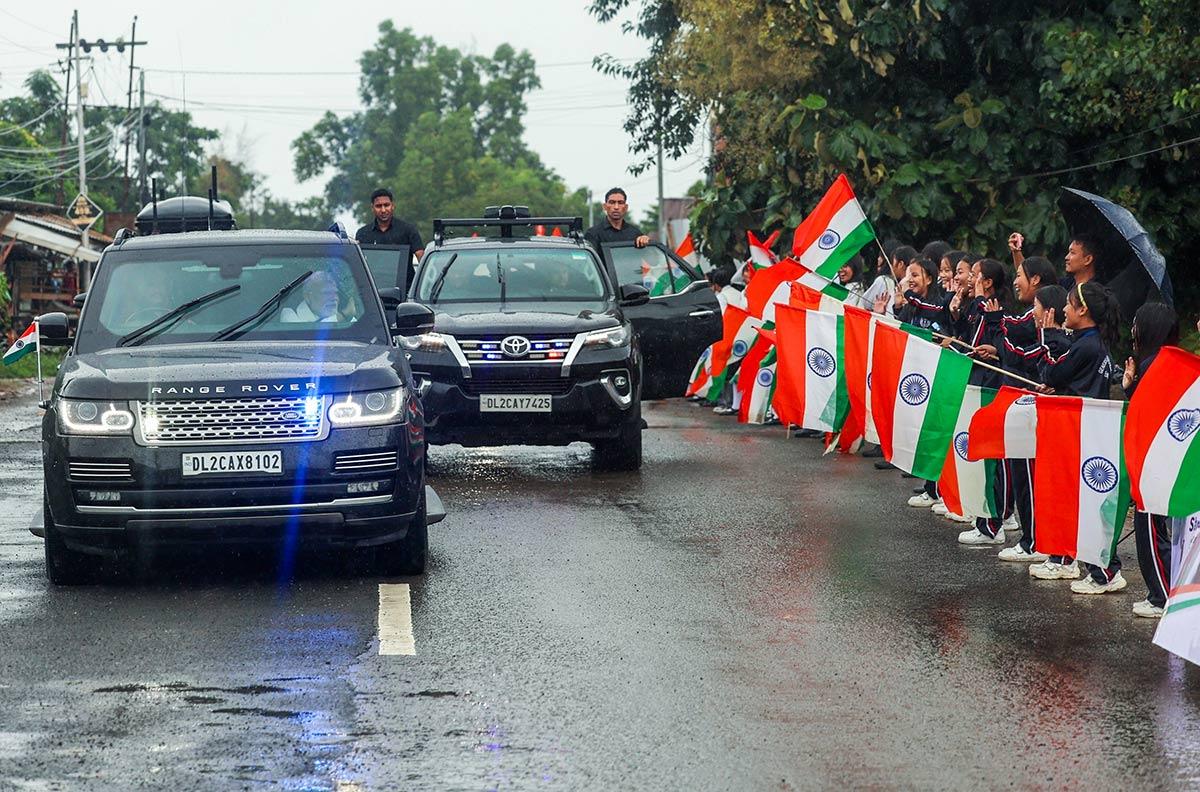
In his first extensive interview following Prime Minister Narendra Modi's long-awaited visit to Manipur, Bharatiya Janata Party MLA Paolienlal Haokip from Saikot delivers a scathing assessment of what he terms a 'choreographed' engagement that failed to address the fundamental issues plaguing the ethnically divided state.
Haokip is a vocal advocate for the rights of hill communities and separate administrative arrangements for the Kuki-inhabited areas of Manipur.
Speaking with characteristic parliamentary precision, Haokip articulates the profound disappointment felt across the hill constituencies, where communities had harboured expectations of meaningful dialogue after nearly two years of ethnic strife, which began on May 3, 2023.
The senior legislator's critique given to Prasanna D Zore/Rediff extends beyond the ceremonial nature of the prime minister's visit to encompass what he perceives as a systemic failure to acknowledge the unprecedented divisions that have rendered the state virtually ungovernable.
What was your assessment of Prime Minister Modi's visit to Manipur, particularly his engagement with the hill constituencies?
The prime minister's visit to Manipur, particularly his decision to travel to Churachandpur-Lamka, which lies approximately 60 kilometres from Imphal, represented a significant acknowledgement of the territorial and administrative separation that this state has experienced.
The fact that he was compelled to undertake this journey from Imphal separately, without the accompaniment of security personnel or administrative staff from the majority community, serves as a stark reminder of the profound divisions that have rendered our state effectively partitioned.
This visit, though belated, provided the prime minister with a firsthand opportunity to witness the unprecedented schism that has befallen Manipur.
We remain hopeful that this direct observation will catalyse his understanding of the urgent necessity for establishing separate administrative structures for the Kuki-inhabited areas.
Did the prime minister engage with elected representatives from the hill constituencies during his visit to Churachandpur?
Regrettably, he did not. This constituted the most disappointing aspect of his entire visit.
We had harboured considerable expectations that he would conduct meaningful consultations with elected representatives as well as civil society leaders, affording us the opportunity for substantive dialogue.
We had prepared to articulate our profound anguish, our legitimate fears, our enduring suffering, our aspirations, and our hopes to the prime minister directly. However, we were denied this fundamental opportunity for democratic discourse.
The prime minister maintained silence on the Manipur crisis for nearly two years following the commencement of ethnic conflict in the state. How do the people of Manipur interpret his sudden appearance after such an extended period?
When intelligence regarding his prospective visit began circulating prior to his actual arrival, there existed considerable expectation amongst the people (from the hills).
The prevailing sentiment, particularly amongst the hill communities, was one of cautious optimism -- that despite the tardiness of his intervention, the prime minister's presence would herald something substantial to anticipate.
However, following his delivery of two addresses -- one at Lamka and another at Jiribam -- the public response has been overwhelmingly one of disappointment.
His approach appeared to deliberately ignore the stark and unprecedented divisions that have effectively bifurcated our state. There was a conspicuous absence of any attempt to address the fundamental issues at the heart of this conflict.
Instead, we witnessed what amounted to routine project inaugurations accompanied by generic appeals for peace.
You describe these peace appeals as inadequate. Could you elaborate?
Appealing for peace without addressing the roots of the conflict, I would say, is hollow.
It represents a superficial approach to what is fundamentally a structural and administrative challenge requiring substantive political solutions.
What concrete measures should the prime minister have announced or initiated during his visit to restore security and confidence?

Realistically, neither you nor I, nor indeed anyone, could reasonably expect the prime minister to arrive and announce some form of magical formula to restore peace instantaneously. Such expectations would be humanly impossible to fulfill.
However, the minimum we anticipated was that he would demonstrate genuine commitment to listening to the people -- their elected representatives, civil society leaders -- to acquire a comprehensive understanding of ground-level sentiments and to engage meaningfully with their hopes and aspirations.
Did the prime minister meet with internally displaced persons during his visit to Churachandpur?
He did meet with some IDPs, but these interactions were carefully choreographed and the participants were selected by the district administration.
These were undoubtedly genuine displaced persons, but they had been specifically chosen by administrative officials and provided with what amounted to a script, instructing them to refrain from discussing certain sensitive matters. The entire exercise constituted choreography rather than authentic engagement.
What transpired during these interactions between the IDPs and the prime minister?
The exchanges were entirely muted in all available footage. The public remains completely uninformed about what actually transpired during these meetings. We do not know what the prime minister communicated to the IDPs, whether he offered empathy or hope.
The deliberate suppression of audio in all recorded material has rendered these interactions opaque to public scrutiny.
Regarding the Suspension of Operations agreement, did you expect the prime minister to provide clarity on its future?
In my realistic assessment, the prime minister need not and would not be expected to comment specifically on the SoO agreement, which is being competently managed by the ministry of home affairs (helmed by Union Minister Amit Shah).
With the dialogue process now underway following the signing of the (SoO) agreement, we remain hopeful that the Centre will recognise the inevitability of establishing a separate administration.
The fundamental reality is that there exists no alternative solution at present other than a separate administration for the hill areas and the valley regions -- specifically, the Kuki-inhabited areas and the remainder of the state.
What specific outcomes or assurances would you have preferred from the prime minister?
It would be overly idealistic to expect dramatic announcements or assurances.
As I mentioned previously, no one anticipated magical solutions or miraculous interventions. However, people across the entire spectrum -- whether residing in the valley or the hills -- expected the prime minister to dedicate at least five to ten minutes to genuinely listening to the voice of the people.
Instead, he delivered standard political addresses without meaningful engagement.
Are the people optimistic about the infrastructure projects announced during the visit?
These projects were already in the development pipeline prior to his visit. They were not situation-specific packages designed to address our current crisis.
Whilst the central government deserves recognition for its increased allocations -- the funding for the North East and Manipur has risen substantially compared to previous decades -- significant disparities persist between allocations for the valley and hill regions.
When examining actual district-wise allocations, approximately 80% to 85% is designated for the valley regions.
For ordinary citizens, the announcement of these projects might sound encouraging, but for those who understand the geographical distribution of these investments, it represents a form of adding insult to injury.
Do the Kuki communities intend to participate in the 2027 assembly elections, or do current circumstances make such participation problematic?
It remains difficult to comment at this juncture. In politics, as the saying goes, a week represents a considerable duration. The political landscape may evolve significantly before we reach that electoral milestone.








 © 2026