
'The ruling elite are supporting those attacking the people of Gaza.'
'As a nation we should not cooperate with the oppressor regime that is allowing mass starvation as a weapon of war.'

Professor V K Tripathi is a plasma physicist and a former physics professor at IIT Delhi.
He is on a mission to ignite the minds of young Indians using the scientific approach of action and reaction, to make them understand the retaliation used by authoritarian regimes.
In a telephone interview with Neeta Kolhatkar, Professor Tripathi said the use of deliberate starvation of Palestinian children as a weapon of war has to be condemned by all human beings and has urged the Indian government to assert itself against it.
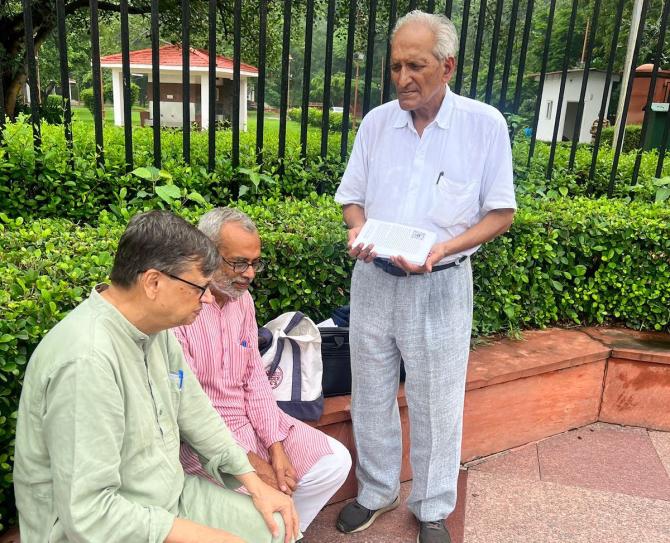
Professor Tripathi and his daughter Rakhi, an associate professor, choose August 15 this year to speak out against Israel's use of starvation as a weapon against the Palestinian people in Gaza.
They sat on a fast at the far end of Rajghat in New Delhi, which was not in anyone's way.
They commemorated Independence Day in a Gandhian way, but the Delhi police decided to have none of it and a 15-member team, led by an inspector, arrived to evict the father-daughter and questioned the senior professor, rudely asking them to wind up their 'demonstration'.
When the professor told the inspector the fast was for justice and spoke of the importance of fasting on Independence Day, the policemen ordered them to put away the posters.
Rakhi pointed out to the policemen that her father is a former IIT Delhi professor and 77 years old.
That is when the policemen toned down their aggression, but that interaction was captured by Rakhi on video and went viral.
"We told them Gandhi is a symbol of truth and we were not there to fight with anybody. We were there to make people aware and were on a fast to get inspired by the strength that Gandhi had. How could they ask us what we were doing there? People come to Rajghat to get inspired by Gandhi," says Professor Tripathi.
Professor Tripathi, why did you and your daughter choose Independence Day to go on a fast?
Hamas attacked Israel on October 7, 2023 and what Hamas did was definitely a sin. But the retaliation by Israel has been far worse, it is a greater crime.
I asked the Government of India to appeal to Israel to stop this war. This is an opportunity for our sectarian elite to know the way (Israel Prime Minister Benjamin) Netanyahu has sought revenge in the name of Hamas.
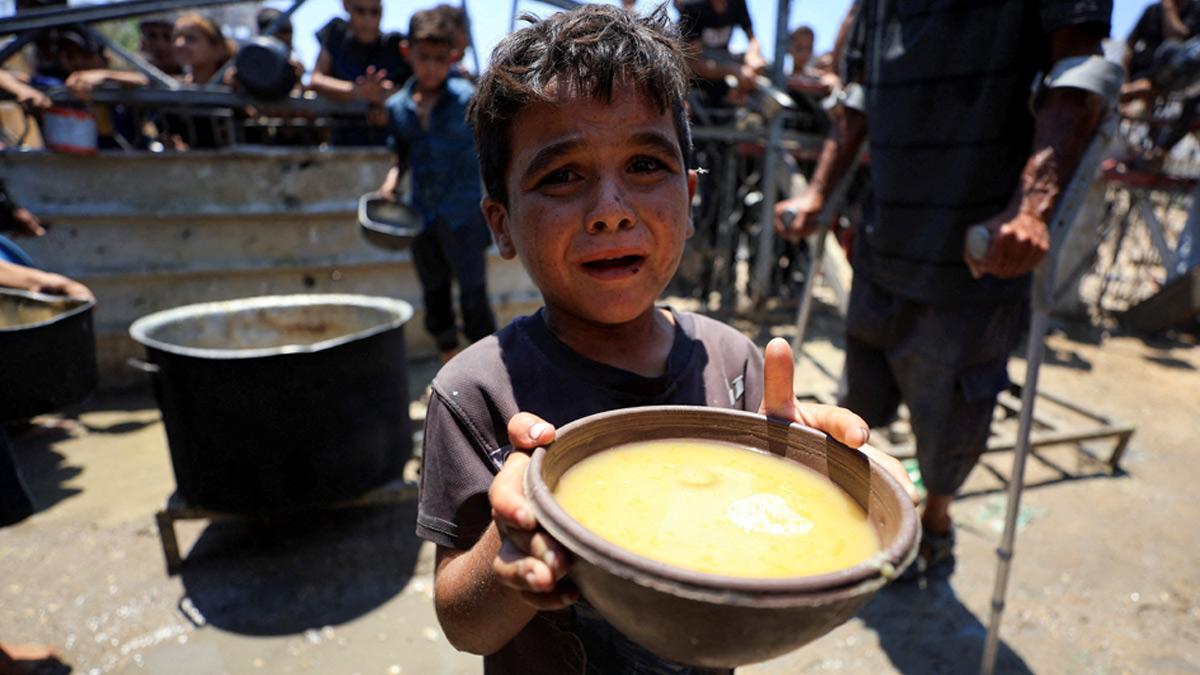
He is actually seeking revenge by killing Palestinian children and women. The bombardment by Israel has been consistent in which children, women and senior citizens have been wiped out.
Israel has now started to use starvation as a weapon in their war and this has to stop immediately.
I am a follower of Gandhi and my mission is to educate people and make them aware of communal harmony and non-violence.
I am against what is happening to the Palestinian people and I thought what better way than to sit on a fast on 15th August, which would be my homage to Gandhi.
We chose a spot at the far end of Rajghat, outside the gate, towards the road. We had placed five small banners under the bushes and trees.
A police team rushed to the spot and couldn't tolerate we had written Gaza.
I genuinely feel we are a part of human civilisation and do they not have any sensitivity? See how the ruling elite across the world are the same in exploiting and repressing. Similarly, the people in the world are the same, their hunger, starvation, pain is the same.
After they behaved in an authoritarian manner, my daughter questioned them, asking how they could humiliate a 77-year-old professor in such a threatening manner. They calmed down and they retreated.

What could have prompted them to order you to end your fast? Is it the fear of Israel?
First, a policeman came and asked us to wind up the fast and we refused. We said look at the messages, they are peaceful.
He left, but later an inspector came with a team of 15 security personnel. Their problem was the spot we had chosen, which was at Rajghat.
Earlier Rajghat was an autonomous body. However after 2014, PM Modi took it under his control and it now comes under the government, not just Rajghat, even the Gandhi Smriti.
The security has been handed over to the minister of defence. Now you tell me, what is there in Rajghat for anyone to steal? There was no need for all this drama.
We told them Gandhi is a symbol of truth and we were not there to fight with anybody.
We were there to make people aware and were on a fast to get inspired by the strength that Gandhi had.
How could they ask us what we were doing there? People come to Rajghat to get inspired by Gandhi.
He was a man of truth and non-violence and that is what we were doing.
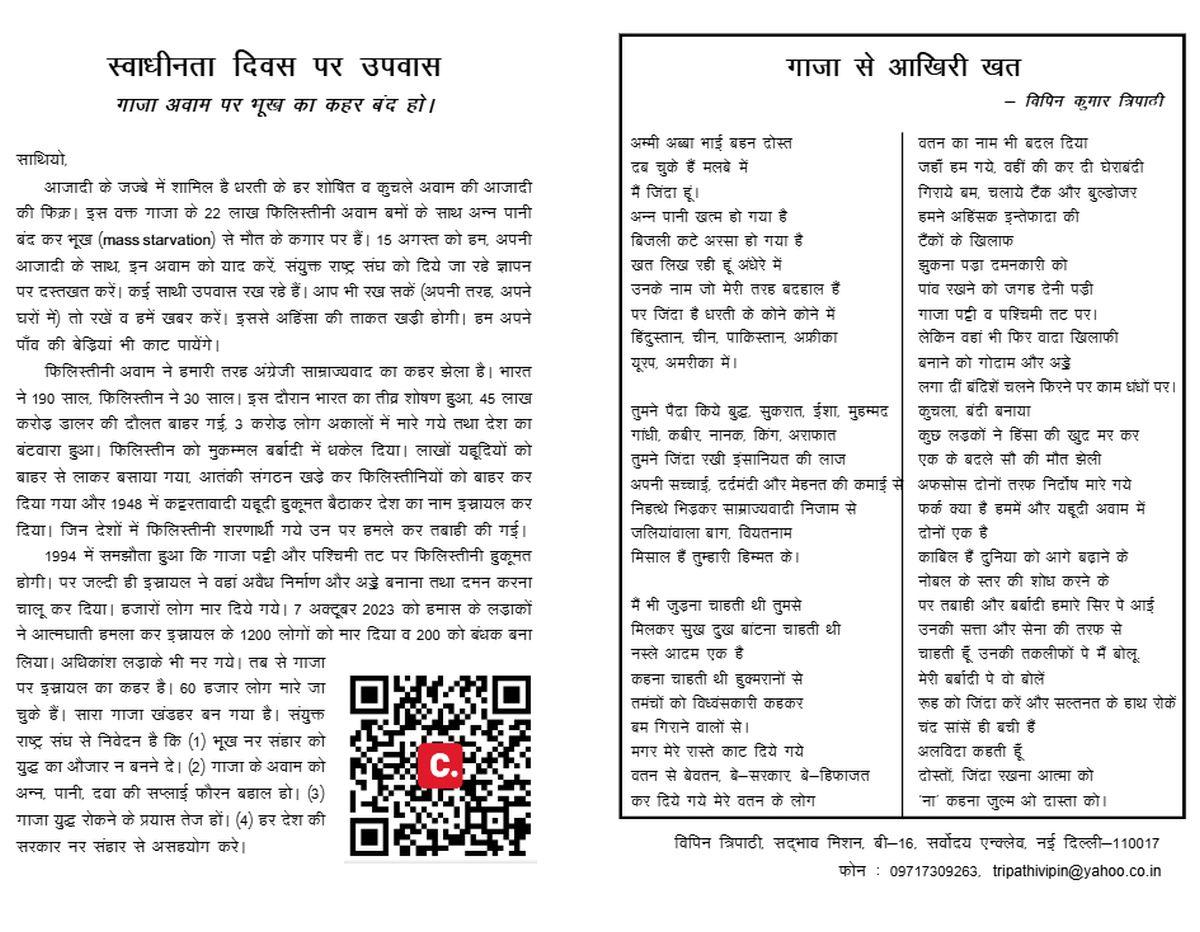
I will tell you what we had written on the banners, how does this provoke action against us?
1. Independence Day Fast
Stop Mass Starvation in Gaza
2. Swadheenta Divas Upvaas
Gaza Bhookh Narsanhaar Band Ho.
3. Drop Prejudice
Nafrat Chhodo
4. Masses of the World are One.
5. Hinsa Sattavan Ka Auzar hai, Ahinsa Aamjan Ka.
Initially we had printed 4,000 leaflets but they fell short and we printed another 1,500.
My aim was to spread awareness; there were no plans to sit on a fast.
Then closer to the date, I felt what is the principle of independence? We need to be inclusive and sensitive to those people who are subjected to extreme violence and exploitation.
This also includes the war that has been going on in Gaza. There has been a war in Ukraine too, but they are getting support from NATO.
This is a one-sided attack by Israel. Since this issue has been on my mind since 1982, I thought of sitting on a hunger fast for the Palestinians.
Then my daughter suggested we should undertake a signature campaign with our petition which we will be sending to the United Nations.
We discussed in our group and the events were planned. I wrote 1,500 pamphlets. My daughter put it out on various social media platforms. I reached out to 23,000 people by physically distributing pamphlets.
My daughter through her messages reached out to a lot many people across the world.
The Hamas attack has to be condemned but the retaliation undertaken by Israel is not against Hamas.
They are killing innocents because Hamas is only two percent of the 98 percent population that is being wiped out.
They are killing children and women who are defenceless. Israel has the protection, weaponry and these people have no such.
They have been forcibly displaced; they have lost their homes and pushed into refugee camps which are also being attacked.

Do you see a pattern of turning a blind eye to the events unfolding around us?
The ruling elite are supporting those attacking the people of Gaza.
They are taking sides and the side of the oppressor.
They are glamorising Netanyahu and seem to be taking lessons from him.
As a nation we should not cooperate with the oppressor regime that is allowing mass starvation as a weapon of war.
How does your day unfold? What time do you start your mission of spreading the word of peace?
I wake up around 5 am, 6 am, I write for some time in the morning. Then I read the newspapers for a while and have breakfast.
Now 50 percent of the time I am out of the house. I leave my home around 10 am and return home around 6 pm.
I go to different areas on different days. Some localities that I go most often are the area around Delhi University, Jamia Shaheen Baugh, Sangam Bihar, Jami Hamdard area, and so on.
The Sangam Bihar area has a mixed population, with only 30 percent Muslims, 70 percent Hindus, mainly belonging to the lower middle class.
I go to the Delhi University area since students are here largely. I don't enter the campus, instead wait outside to meet and speak to the students.
Apart from these areas, I also go to Chandni Chowk, Jama Masjid, Daryaganj, Ajmeri Gate; these neighbourhoods are quite crowded.
I also campaign in north east Delhi, Mustafabad, Silampur, surrounding neighbourhoods.
I bring out one leaflet every month which I print and take to distribute in all these areas.
I also travel for about ten days out of Delhi every month. I recently travelled to West Bengal, prior to that I had gone to Ahmedabad and other cities in Gujarat.
This must be costing you quite a bit. How do you manage -- the printing, distribution, your transport and so on?
One flyer doesn't cost much. We can print 4,000 leaflets and it costs us Rs 2,500.
I personally hand them out. I use public transport. I pick a few rotis with some chutney or pickle and eat it on the way.
How have people responded to your campaign? Specially students, do they accept the leaflets?
Students are more respectable even if some may not agree with my points. Even if some are sectarian they are not disrespectful.
Shopkeepers and traders are impudent. It is rather difficult to have a polite discussion with them, yet I go and hand over the leaflets.
This has been my experience -- among 20 traders, barely four to five are polite. Some refuse to even accept the leaflets and show me the door; some ask me to move on.
What prompted you to start this kind of work, to educate and make the public aware of the principles of secularism, speak of our Constitution and humanity? You have left plasma physics far behind and walked into hot politics.
(Laughs) I am pursuing this because there have been three critical points in life.
The first time, in 1982, was a point of transition for me. I used to live in Maryland and was a professor there from the 1970s.
In 1982, Israel attacked Lebanon and killed around 20,000 Palestinians. I asked colleagues and professors at the university since I was deeply disturbed by these actions.
I realised they were reluctant to discuss this issue since the American government was getting a lot of help from Israel.
It was a distinct example of an imperialistic mindset. At that time I decided to leave that country and return to India.
There was a vacancy at IIT Delhi and I joined as a professor. Once here, I realised, if our people have to be truly free, they need to be empowered with accurate information and their weapon has to be non-violence.
It has been my endeavour to expand knowledge of our subcontinent and form ties with people from our neighbouring countries.
I have visited Pakistan, Sri Lanka and try to develop bonds with the academicians and our fraternity.
In 1989, I took a sabbatical. The University of Maryland invited me to teach there for a year.
I read about the severe riots in Bhagalpur at that time in The New York Times. I was disturbed by that news and became restless. I booked my ticket to come to India for three weeks.
Then I went back to the US and started a signature campaign on the Bhagalpur riots.
I contacted 4,000 people who I had personally contacted for getting signatures.
We formed a Forum for Secular India, but I wasn't comfortable with the English name. By then my sabbatical too was ending so I came back to India.
I toured India and visited riot-affected areas. After returning to Delhi we formed the Sadbhav Mission.
How supportive has the IIT professor fraternity been to your secular and humanist ideas?
There are around 500 faculty members and around 100-125 may be secular minded.
I had published a newsletter and distributed it among our faculty at that time.
Initially I thought of distributing to all faculty members but changed my mind.
Out of these 500, around 150 professors were actively involved in the Ram temple movement.
I had got a whiff of their involvement and I didn't give them the pamphlets.
I distributed the pamphlets to other faculty members, who I thought were not actively involved in the Ram temple movement. They too turned out to be sympathisers.
Though I must say there were definitely 100 secular minded faculty members and I remember we gave them the pamphlets.
They joined our Sadbhav Mission even though they couldn't attend our weekly meetings Sometimes a handful would drop in, but around 150 students were actively involved.
Has the Indian secular fabric begun eroding since 1989?
When I was studying for my PhD at IIT in 1969, there were riots in Ahmedabad and Bhiwandi at that time. I was deeply pained by the events.
I saw that the IIT students were indifferent about the killings in those riots. Those who study at IITs are from elite, well-to-do families. I remember these elites had hatred against workers and the labour class.
They did not have hatred against Muslims. They hated the poor workers because they were unionised, called for strikes and had demands.
The other person they despised was Gandhi.
In 1991, P V Narasimha Rao liberalised our economy which made the corporates more powerful.
Now the corporates ideologically believe communalism is a good weapon to crush the workers.
Though there wasn't a BJP government for many years, these forces were empowered due to corporate support.
Sadly, today the hatred has penetrated deep into our society. We have been seeing incidents of lynchings and killings of Muslims on the rise.
One thing I must say -- in the last two years, Rahul Gandhi's Bharat Jodo Yatra has made a difference in the minds of people.
Professor Tripathi began his career as a lecturer at IIT Delhi in 1970. He joined the University of Maryland in 1976 as a post-doctoral researcher and then a research associate. He was involved in the research on radio frequency heating of fusion plasma at the university. In 1983, he joined IIT Delhi as a professor of physics where he worked for nearly 30 years.
Feature Presentation: Rajesh Alva/Rediff






 © 2025