

'The watershed moment was June 22, 2024, when the divisional in-charge of Gadchiroli, Giridhar Tumreti, who was their senior-most commander, along with his wife, came forward to surrender before the then deputy chief minister and home minister Devendra Fadnavis.'
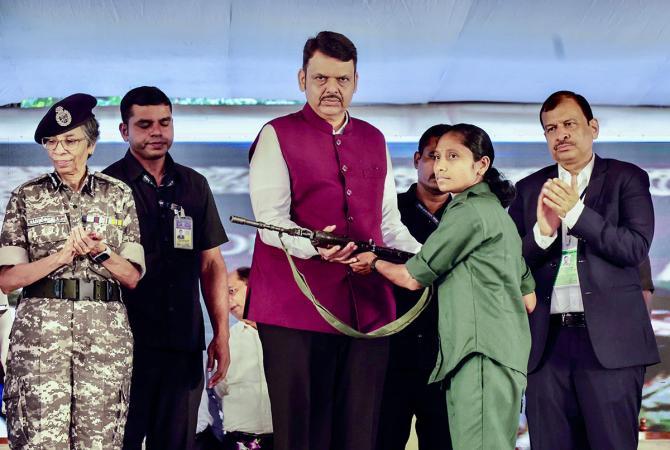
Gadchiroli district in Maharashtra has witnessed an unprecedented decline in Maoist insurgency, with 783 Maoists surrendering before the police under the state's Surrender and Rehabilitation Policy since its introduction in 2005.
The years 2024 and 2025 have been particularly transformative, marked by several watershed moments that signal the movement's imminent collapse in the region.
The most significant breakthrough occurred on October 15, 2024, when senior Communist Party of India (Maoist) leader Mallojula Venugopal Rao, alias Bhupati or Sonu -- carrying a bounty of Rs 6 crore -- surrendered along with 61 senior cadres before Maharashtra Chief Minister Devendra Fadnavis at the Gadchiroli police headquarters.
The group relinquished 54 firearms, including seven AK-47 assault rifles, six self-loading rifles and six INSAS assault rifles. This surrender was particularly symbolic as Bhupati had been instrumental in strengthening Maoist networks across Maharashtra, Andhra Pradesh, and Chhattisgarh in the last four decades.
Earlier, on January 1, 2025, another mass surrender saw 11 Maoists, including Dandakaranya Special Zonal Committee member Tarakka Sidam (Bhupati's wife), laying down their arms. Subsequently, in December 2025, 11 more Maoists carrying a combined bounty of Rs 82 lakh surrendered, demonstrating a cascading effect.
In this two-part interview with Prasanna D Zore/Rediff, Gadchiroli Superintendent of Police Neelotpal reveals the multi-pronged strategy that catalysed this remarkable transformation.
2025 has witnessed a noticeable rise in Maoist surrenders in Gadchiroli. What changes on the ground persuaded Maoist cadres to abandon violence in Maharashtra?

We have adopted a multi-pronged approach to address this challenge comprehensively. Firstly, we conducted aggressive anti-Naxal operations in both North and South Gadchiroli, with particular emphasis on the southern region, which had been more severely affected.
It is important to note that we administer an area of 14,500 square kilometres, bordering five (Maoism-affected) districts of Chhattisgarh.
The second element was our community development-led approach. Previously liberated areas -- those under Maoist control -- were systematically connected to the mainstream. To achieve this, we secured the construction of roads and bridges, and ensured the installation of mobile towers in these hitherto isolated regions.
Over the past three years, we have successfully commissioned 521 mobile towers across all tehsils (of Gadchiroli district), vastly improving connectivity. Additionally, 65 bridges have been constructed, and roads have been built in the most remote areas.
These infrastructural developments have consumed approximately three years of concerted effort. This developmental initiative aimed at integrating the population with the mainstream system.
To accomplish this integration, we addressed the security vacuum that existed. We had a substantial security vacuum of approximately 3,000 square kilometres (the so-called liberated free zone in Dandakaranya, which spreads across Chhattisgarh and Maharashtra, the core operational area of the Maoists), which we have reduced to merely 500 square kilometres over the last three years.
This was achieved by opening new forward operating bases in all Maoist-dominated areas where they previously exercised unchallenged dominance. We established our outposts in such locations, and we are preparing to inaugurate two additional posts in the coming months.
This systematic approach has resulted in the reduction of the security vacuum, enhanced police presence in previously inaccessible areas, and the establishment of law and order.
Following the restoration of police presence was followed by the percolation of development activities -- roads, mobile tower connectivity, water supply infrastructure, and other welfare schemes.
Crucially, we also initiated community policing programmes. We launched two flagship schemes in this regard: 'Police Dada-Lora Khidki' and 'Project Udaan'.
The term 'Dada' means elder brother in Gondi, the local tribal language, while 'Lora' translates to 'door', and 'Khidki' means 'window'. Essentially, we have opened a window in every outpost where any individual requiring assistance can simply visit our police station. Our FOB's/outposts function as a single-window facilitation centre.
Whether someone lacks documentation for various schemes, does not possess an Aadhaar card, does not maintain a bank account, or is unable to access benefits from numerous central and state government schemes, they need only visit our police station.
We function as a single-window facilitation centre. The police assist in completing the requisite forms, which are then submitted to the appropriate departments. Subsequently, schemes like the Ayushman Bharat cards (just to give one example) and other documents are processed by our officers and ultimately distributed to the beneficiaries at their doorstep. This single-window system has proved to be transformative.
These three approaches -- intensive anti-Naxal operations, development-led initiatives (including the creation of new outposts and reduction of the security vacuum), and our community policing initiatives -- have collectively succeeded in winning the hearts and minds of the people in previously liberated areas who used to support the Maoist movement.
Support (for the Maoists) has been reduced dramatically. The security vacuum is now confined to only 500 square kilometres.
A telling indicator of our success is that not a single person from Gadchiroli has been recruited into Maoist ranks in the last four-and-a-half years. The Maoists have been unable to secure recruits either from Gadchiroli. Those who have surrendered have confirmed this. Consequently, their linkage with the populace in previously liberated areas has been severed. We have successfully established our dominance over the people's affections and trust.
Without public support, the Maoists cannot survive.
This multi-pronged approach has led to the erosion of public support, and at present, I would assert that there exists virtually no public support -- at least, none that I am aware of.
Over the last year, and continuing into 2025, hardcore villagers declared 'Gaon Bandi' (no entry) against the Maoists in their respective villages. They refused to provide food, rations, or any form of support, and did so without fearing retaliation.
That demonstrates the faith the police have been able to restore among locals. We have successfully reclaimed popular support. Without public backing, the Maoist movement cannot persist, cannot endure. This ultimately precipitated the mass surrenders.
Could you elaborate on the watershed moments that triggered this cascade of surrenders?

The second critical factor was that we instilled fear in them -- a recognition that we are prepared to engage them anywhere, even deep inside their Dandakaranya strongolds.
The watershed moment was June 22, 2024, when the divisional in-charge of Gadchiroli, Giridhar Tumreti, who was their senior-most commander, along with his wife, came forward to surrender before the then deputy chief minister and home minister Devendra Fadnavis.
The symbolic power of such a senior cadre, against whom multiple cases were registered, receiving an opportunity to surrender in Gadchiroli had a cascading effect. That single moment shattered their confidence and triggered mass surrenders across regions. Following Giridhar's surrender, approximately 150 more Maoist cadres surrendered.
In 2025, we are discussing 112 surrenders. This includes the historic surrender on October 15, 2024, when Bhupati, the Dandakaranya special zonal committee member, surrendered along with 61 other cadres carrying 54 weapons. This was also unprecedented.
Subsequently, 426 individuals surrendered in different parts of the country -- Madhya Pradesh, Chhattisgarh, and Telangana -- within just 45 days (of Bhupati's surrender). Over 350 (sophisticated) weapons were also surrendered.
Most of these weapons were sophisticated -- AK-47 calibre automatic weapons and in-house manufactured single-shot rifles.
Have the surrendered Maoists or those who have been apprehended divulged information about who is funding the movement and where they are procuring weapons?
Regarding their arms procurement, what we have recovered are weapons that had been looted from security forces. For instance, the weapons we recovered included those seized during the 2010 Tadmetla massacre, when 76 CRPF jawans were martyred and all equipment was looted.
Bhupati himself brought back weapons that had been looted in the (2019) Jambulkheda blast, which claimed the lives of 15 Gadchiroli police personnel. All the weapons and ammunition they had been carrying were sophisticated items looted from security forces.
As for funding, it is evident they have been receiving money through extortion or protection money from various sources -- particularly from tendu leaves contractors, road construction contractors, and bamboo traders.
In 2023, they were collecting approximately Rs 18 crore (Rs 180 million) annually from extortion. This figure reduced to Rs 5 crore (Rs 5 million) in 2024, and further declined to merely Rs 5 lakh (Rs 500,000) in 2025.
In July 2024, we declared North Gadchiroli completely cleared. The focus then shifted to South Gadchiroli from January 1, 2025.
Today, out of our nine tehsils, only a small portion of one sub-division remains affected (by Maoist ideology), with approximately ten hardcore cadres. Those ten are also on the verge of surrender or neutralisation and our appeal to them is to surrender and accept the Constitution.
What role did the Gadchiroli police play in persuading Bhupati to surrender? Why did he choose to surrender in Maharashtra?

The first achievement was that we were able to instill confidence in everyone who was contemplating surrender. We assured them that they would be accepted without any terms and conditions, and that they would be provided with a genuine sense of security -- that nothing adverse would befall them.
This sense of security, combined with the sense of ownership we have demonstrated towards surrendered cadres, has been pivotal.
We have approximately 70 former Maoists currently employed with the Lloyds Steel Plant today. The state government is ensuring protection and rehabilitation.
You mentioned that family members played a role. What about local villagers and intelligence inputs in identifying and persuading the Maoists to surrender -- especially the roles played by Bhupati and his wife, Tarakka?
Indeed, their contributions have been substantial. Bhupati's wife had previously surrendered (in January 2025). Some surrendered Maoists maintain contact with those still active. Some of those we have apprehended also establish communication with them.
Family members who are now living lives of dignity in our area have been instrumental. Over the past two years, we have invited family members of active Maoist cadres to our surrender programmes. They gained a sense of dignity and realised that even if their brother or relative is involved in the revolutionary movement, they themselves can live in Gadchiroli as ordinary villagers without facing ostracism. That dignity I am describing is significant.
In all surrender programmes conducted over the last year, we invited the family members of those we wished to persuade. Villagers also played a considerable role in conveying the message to them: That enough is enough, that numerous people are returning to the mainstream.
- Part 2 of the Interview: 'Maoists Collapsed Like A House Of Cards'
Photographs curated by Manisha Kotian/Rediff







 © 2026