

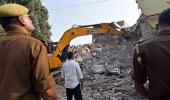
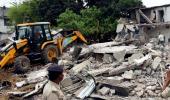
'Social acceptance and glorification of demolitions as a symbol of 'strong governance' has, in many ways, incentivised the political leadership to continue projecting a pro-bulldozer image, even when such actions defy Constitutional rights and values.'

A year after the Supreme Court verdict that declared punitive demolitions illegal, M Huzaifa, advocate practising at the Supreme Court of India, avers that the so-called 'bulldozer justice' continues to be enforced.
In the first part of his interview to Syed Firdaus Ashraf/Rediff, Huzaifa had said, "No formal contempt proceedings have been initiated either by the Supreme Court or any high court against officers or demolition squads who have acted in violation of it."
"The implementation of the judgment has largely been left to the discretion of the very executive authorities it sought to restrain," points out Huzaifa in the concluding segment of the interview.
Why do you think the local administrations still conduct demolitions in apparent violation of the Supreme Court directive? Is this a gap in monitoring or political will?
First of all, the responsibility does not rest solely on the administration or the judiciary, it also lies with society itself.
Over the past few years, there has been a growing public fascination with the idea of 'bulldozer justice', a kind of political romanticism that celebrates instant retribution over due process.
This social acceptance and glorification of demolitions as a symbol of 'strong governance' has, in many ways, incentivised the political leadership to continue projecting a pro-bulldozer image, even when such actions defy Constitutional rights and values.
At the institutional level, there is indeed a gap in both monitoring and political will.
The Supreme Court's demolition judgment should ideally have been followed by a continuing mandamus and system of periodic monitoring should at place to ensure that its directions were being implemented on the ground over a long period of time. That has not happened.
Without judicial follow-up or accountability mechanisms, the implementation of the judgment has largely been left to the discretion of the very executive authorities it sought to restrain.
The court also carries a moral responsibility to ensure that its rulings are not reduced to mere declarations of principle but are implemented in letter and spirit, reaching the 'last mile' and effectively restraining the malice it sought to curb.
The absence of such vigilance has allowed this culture of impunity to persist, and the gap between Constitutional ideals and administrative reality continues to widen.
Many argue that 'bulldozer action' has become a political symbol of 'strong governance'. How does this narrative clash with Constitutional principles of equality and due process?
India is a democratic republic founded on the principle of constitutionalism, which means that the powers of the government are limited by law and must operate strictly within the boundaries set by the Constitution.
The idea is not merely about having a government elected by the people, but about ensuring that every act of governance is constrained by due process, fairness, and accountability.
The Supreme Court of India, through a catena of judgments, has reaffirmed that arbitrariness is antithetical to equality and that any action of the State which is arbitrary or disproportionate violates the fundamental right to equality under Article 14.
Governance, therefore, cannot be reduced to populist displays of power or retributive acts of control.
While the optics of bulldozer action may project an image of decisiveness or 'strong governance' to sections of the public, such symbolism directly clashes with the spirit of Constitutional governance, which values legality, procedural fairness, and restraint over speed and spectacle.
True strength in a democracy lies not in the force of the bulldozer, but in the force of the rule of law.
As Dr B R Ambedkar warned, the real test of Constitutional morality lies in whether those in power observe the limits imposed upon them by law even when the majority cheers them on.
What happens to the people whose homes are demolished overnight? Are there any mechanisms for rehabilitation or compensation in such cases?
There have been a very few court judgments where compensation was awarded to individuals whose homes were demolished, but these cases are limited and largely address the arbitrariness of executive action rather than the punitive nature of such demolitions.
The evolving character of these actions where demolitions are used as instruments of punishment rather than as legitimate administrative measures poses a deeper Constitutional concern that remains under-explored in current jurisprudence.
Unfortunately, there is no consistent mechanism for rehabilitation or compensation for those affected by punitive demolitions. Victims are often left to rebuild their lives on their own, facing not only the loss of shelter and livelihood but also the stigma of criminalisation that precedes or follows such acts.
Still, as citizens, we hold on to the hope and faith in the judiciary that the courts of this country will eventually rise to the occasion, enforce accountability, and ensure that justice is not just done, but also seen to be done.
Critics allege that such demolitions disproportionately affect members of certain communities or groups. Do you see a pattern of discrimination, and how can this be legally challenged?
The question of whether certain communities are being specifically targeted is, in principle, an empirical one that requires rigorous documentation and study.
The Supreme Court itself has been cautious and somewhat reluctant to engage directly with this dimension in its judgments.
That said, on the ground, it is evident that the brunt of these demolitions is disproportionately borne by communities and individuals who exist on the margins of political and social power.
This pattern becomes most visible in the aftermath of communal incidents or protest-related violence, where members of the Muslim community, in particular, have often been criminalised and punished collectively through demolitions that follow police crackdowns.
Legally, such patterns can and must be challenged through Constitutional litigation, especially under Articles 14 and 15 (equality and non-discrimination), and Article 21 (protection of life and livelihood). However, this requires systematic evidence and consistent judicial engagement, both of which remain limited at present.
Should the Supreme Court or high courts set up special monitoring committees to ensure compliance with their demolition guidelines across all states?
Yes, the courts should actively monitor compliance through periodic compliance reporting and swift contempt action for violations. Without such oversight, officials often flout even Supreme Court directives with impunity, undermining the authority of the judiciary and the rule of law.
Are there any current or planned PILs addressing the violation of the bulldozer judgment? How effective can such litigation be against systemic misuse?
As the Supreme Court's landmark demolition judgment touches one year, a major setback has come from Rajasthan, where the new Prohibition of Unlawful Religious Conversion Act, 2025, shockingly prescribes punitive demolitions as punishment for alleged unlawful conversions.
This law effectively nullifies the Supreme Court ruling and hands over adjudicatory and punitive powers to executive officers, violating the principle of separation of powers.
A PIL challenging its constitutionality has already been filed by us in the Supreme Court.
Beyond the courts, what role should civil society organisations and the media play in ensuring that the Supreme Court judgment is respected and implemented on the ground?
Civil society and the media play a vital role in upholding Constitutional values and ensuring that judicial rulings translate into ground reality. They must create awareness about the illegality of punitive demolitions and build public pressure against such extra-judicial bulldozer actions.
Responsible, objective journalism free from sensationalism or glorification of bulldozer politics, is essential highlighting human cost of disastrous bulldozer politics.
When media and civil society hold power to account, they help shift the narrative from demolition and destruction toward justice, construction, and Constitutional governance.
How can courts or citizens prove that a demolition is being used as a punitive measure rather than a legitimate urban planning activity or for safety because these things are happening far away from New Delhi where the Supreme Court is located?
The jurisprudence around punitive demolitions is still quite limited in India, primarily because this is a relatively new and evolving phenomenon that has emerged over the past decade. Developing a robust body of progressive legal precedent takes time, effort, and consistent engagement from litigants, lawyers, and the judiciary.
While the Supreme Court has laid down the foundational principles through its landmark judgment on so-called 'bulldozer justice', the responsibility to apply and enforce this legal framework lies with the respective high courts and local courts, which are geographically and jurisdictionally closer to where such demolitions occur.
These courts must interpret the facts before them through the lens of the Supreme Court's reasoning to determine whether a demolition is administrative or punitive in nature.
A punitive demolition can often be identified by examining the sequence and context of events. For example, if a demolition follows closely after a criminal allegation or police action against an individual, family, or a particular community and the timing, language, or manner of execution suggests an intent to collectively punish then the punitive motive becomes apparent on the face of it.
It is the duty of lawyers and petitioners to present courts with the relevant documents, notices, media statements, and other evidence that demonstrate this correlation between the criminal accusation and the subsequent demolition action.
Another important indicator is selective targeting when authorities single out particular properties or neighbourhoods for demolition while leaving other similarly situated properties untouched.
Such discriminatory application of power strongly suggests that the demolition was driven by punitive or political considerations rather than legitimate urban planning, safety, or regulatory enforcement.








 © 2026