
'It makes law-making on the part of the state governments much more difficult and throws up bottlenecks as governors are not acting on bills.'
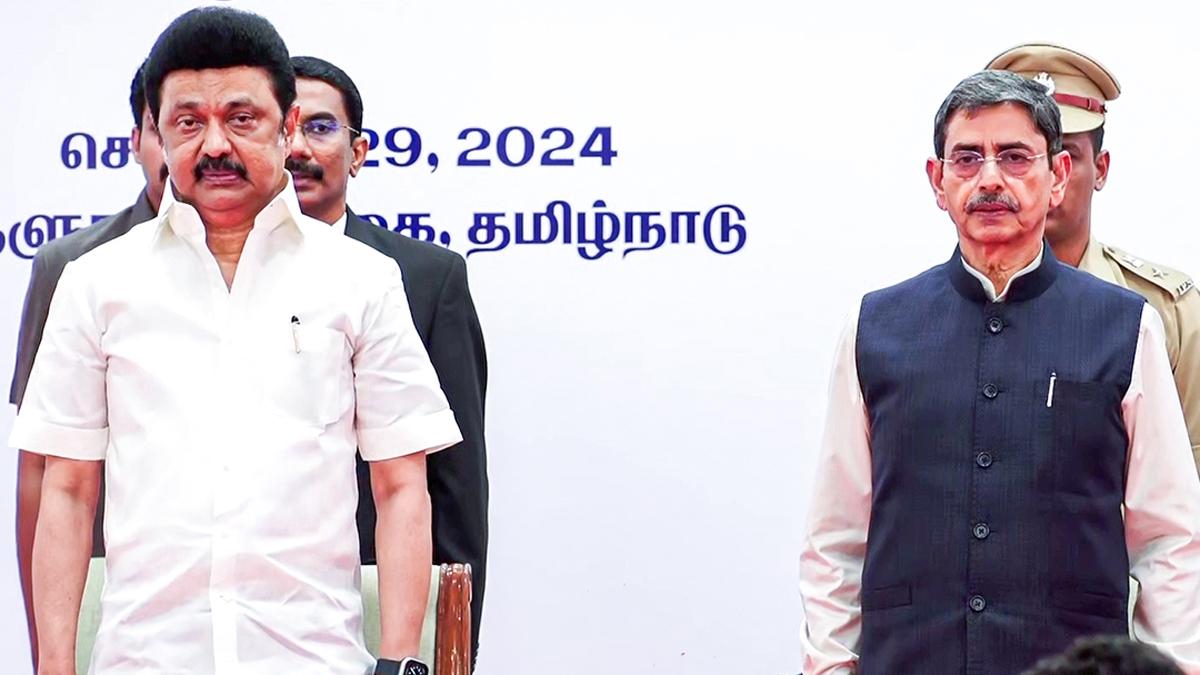
In a political climate where the tensions between the Centre and Opposition-ruled states are rising, the Supreme Court's recent opinion in the presidential reference to it, that it cannot impose timelines on governors or the President for deciding on bills, is set the escalate the situation further.
The Supreme Court's opinion comes amid a series of standoffs, most prominently in Tamil Nadu where Governor R N Ravi had withheld assent to several key bills, prompting the state to move the apex court which ruled in its favour and imposed a timeline for approving bills.
It also invoked Article 142, which grants its powers to pass orders to ensure complete justice, to rule that the delayed bills were deemed to have received assent -- a stand that the Suprme Court's opinion has negated.
Across the country, close to 33 bills passed by Opposition-ruled states remain stalled, either at the Raj Bhavans or pending before the President.
The presidential reference to the Supreme Court came in the wake of the April verdict where a two-judge bench held that governors must act on bills within a reasonable timeframe and cannot sit indefinitely on legislations.
In response to the President's questions to the Supreme Court, a five-judge bench headed by then Chief Justice B R Gavai effectively negated that position, concluding that the court cannot prescribe strict deadlines and must leave the matter to constitutional conventions and good-faith conduct.
Against this backdrop, Gautam Bhatia, the well-known lawyer, spoke to Syed Firdaus Ashraf/Rediff on the implications of the Supreme Court's opinion.
What is the future for a state government now if the governor/President of India does not clear a bill indefinitely, considering the Supreme Court has now opined that courts cannot prescribe timelines?
The state government will have to go to the Supreme Court of India over each individual bill to say that the delay is unwarranted.
Does it mean that now a governor/President will be more powerful than the elected chief minister?
That you can assess yourself.
I can tell you that the state governments will have to go to the Supreme Court every time there is a delay (in assent to the bill).
As far as who is more powerful, that everybody can see for themselves.
Does the Constitution allow the governor or President to withhold a bill passed by the state legislature?
The Constitution gives them a set of options to return the bill for reconsideration.
In the case of governor, h/she can refer it to the President if the governor so feels and for assent.
There is no withholding option in the Constitution.
Could a situation arise in future where Opposition-ruled states and governors are at daggers drawn over assent to bills not forthcoming?
That you can see what is happening already.
There are delays in taking action by governors under Article 200 of the Constitution. This is the reason why this litigation happened in the first place.
In the case of Tamil Nadu that is already happening.
Why do you think the framers of the Constitution didn't prescribe a timeline? Did they not anticipate a situation like this?
The framers thought that not everything can be codified in the Constitution. Some things would have to be left to constitutional conventions and norms of conduct and those who occupy Constitutional offices would normally act in good faith.
That was the assumption and therefore not everything was codified in the Constitution.
Can you explain the significance of Article 200 of the Constitution?
The Supreme Court has opined that the governor must be given this constitutional option, that is to exercise his discretion under Article 200.
However, at the same time, the court also opined that the governor must not sit over a bill in perpetuity and must have a dialogue with Constitutional functionaries. This is leading to confusion as who is the ultimate deciding authority for a law.
The Constitution basically (says) the state government has to have a centrally appointed governor. The main legislative body is obviously the state assembly.
A bill, even if passed by the state assembly, will not become a law until and unless the governor gives assent.
The governor has few options, firstly, in normal course he gives assent and the bill becomes a law.
The Constitution envisages that perhaps the governor feels there is some repugnance between the state law and the central law, in that case the governor can refer the bill to the President of India or if the governor has other objections h/she can return the bill to the assembly for reconsideration.
After which when the assembly sends back the same bill for a second time the governor has to assent to the bill. And that is what the idea is.
Now, after the Supreme Court's opinion that timelines can't be set, it is a very vague situation.
So effectively if the governors don't act for a long time on a passed legislative bill then possibly the states can go to the Supreme Court of India that a delay has happened in which case the court might or might not tell the governor to take some action on the bill.
That is the position right now.
Does this not put Opposition ruled governments at a disadvantage?
There are many things that state governments do that does not involve law-making. There could be executive action and administrative things like that. So it is not that there is no point in electing Opposition parties.
It is just that in one domain, and of course it is an important domain of law-making, there will now be a lot of bottlenecks.
This is what the full picture is.
Dr Ambedkar did say that the Constitution should be implemented in letter and spirit. Are governors sometimes not implementing the Constitution by sitting on bills?
That is exactly why these cases came to court. The governors were exercising pocket vetos on bills. And they were not conducting themselves in accordance with the three options under Article 200, which exactly led to the litigations in the first place.
Critics have said the Supreme Court's observation is a blow to federalism, do you agree?
It is a blow in the sense it makes law-making on the part of the state governments much more difficult and throws up bottlenecks as governors are not acting on bills.
In that case it takes away a degree of power from the state legislative assembly.
Those supporting the Supreme Court opinion state that Article 142 cannot be used to usurp the powers of President and governor. In other words, the Supreme Court has balanced the structure of power rather than putting its foot down against the governor or President of India. What do you think?
I have no comment as people can have their own views on this matter.
In future, will a state bill that is kept on hold lose its significance as there would be no clarity?
Like I said, up till now there was no clarity.
For example, in Tamil Nadu for 2-3 years the bills were pending after being passed in the state assembly.
The judgment by Justice J B Pardiwala in April setting a timeline for governors to clear bills brought clarity, but now the clarity has once again been thrown into doubt by the removal of timeline.
This leaves the question of how much delay is too much delay to the discretion of the Supreme Court of India.
In that sense there is very little clarity now over at what point the governor's inaction is justifiable or not. That takes away a lot of clarity.
For instance, Tamil Nadu's National Eligibility cum Entrance Test (NEET) Exemption Bill went against the Centre's rules on the medical entrance test. So how can the state expect Governor Ravi to clear that legislation?
We have the Supreme Court in our country which adjudicates Centre-state disputes. That is the Supreme Court's job.
If there is a state legislation that is repugnant to the Centre's laws, the appropriate authority to determine that is the Supreme Court where a petition can be filed.
Why is it being said that the Supreme Court observation on no timeline to governor and President is dangerous to India's federal structure?
Ask the people who are saying that. I haven't said it. I am only commenting on the legal aspect.







 © 2025