

'His report created a lot of negative reaction in Kerala and in a way, he was crucified for writing such a report.'
'I asked him, "Don't you feel frustrated?"'
'His reply was, "Have you read Bhagavad Gita Chapter2"?'
'He particularly mentioned verse 47, where Sri Krishna tells Arjuna, "Your duty is to work without thinking of the fruits you get".'
"He said, "similarly, my duty was to do what best I could do without hoping for any rewards".'

World renowned environmental scientist Dr Madhav Dhananjaya Gadgil was a giant in the field of ecology and environment protection.
Dr Gadgil protected environment from corrupt practices, which perhaps nobody else has done in the recent times.
Dr Gadgil submitted a report, known as the Gadgil Committee report as the head of the Western Ghats Ecology Expert Panel (WGEEP), constituted by the ministry of environment and forests in 2010.
The Gadgil Committee Report mapped the entire Western Ghats as an Ecologically Sensitive Area that had to be protected. But the report was not made public because of its content.
It was then that an economist and environmental activist from Kerala, G Krishnan filed an RTI application in the Delhi high court asking the ministry of environment and forests to disclose the Gadgil report.
The high court then ordered the ministry to post all the reports on the ministry's web site within 30 days of being received.
"I remember him as a man who was sincere to the core, extremely knowledgeable, and who had real concern for people and the environment. He did not have a tunnel vision unlike our present day leaders. He had a long-term vision. I remember him for his long-term vision and understanding of issues," Mr Krishnan tells Rediff's Shobha Warrier.
Meeting Dr Gadgil
Though I had heard about Dr Gadgil in the 1990s in the context of the book Ecology And Equity which he wrote along with historian Ramachandra Guha.
As you know, the Western Ghats Ecology Experts Panel was appointed in 2010.
As an afterthought, Dr Gadgil was asked to look into Athirapalli project by (then environment minister
For the first time I met Dr Gadgil at Athirapalli when he came to visit.
There were a lot of people there, and it was a very crowded meeting. I got introduced to him as a representative of the Rain Research Centre that was fighting to save Athirapalli, and I talked to him briefly.
Subsequently in the afternoon, there was a smaller meeting at Chalakudi where the Kerala State Electricity Board and irrigation department representatives were also there.
During that meeting, we gave a representation as members of the River Research Centre who was one of the pioneer organisations which was fighting the Athirapalli project.
We had prepared a detailed report on the implications of the project.
The report impressed him very much because it was very systematically done with a lot of data, facts and figures. He complimented us for preparing such a report.
During the meeting, he asked all the departments to give their views, but the KSEB and irrigation department officials chose to remain quiet.
One of the negative impacts of the Athirapalli project was on the water supply for irrigation purposes.
I had collected a lot of information from the irrigation department through several RTI applications spanning one-and-a-half years. And it said the project was bad from the irrigation point of view, and it would completely destroy the cropping pattern in our area.
I had put all the information I had collected as a separate representation and told Dr Gadgil about this. I also told him that the hands of the irrigation department are completely tied, but they submitted to me in the RTI that the project was not desirable.
Then he said, give me all those papers.
The next day, I met him and gave all the papers. In fact, I had already prepared everything in anticipation of this.
He was quite impressed with what I had prepared.

He was really feeling the pain of the destruction of Poona
After the meeting, I saw him sitting in the lobby. There was nobody with him.
I asked whether I could talk to him. He said, of course. I told him I wanted to talk to him about Pune from where he was.
I had gone to Pune as a student in the late 1960s for the first time. In 2005-2006 I found that the place had been completely ruined.
He agreed that a beautiful city like Pune had been completely destroyed by lack of planning and urbanisation process without creating the required infrastructure for development. He spoke about how the corporate builder lobby had taken over the land, how unplanned growth had destroyed the city.
He said he was very pained to see how a beautiful city was destroyed.
I felt he spoke from his heart. After all, he was basically a Poonaite.
His father was an eminent economist who was the founder director of the Gokhale Institute of Economics and Politics.
Since I had read a lot about his father and his work, we spoke about his father and how he developed the Gokhale Institute. At that point of time it was one of the leading educational institutions in Poona, and Poona was known as the Oxford of the East.
I could feel he was really feeling the pain of the destruction, the gradual and slow destruction of Poona as a city as well as a centre of education.
Regular correspondence on the Athirapalli project
We continued to interact via e-mail after he went back to Poona because he went through whatever we had written about the Athirapalli issue and wanted clarifications on some points.
That was how our e-mail correspondence started.
He wanted to know more about the impact on water flow in the Chalakudi river which was already declining.
In fact, the Chalakudi river feeds about 24 villages in the Ernakulam and Trissur districts.
After a couple of months, the e-mail correspondence came to an end once he got all the clarifications. He must also have got busy with preparing the report by then.

The Gadgil Committee report was not made public
Subsequently I came to know that he had submitted the report to the ministry, but the ministry was not inclined to release the report to the public.
It was then that I decided to file an RTI in the Delhi high court. But I did not tell him that I intend to do this.
After the Delhi high court asked the ministry to release the report to the public, Dr Gadgil sent me an e-mail saying, 'You have done good work. I am happy that somebody from Kerala took the initiative and tried his best to bring the report out in the public'.
I told him that I didn't do anything great. It was a job which any citizen in Kerala or anybody in the country could have done. It just happened that I did it.
The real correspondence between us started after the report was released in 2011 and continued for another six months.

Kerala reacted negatively to the Gadgil committee report
His report created a lot of negative reaction in Kerala and in a way, he was crucified for writing such a report.
I told him I felt very frustrated to see such a reaction in Kerala after he had done so much work.
I asked him, 'Don't you feel frustrated?'
His reply was, 'Have you read Bhagavad Gita Chapter2?'
He particularly mentioned verse 47, where Sri Krishna tells Arjuna, 'Your duty is to work without thinking of the fruits you get'.
He said, similarly, my duty was to do what best I could do without hoping for any rewards. He wrote the quote in Sanskrit.
He said he was not frustrated because he did his duty and was not bothered about whatever happened after that.
I felt he was consoling himself and at the heart of hearts, he was feeling bad.
As I felt bad, I wrote long mails to him on what was happening in Kerala.
But his replies were brief, in three or four sentences, always mentioning the Bhagavad Gita, and quotes from Bhagavad Gita.
When the Kasturi Rangan report came, he mentioned that at least he (Kasturi Rangan) could have discussed the matter with him before finalising the report, which unfortunately he didn't seem to inclined to do.
But Dr Gadgil said he had no grudges against him (Kasturi Rangan) as each one had their own way of working.
He was a very large hearted person.
Later on, it was Dr Sajeev, a senior scientist at KFRI (Kerala Forest Research Institute) at Peechi in Thrissur who regularly updated Dr Gadgil about what was happening in Kerala.
It was Dr Sajeev who did the maximum work in Kerala spreading the true message of the Gadgil Committee report.
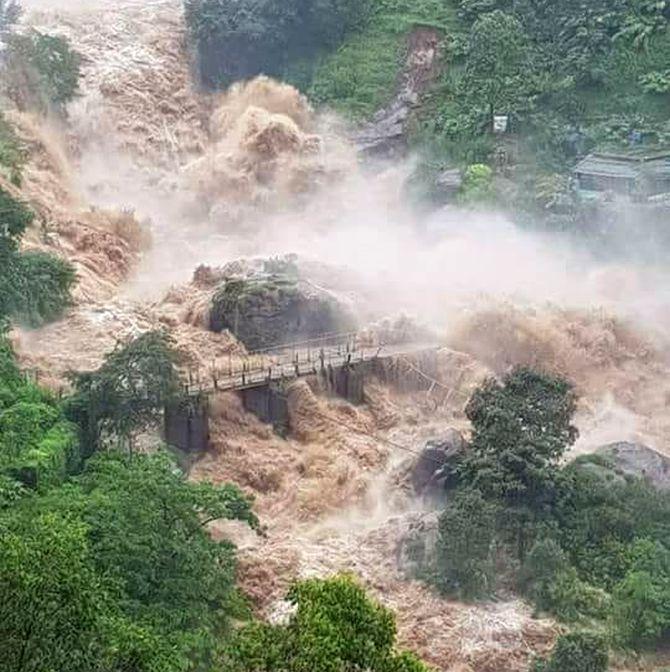
Dr Gadgil was aware of what was happening in Kerala during the monsoon. After every flood and every landslide, the Kerala media had been asking for his opinion, and on what he had predicted in the report.
By then, he had major health issues and his wife, a renowned scientist herself, was also not keeping well. And they had turned into kind of recluses in Pune. So, I did not want to trouble him.
Dr Gadgil, an unassuming person.
My first impression of him was that he was a very simple, unassuming man.
He was very humble. I consider humility as one of his major virtues.
When you talked to him, you did not get the impression that he was on a very high pedestal. He treated you as an equal. He put everybody in their comfort zone.
You never got intimidated by him; he was a well-known scientist and you were a layman. But he treated you like an equal.
Whenever I met him, I was at ease.
He was a wonderful person, a wonderful human being, simple, unassuming and knowledgeable.
 IMAGE: G Krishnan
Remembering Dr Gadgil...
I remember him as a man who was sincere to the core, easy to deal with, extremely knowledgeable, and who had real concern for people and the environment.
He had a clear understanding of the long-term impact of environment on people and their livelihood, and the future of mankind.
He did not have a tunnel vision unlike our present day leaders. He had a long-term vision. I remember him for his long-term vision and understanding of the issues.
Unfortunately, our new generation, barring for a very few, are not bothered about the environment.
Everybody seems to think that make hay while the sun shines. That is everybody's attitude. Of course, there are exceptions.
The media in Kerala remembers him only when there is a flood or a landslide in the state.
I always say that like Mahabali's visit to Kerala once in a year for Onam, Dr Gadgil also comes to Kerala during the monsoon season every year. That is the only time Kerala remembers him.
Feature Presentation: Aslam Hunani/Rediff







 © 2026