
'Handling or mitigating a rebellion is not a corporate plan with quarterly, half-yearly and annual goals and results but an aggregation of the effort of several years.'
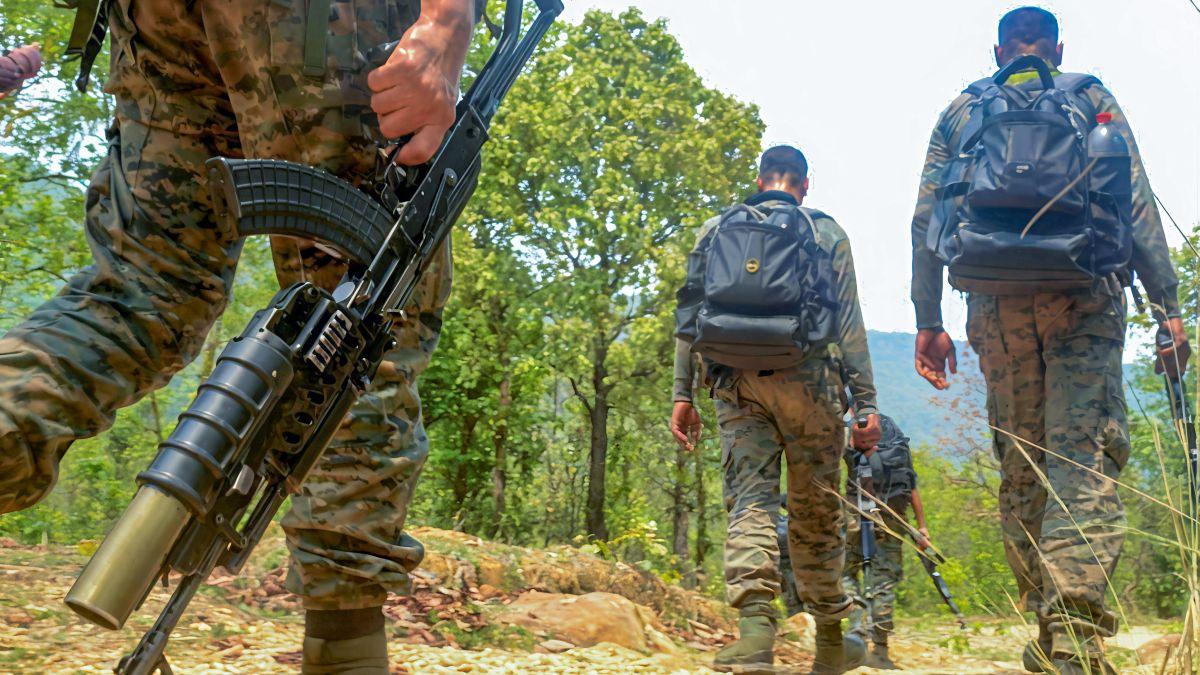
Union Home Minister Amit Shah has, on several occasions over the past few months, claimed that the Maoist insurgency in India will be eliminated by March 31, 2026.
To support his claim about the 'improved security situation' in states affected by Left Wing Extremism (LWE), Shah points to the increasing number of Maoists surrendering and the high voter turnout in these regions during the recent Lok Sabha elections.
To explore whether this declaration is grounded in credible on-the-ground realities or merely political rhetoric aimed at projecting decisive governance, Rediff's Utkarsh Mishra spoke to Sudeep Chakravarti, a longtime observer of the Maoist rebellion.
In this wide-ranging conversation, Chakravarti -- also the author of Red Sun: Travels in Naxalite Country, an authoritative book on the Maoist insurgency -- discusses its roots and evolution, and assesses how much the situation has truly changed since its peak in the mid-2000s.
Home Minister Amit Shah often claims that Naxalism 'will be eliminated' from the country by March 31, 2026. Is this merely rhetorical, or is there credible ground intelligence backing this claim?
The Maoist insurgency -- which is erroneously called Naxalism -- is vastly diminished since its millennial peak in 2006, with the active strategy the central government and various state governments.
Handling or mitigating a rebellion is not a corporate plan with quarterly, half-yearly and annual goals and results but an aggregation of the effort of several years.
Announcing its 'elimination' by March 31, 2026, is foolish because, whatever the official spin, extreme leftwing impulses will not disappear until the root causes of rebellion are addressed.
The fact that leftwing extremism has existed in one form or another since the 1967 'Naxalbari' uprising despite massive State response, is a proof of concept.
You wrote Red Sun about 20 years ago. How has the situation changed since then? Does the Red Corridor still cover as much territory as it did then?
According to the latest government figures, 38 districts across nine states are now labelled as 'LWE-affected', down from 55 earlier.
I published Red Sun in 2008, an updated edition in 2009, and a book on business and human rights that contained a large component of Maoist-related issues, in 2014.
I have actively observed and written about the conflict for the past two decades.
In that time, the so-called Red Corridor, a name given by a right-wing politician and popularised by the media, has shrunk in both width and in strength, but not entirely in intent.
What is the current state of the Naxal leadership? Since you wrote the book, senior leaders like Kishenji, Basavaraj and Jambri have been killed, while Ganapathy has retired. Media reports have recently suggested a 'leadership crisis' within the Maoist ranks. How accurate is this assessment?
The leadership crisis in the Communist Party of India-Maoist, or CPI-Maoist, is more than a decade old.
Indeed, the crisis is also in second tier and third-tier leadership, and even squad-level leadership.
Years of intense government operations, deaths of leaders and cadres, rehabilitation through various surrender policies, and, in a few places, improvement in governance and better delivery of the criminal justice system, have all contributed to this attrition.
Beyond strengthening security infrastructure, the government cites several civic schemes and youth programmes as contributing to the decline of Maoist influence. How credible is the claim that these initiatives are causing the Maoists to lose ground support among Adivasi communities?
It is credible. But civic programmes and youth development schemes need to follow a path of genuine development and inclusion, not a template driven by notions of majoritarian politics, or there will inevitably be a price to pay.
In its Urban Perspective document, the CPI-Maoist outlines a strategy of building underground networks in cities, particularly among workers, students, Dalits, and minorities. The government, meanwhile, has popularised the term 'Urban Naxal' -- a label that is now often applied to any critic of the regime.
While this has had serious consequences for many activists, it has also become a routine political slogan. Does the overuse of the term risk undermining the state's ability to deal with the CPI-Maoist's actual urban strategy?
The Urban Perspective Document pre-dates CPI-Maoist, a conglomerate formed in 2004.
Besides, as mentioned clearly in the document, Maoist ideologues themselves admitted the difficulty in penetrating India's urban areas for a number of reasons, from heightened State security in urban areas compared to rural areas, the relative allure of job opportunities, and several other factors.
The central logic of the Urban Perspective document remains valid, but its approach is outdated.
The current central government and a few state governments popularising the term 'Urban Naxal' is nothing more than a stick with which to beat its critics.
That it has massive implications is already evident in human rights violations, the lamentable curbing of judicial redress, and a diminishing of democracy.











 © 2025