

'The moment they fall foul of the party in power, they become unsafe. Then nobody can guarantee their safety.'

In the concluding part of this two-part interview with Prasanna D Zore/Rediff, Supreme Court Senior Advocate Dushyant Dave paints a grim picture of India's democratic institutions and rule of law. He argues that Constitutional safeguards have eroded to the point where citizens are safe only if they don't oppose the government.
Dave criticises the judiciary's role in enabling this situation through "apathy and lukewarm approach", while acknowledging that parts of the judiciary are trying to maintain checks and balances. He calls for greater judicial sensitisation and warns that without mass movements like the farmers' agitation, civil society has limited power to resist such draconian legislation.
- Part 1 of the interview: 'Such Laws Are Designed To Terrorise People'
There's growing concern that laws like the Maharashtra Special Public Security Act can be used to conflate political dissent with terrorism. As a senior lawyer, do you believe this amounts to a breakdown of democratic safeguards under Article 19?
There are very few safeguards left in this country. Look at the way cow vigilantes are killing people. Look at the way fake encounters are taking place and people are being killed.
Look at the way people are being harassed in the name of love jihad. Look at the way bulldozer justice is being meted out to people.
Where is the rule of law left today?
This is all part of a larger game plan by the party in power to deal with critics, opponents, and minorities. It's a very poor reflection of democracy and rule of law. To my mind, the rule of law today is seriously compromised.
Note: Article 19 of the Constitution guarantees fundamental rights related to freedom of speech and expression, the right to assemble peacefully, the right to form associations and unions, the right to move freely throughout India, the right to reside and settle in any part of India, and the right to practice any profession or occupation.
Do you believe we have reached a point where citizens don't have Constitutional safeguards against Executive excesses?
So long as citizens are not falling foul of the government or are not on the wrong side of the party in power, they are safe. The moment they fall foul of the party in power, they become unsafe. Then nobody can guarantee their safety.
So, one can safely say that citizens are safe from the government only when they don't oppose the government.
The whole game plan is to tackle and root out the opposition from this country.
Naxalism is a problem, and I must be clear -- violence of any kind has to be condemned, and I condemn it fully. But the root causes of Naxalism lie in the conflict between tribals and so-called sustainable development, which really means industry and mining have entered their areas, and large-scale deforestation is taking place.
There must be a political dialogue between the State and those advocating for the rights of tribals, Dalits, the poor, and other marginalised communities.
Without such dialogue and genuine political solutions, these groups remain vulnerable to exploitation by the rich and powerful. The root causes of their oppression must be addressed by society as a whole.
The term 'urban Naxalism' gained prominence since the Bhima Koregaon case, and we've seen how legal processes can become punishment tools.
Do you fear the Maharashtra Special Public Security Act, 2024 institutionalises pre-trial incarceration as punishment?
That is what is happening in this country. People are being arrested, and bail is being denied by the courts without really understanding the implications of arrest and taking away citizens' liberty.
This isn't just about Bhima Koregaon -- look at the Delhi riot cases. In contrast, people responsible for other riots have gotten away free.
The judiciary is singularly responsible for not understanding the seriousness of this problem -- the government's attempt to target the Opposition, minorities, and critics.
People are being harassed for no reason. These laws are being abused, but thanks to judicial apathy and the judiciary's lukewarm approach, this situation has developed and is almost galloping across the country.
The Supreme Court in the Shreya Singhal case upheld freedom of expression by striking down Section 66A of the IT Act because it was vague and had a chilling effect. Can the Maharashtra Special Public Security Act stand Constitutional scrutiny given this precedent?
There are numerous Supreme Court judgments that have struck down various laws impacting citizens' Constitutional and fundamental rights on grounds of vagueness. This is nothing new.
The Supreme Court has power, as do high courts under Article 226 (Article 226 of the Constitution grants high courts the power to issue writs for enforcing fundamental rights and other legal rights), to examine the Constitutional validity of these laws, their capability for misuse, and the vagueness with which they are enacted -- with provisions that are extremely dangerous in the long run.
There is no dispute about this power, and I have no doubt the courts will examine it if matters go before appropriate benches.
What legal options does civil society have to push back against such legislation, apart from approaching the Supreme Court?
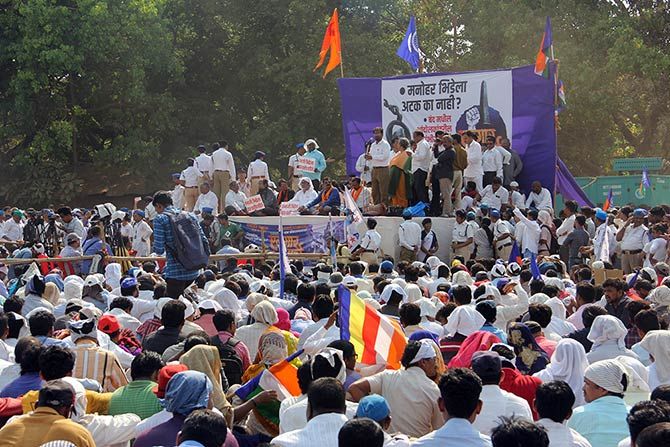
Civil society is unfortunately very fragmented and small to raise issues of this magnitude. It is only when mass movements are started that these problems can be addressed -- like the farmers' agitation, which forced the government to withdraw those laws.
That kind of resistance and protest doesn't happen on a large scale on these issues because nobody really cares.
Everyone thinks, 'I'm not going to be arrested, so why should I bother? Let somebody else be arrested and spend 5, 10, or 15 years in jail, and maybe become innocent after 15 years.'
This kind of consciousness is not present in society unless political parties take these issues to people at large.
Society has a limited role. People like me can only speak to a small audience through social media or newspaper articles. Political parties have a large base -- they should take these issues to people. But they are not interested. They don't even understand these issues. They're only interested in small things.
Is the judiciary doing enough to preserve democratic space in the face of such laws?
Part of the judiciary is definitely doing more than enough. They are trying to maintain serious checks and balances on the executive and legislature. This part of the judiciary is also trying to protect citizens and their fundamental and Constitutional rights.
But there is another part of the judiciary that is unable to do this. They cannot see through this game plan. The judiciary needs sensitisation across the board, from the lowest to the highest levels, including the Supreme Court.
Unless judges are sensitised about problems faced by people, especially weaker sections of society, minority communities, the opposition, critics, and women, they cannot fulfill their role properly. This sensitisation must take place.
When judicial appointments are made, whether at the lowest or highest level, the sensitivity of the individual being appointed -- whether man or woman -- is never taken into consideration. Nobody checks whether, as a lawyer, they were sensitive to problems of democracy, problems of people, problems of weaker sections, minorities, women, etc.
This aspect is completely lost while making appointments from the lowest to the highest echelons of the judiciary. This is reflected in their decision-making -- they remain oblivious to these problems.







 © 2026