

'The BJP will win comfortably if the Congress and AAP fight separately -- though not with 162 seats.'
'But if they form an alliance, it will become a major problem for the BJP. That's precisely why this expansion is happening now.'

Senior Gujarat journalist Bhargav Parikh tells Prasanna D Zore/Rediff that the Bharatiya Janata Party's ministry expansion reveals vulnerability -- using ministerial insecurity as a compliance tool to deflect anti-incumbency before elections.
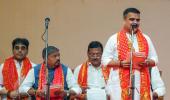
Gujarat Chief Minister Bhupendra Patel's ministry expansion/reshuffle on Friday, October 17, 2025, adding 19 fresh faces as ministers to take the total from 16 to 27 (six from the earlier ministry have been retained), follows a well-worn BJP strategy deployed since 2005, according to Mr. Parikh.
The reshuffle, executed nearly two-and-a-half years before the next assembly elections, mirrors a pattern established during Narendra Modi's tenure as Gujarat chief minister -- changing ministerial faces to deflect anti-incumbency sentiment.
Mr. Parikh argues that after 28 years of uninterrupted BJP rule, Gujarat faces significant challenges: Farmer distress, student unrest, unemployment, and reservation disputes.
The expansion, he suggests, is less about governance and more about political management -- distributing power among 162 MLAs while maintaining central control from Delhi.
The reshuffle has given prominence to Saurashtra region, which remains crucial for the BJP's electoral fortunes, with eight to nine ministers from the electorally crucial region.
Deputy Chief Minister Harsh Sanghavi's elevation at 40 reflects his command over western Gujarat, particularly Surat, which proved decisive in 2017 when the BJP's seat count dropped to 99, Mr. Parikh reckons.
With anti-BJP votes consolidating around the Congress (27.8%) and AAP (12.92%) in the 2022 assembly election, Mr. Parikh believes the BJP's 28 year dominance in Gujarat faces its strongest test yet -- unless the Opposition remains divided.
As someone who has observed Gujarat politics from close quarters, how do you view this ministry reshuffle? What does it reveal about the BJP's current political position in Gujarat?
This is a continuation of a well-established pattern. Ministry reshuffles have been happening every two-and-a-half years in Gujarat since 2005, typically before general elections, assembly elections or local body polls.
Even during Narendra Modi's tenure as chief minister, this was standard practice. The first major expansion happened in June 2005 after the BJP lost six municipal corporation seats. That was also when Gordhan Zadaphia refused to take the oath -- the first major internal revolt within the Gujarat BJP.
Before the 2009 Lok Sabha elections, Modi expanded his ministry in 2008. Before the 2012 assembly elections, another expansion in 2011. Before 2014, six new ministers were inducted in 2013. This is not new; it's the BJP's established formula for Gujarat.
Does this indicate anti-incumbency sentiment in Gujarat?
Obviously, there's anti-incumbency. You've been in power for 28 years -- how can there not be?
Farmers are unhappy, students are agitated, unemployment is a massive problem. These aren't minor issues. The anti-incumbency is real and visible on the ground.
If the issues remain constant -- farmers, students, jobs -- how does merely changing ministerial faces help the BJP win elections repeatedly?
It's clever political management. They tell voters: 'You have a problem with a particular minister, not with us. We're removing him. Look at Modi -- you don't have any problem with Modi, right?'
It's what scholars call the 'no-repeat theory.' They're essentially hoodwinking voters by shifting blame to individual ministers while projecting Modi as above the fray.
Does this reshuffle represent continuity of the BJP's Gujarat model, or does it hint at insecurity?
The BJP isn't insecure in the conventional sense -- they have 162 MLAs, the highest number since Independence when you account for independents who've joined them after the result. But managing 162 MLAs is extremely difficult.
Everyone has aspirations. Chief Minister Bhupendra Patel was running the government with just 16 ministers when the rules allow 27. That's untenable.
The same situation occurred in 1985 under Madhavsinh Solanki, who had 149 MLAs. Everyone wanted positions; when they didn't get them, revolts erupted. History is repeating itself.
Could we see a revolt within the Gujarat BJP given these massive numbers?
Where would they go? Look at why Congress MLAs keep joining the BJP -- it's not just about money. I know many Congress leaders with substantial personal wealth. The real issue is age and opportunity. Many are approaching 60-61. If they wait for the Congress to win, they'll be 65 before getting power -- and that's far from certain.
It's human nature. The same applies here. About 30% of those switching parties are driven by the desire to be in power during their active political years.
What's significant about the composition of the new 27-member ministry?
Caste remains crucial -- they've balanced it with eight OBCs, three SCs, and four STs. But the real story is Saurashtra. The BJP has consolidated power there with eight to nine ministers from the region.
Saurashtra has emerged as critical for the BJP -- it was their easy route to Gandhinagar. In the new ministry, nearly one-third are from Saurashtra, even though the chief minister is from Ahmedabad.
To what extent is this exercise about Modi-Shah centralising authority versus preparing a second line of leadership?
They are not preparing a second line -- that's the biggest problem. They need people who will say 'yes,' nothing else. They need yes men.
If they wanted strong second-rung leadership, they could have elevated leaders like Dileep Sanghani or others with genuine grassroots support. It's about compliance, not capability.
How does this reflect Modi-Shah's control over Gujarat?
Understand the economics first. Which states are India's money bags? Gujarat, Maharashtra, Rajasthan, Madhya Pradesh. These are the states with resources. Every party needs control over these states -- the Congress did too when they were in power.
Gujarat is too valuable to leave to autonomous regional leadership.
Is this reshuffle a sign of the BJP weakness in Gujarat?
It's a response to anti-incumbency -- that itself indicates vulnerability. They are not continuing ministers for full five-year terms. Very few are carried through. This creates constant insecurity.
When your boss constantly threatens to fire you, you become a yes man. Same principle applies here.
The message the BJP sent in 2021-2022 by changing entire ministries including chief ministers in four states has percolated everywhere: Nobody knows if they'll be in the cabinet tomorrow, or remain a minister, or even be an MLA after five years. That sword of uncertainty keeps everyone compliant.
Will this sword hang over the new ministers too?
Absolutely. For the next two years, if they do 'something fishy,' they'll be kicked out citing health issues or other reasons. The insecurity is institutional.
What's significant about Harsh Sanghavi's rise to deputy chief minister at just 40?

This isn't unprecedented. Narhari Amin was similarly young as deputy CM in 1993-1994. When Harsh Sanghavi became home minister, he was 36; Amin was 38.
Sanghavi has won three consecutive terms.
In 2017, if he hadn't performed exceptionally, the BJP might have lost power in Gujarat. They were stuck at 99 seats -- the victory came from Surat and surrounding areas where Sanghavi has strong command. He's being rewarded for delivering when it mattered most.
Do you see Harsh Sanghavi as the next chief ministerial face?
I don't think so. Nobody can predict the BJP's next move -- that's their operational model.
AAP is making inroads in Gujarat. How do you assess their urban middle-class appeal?
The AAP's emergence as a strong political force in Gujarat is a big myth. Look at the data carefully. In the last election, AAP contested 171 seats and lost deposits in over 100. They have a strong presence in only 30-35 seats, mostly in Saurashtra and Surat.
Why Surat? Because large numbers from Saurashtra have migrated there. The same applies to Ahmedabad. Saurashtra connectivity is the formula for success in Gujarat politics -- control Saurashtra, and you win in Surat and make gains in Ahmedabad.
Who is the BJP more afraid of -- AAP or the Congress?
AAP is targeting the 35-36 core BJP seats, which were previously Congress seats. That's why the BJP won't repeat its 162-seat performance. Its numbers will decline, and everyone will say the system is weakening.
But look at the arithmetic: In 2017, anti-BJP votes totalled 41.7% (Congress' vote share), and the BJP won just 99 seats.
In 2022, anti-BJP votes were Congress (27.8%) plus AAP (12.92%) plus others, totalling approximately 41.3% -- almost the same percentage. But this time, vote division gave the BJP 156 seats.
The BJP is not popular; there's a huge anti-BJP vote in Gujarat but the Opposition is divided.
Are Congress votes loyal Congress votes or anti-BJP votes?
They are loyal Congress votes. If AAP had genuine mass appeal, why would they lose deposits in over 100 out of 171 contested seats? That's simple logic.
If AAP wins 15 to 17 out of their target 35 seats, they'll have real bargaining power. They know how to engage with rural populations, how to mobilise in villages -- that's their strength and the Congress' weakness. That's why the Congress vote bank is gradually shifting to AAP.
What's the BJP's ideal scenario for 2027?
The BJP will win comfortably if the Congress and AAP fight separately -- though not with 162 seats. But if they form an alliance, it will become a major problem for the BJP. That's precisely why this expansion is happening now.
It's simple political logic -- prepare early, manage anti-incumbency, and hope the Opposition remains fragmented.
So the BJP is on shaky ground in Gujarat?
Yes, to the extent that they are having to deploy these tactics to counter anti-incumbency after 28 years.
The anti-incumbency is real, it's visible, and it's forcing BJP to constantly reshuffle and manage perceptions. They have been doing this since 2005.
The ground reality shows strain, even if the electoral outcomes haven't reflected it yet -- primarily because the Opposition remains divided.
Photographs curated by Manisha Kotian/Rediff








 © 2026