
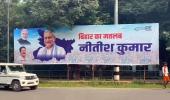
'This election was won because of Nitish Kumar's face and his policies.'

"The lion's share of credit goes to Nitish Kumar, along with the BJP's field management and Prime Minister Modi's brand," says Dr Kartikeya Batra, assistant professor at the Azim Premji University and a Visiting Fellow at the CVoter Foundation.
Dr Batra holds a PhD in economics from the University of Maryland (College Park) and a master's in international affairs and policy from the Fletcher School at Tufts University.
One of the most incisive commentators of this election, he spent time in Bihar during the campaign. In a two-part interview to Rediff's Archana Masih , he discusses the reasons for the NDA sweep, the AGC (Age Caste Gender) Effect and why Nitish Babu is a hero with a formidable legacy.
What are your primary takeaways from this verdict?
Nitish Kumar and the BJP have swept. It's a sweep for the NDA across regions -- and a rout for the Mahagathbandhan with no saving grace.
Even in Seemanchal where the demography would have favoured the Mahagatbandhan, the AIMIM has done well.
It is a repeat of the 2010 election. The scenario changed in 2015 because the RJD (Rashtriya Janata Dal) and JD-U (Janata Dal-United) fought the election together.
People often misread and misanalyse the 2020 election because they look only at the aggregate vote shares. The vote share of both alliances were very close -- about 37.2% each. But if you look at the alliances in today's context, the Mahagathbandhan actually began with a 4 percentage point deficit.
Not only did they fail to close that gap, the gap has now widened.
The Mahagathbandhan might still end up at about 38% while the NDA appears to have gained immensely to 47%-48%.
In terms of vote share, this is fundamentally an election in which the NDA gained. The lion's share of credit goes to Nitish Kumar along with the BJP's field management and the Prime Minister Modi's brand.
But largely, it's an election won because of Nitish Kumar's face and his policies.

Can you expand on that thought about why you think this is Nitish Kumar's victory?
After 2005, Nitish Kumar very carefully cultivated a vote bank for himself. This vote bank was not his own caste; it was not his own gender.
It was the Extremely Backward Castes, Mahadalits and women.
He took three leaderless groups in Bihar, and became their leader.
Nitish Kumar's own caste [Kurmi] is 2.5 per cent. We all know caste is an important factor in Bihar. Caste politics was way more relevant back then, than today -- and Nitish Kumar built a political base almost entirely outside his caste.
Even if you symbolically add the Koeri caste, you get to only 7%. A leader of a 7% caste bloc can't aspire to be chief minister on caste arithmetic alone.
The composition of three largely leaderless groups were:
EBCs: About 36% of the population (Hindus: 27-28%; the rest Muslim EBCs). These are very small caste groups -- Nonia, Chandravanshi, Bind, Mallah, Chaurasia. Nitish executed a bunch of policies for them.
Mahadalits: He carved out this category, separating them from the Paswan community (about 5%, with late Ram Vilas Paswan as their leader). He argued they needed special attention and built a set of welfare schemes around them.
Women: His biggest and most durable investment. He cultivated them very carefully providing cycles and uniforms for girls, alcohol prohibition, reservations for women in panchayats, recruiting more female police personnel.
Once he came to power, the first few things he did was constructing roads, improving law and order and electricity. These were visible changes, low-hanging fruits, but the fear of the Yadav Raj was such that middle-aged people, 35+, are still thankful.
These women remember the contrast with the Lalu era. These groups -- EBCs, Mahadalits and women -- were the most vulnerable during the Lalu-Rabri era, far more than upper castes who had the wherewithal to overcome this suffering.
This is why Nitish's governance record still carries emotional weight for the 35+ generation.
In this election, there was anxiety that the BJP might sideline Nitish as CM or that his ill-health might cost him. That seems to have produced a consolidated vote for him, which also benefited the BJP and LJP (Chirag Paswan's Lok Janshakti Party).
Interestingly, women voters are almost party-agnostic.
There was some doubt on the ground that the BJP may suffer because of poor ticket distribution and a general sense of fatigue amongst voters, but the BJP's own field management along with Nitish Kumar's goodwill, especially among women triumphed.
Women see Nitish Kumar even in the party symbol of the other parties that constitute the NDA alliance -- lotus, helicopter, teer-dhanush, cylinder, kadhai.
They saw him everywhere.
Men care more about candidate selection, outsider versus insider tag, and ticket distribution, but women ignore all this.
For them, Nitish represents safety, welfare and continuity, and Modi represents ration and housing.
This combined appeal was formidable and I won't be surprised if eventually we observe that even some Yadav and Muslim women voted for them.
We even saw this cross-cutting effect in communities like the Mallahs. Male Mallahs shifted to the Mahagathbandhan for reasons of caste or hopes of jobs. Female Mallahs stayed with Nitish.
Basically, Nitish Kumar has blocked 50% of the core women vote and reduced the scope of expansion beyond the Muslim-Yadav base for Tejashwi.
This is why I call this election the AGC effect -- Age, Gender, Caste.
People will play up the narrative of Rs 10,000 disbursed by Nitish Kumar under the rozgar yojana for women just before the election. It was an important factor which oiled a machine that had been set up 15 years back.
If you did not have that machine to begin with, you would not have been able to oil it.
Nitish built a maternal welfare state over the last 10 to 15 years -- and the latest Rs 10,000 scheme further mobilised women voters.

So the hero of the verdict is Nitish Kumar?
Absolutely, I have no doubt about it -- and this is not because of the Rs 10,000 scheme to women or his governance record in the last 5 years.
He is basically the Amitabh Bachchan of Bihar politics. He has built a brand over time.
Why do people love Amitabh Bachchan? It is because of his legacy -- and his latest movie is another reason to love him.
Nitish Kumar has firmly secured his place in history.
Feature Presentation: Aslam Hunani/Rediff








 © 2025