

'...the electoral playing field is tilted significantly in its favour.'
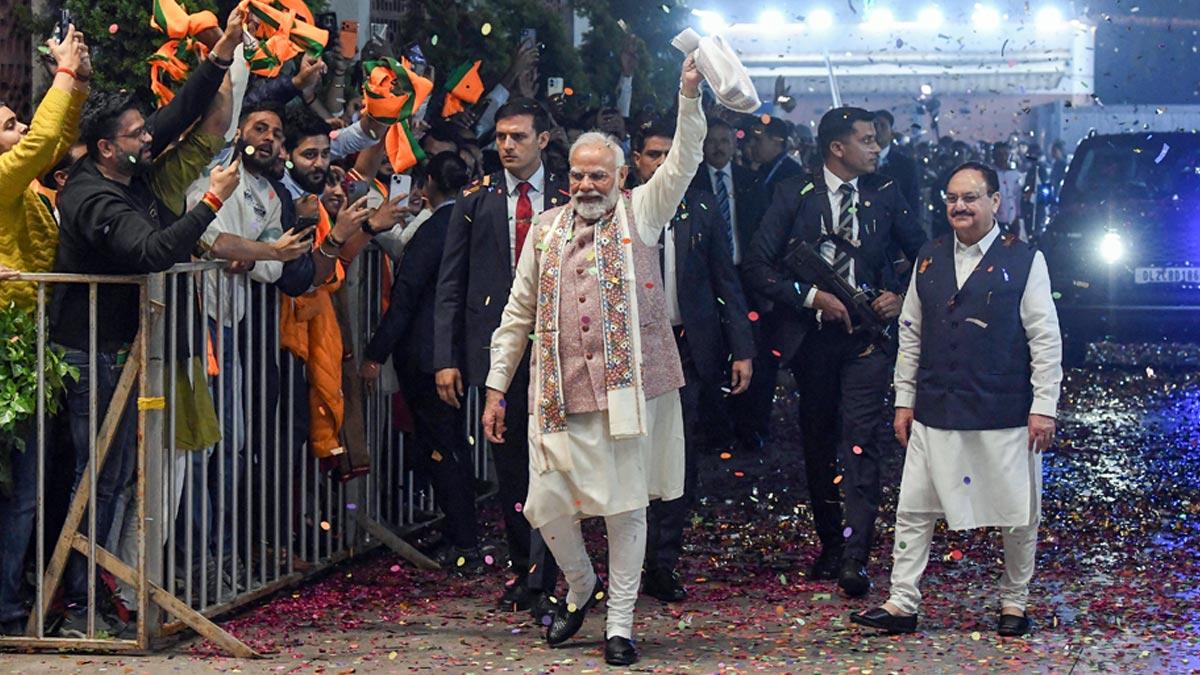
Unbelievable. Unprecedented. Unmatched.
Just some of the adjectives used to describe the Bihar assembly election results by those who crisscrossed the state trying to sense the mood of its people.
"Political momentum must be carefully cultivated, and a strong organisation coupled with a clear, compelling narrative is crucial for electoral success. The Opposition lacked both," Zoya Hasan, the eminent political scientist and Professor Emerita, Centre for Political Studies, Jawaharlal Nehru University, tells Rediff's Shobha Warrier.
An unemployment rate of 9.6%, above the national average of 6.9%. 33% of the population below the poverty line compared to the 0.55% in Kerala. 57 lakh Biharis migrate for work outside the state.
Still, the incumbent chief minister is re-elected. Were you surprised by the Bihar assembly results?
Yes, I am surprised by the Bihar results, which were completely unforeseen.
All poll surveys predicted the NDA to win, but even they did not predict a mandate of this scale.
The NDA winning 202 seats out of 243 seats despite no substantial improvement in jobs, education, healthcare, or law and order, is unexpected and astounding.
It shows how factors beyond governance performance shaped the outcome: Targeted cash transfers to women, wider social caste coalitions, Nitish Kumar's late surge in sympathy, and accusations against the Rashtriya Janata Dal of 'jungle raj' -- all worked together to produce a result far bigger than anticipated.
The election disrupted traditional caste-based calculations and highlighted the Opposition's strategic and tactical weaknesses.
Political momentum must be carefully cultivated, and a strong organisation coupled with a clear, compelling narrative is crucial for electoral success. The Opposition lacked both.
Do you think the Rs 10,000 bank deposit promised to poor women was the main reason for this unprecedented result? The freebie culture.
The same prime minister who criticised revadi culture approves of it during the elections....
Yes, the direct benefit schemes for women and the distribution of Rs 10,000 during the election campaign had a major impact on women voters gravitating towards the NDA and the JD-U.
The Mukhyamantri Mahila Rojgar Yojana was announced on September 25, and the first transfer covering 75 lakh women was made on September 26, before the Model Code of Conduct came into force.
However, subsequent disbursements continued into October, after the MCC had been imposed.
Opposition parties formally challenged this as a violation, but the Election Commission did not intervene, citing the scheme as 'ongoing'.
Even if it did not technically breach the MCC, the timing of the transfers was ethically questionable.
The scheme, described by many critics as effectively a 'bribe', proved to be a major draw, and it played a decisive role in the NDA's sweeping victory without any questions asked. This is a key issue in the Bihar election.
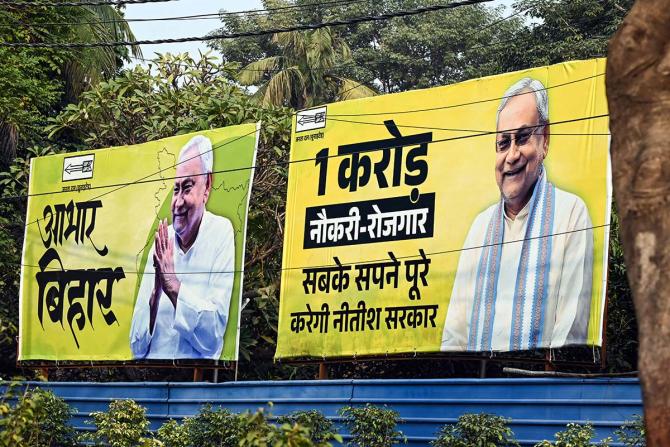
This time, the BJP did not talk of Hindutva in Bihar. Do you think instead of consolidating Hindu votes, they consolidated women's votes with the Rs 10,000?
There was no overt Hindutva talk in this election. Instead, the NDA consolidated the women's vote through the Rs 10,000 cash transfers, but its landslide victory cannot be explained by this alone.
Undoubtedly, the phased cash transfers that overlapped with the poll process created a sustained perception of direct economic benefit.
Second, electoral roll revisions and deletions undertaken by the ECI had their own impact.
Third, the NDA succeeded in forging a broader social-caste coalition than the Mahagathbandhan, whose support remained largely confined to a Muslim-Yadav base.
The RJD was seen over-allocating tickets to its core constituents instead of widening its social outreach.
Unlike the Samajwadi Party in UP, which expanded its social coalition in the 2024 Lok Sabha elections, the RJD failed to move beyond the Muslim-Yadav combination.
Also, the Opposition parties, especially the Congress, gave disproportionate attention to allegations of 'vote chori', rather than focusing on substantive issues such as livelihood and employment.
Trains overflowing with Biharis from Tamil Nadu, Kerala and Karnataka went to Bihar to vote.
Opposition parties rightly called out the BJP for ferrying voters on sponsored trains.
But the EC overlooked these complaints, ignoring allegations of the BJP paying for out of the state voters to travel to Bihar on special trains
The election's timing just after Chhath Puja seems to have played a part in the process.
Modi and Nitish Kumar reminded people of 'jungle raj', which Bihar was under Lalu Prasad Yadav. Do you think it had an impact?
Yes, the 'jungle raj' narrative and the fear of its return played a major role in consolidating voters behind the NDA.
Tejashwi Yadav struggled to counter this framing, something Akhilesh Yadav managed more successfully in Uttar Pradesh.
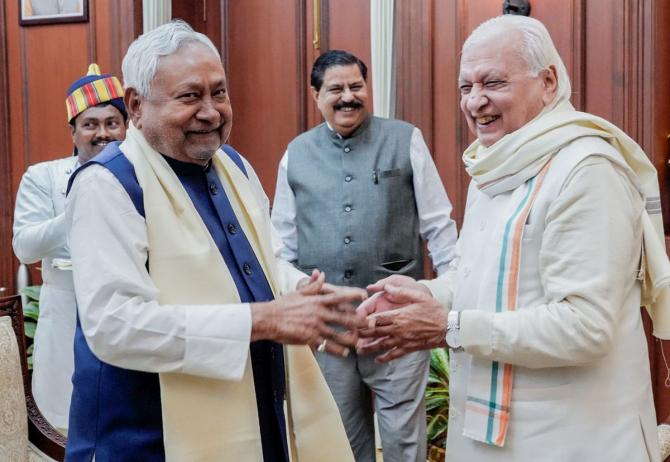
Do you feel the BJP is undefeatable and unstoppable in northern India? What is it that makes the BJP undefeatable?
The BJP is not undefeatable in north India, but the electoral playing field is tilted significantly in its favour.
A level playing field in any election depends on both the resources available to competing parties and the conduct of key institutions.
The combination of funds raised through electoral bonds, and the use of public money to deliver benefits during elections contributed to an uneven electoral landscape.
In addition, the patterns of electoral manipulation from voter deletions to selective additions and to biases in the functioning of the Election Commission place the Opposition at a further structural disadvantage.
The importance of institutional independence and a level playing field cannot be overstated.
What kind of impact will the Bihar election results have on the national political scene?
The Bihar election results are likely to have significant implications for the national political landscape.
For the BJP, the outcome reinforces its dominance in the Hindi heartland and provides a strategic platform to expand into Bengal and the southern states, which have so far been more challenging to penetrate.
The results are even more consequential for the Opposition. The alliance of the RJD, Congress and the Left parties suffered huge setbacks, underscoring the need to rethink their strategy and emphasising the critical importance of unity.
Although the RJD secured the largest vote share, it failed to convert this into seats due to poor seat-sharing arrangements and vote-splitting.
After the Bihar debacle, the Congress faces its greatest challenge, as the party won just six out of the 61 seats it contested.
The Congress is struggling to balance its social justice agenda with allegations of electoral manipulation. As of now, the disconnect between the two has weakened its message.
Voters may perceive the claims of vote theft as insufficiently substantiated and somewhat disconnected from their lived realities.
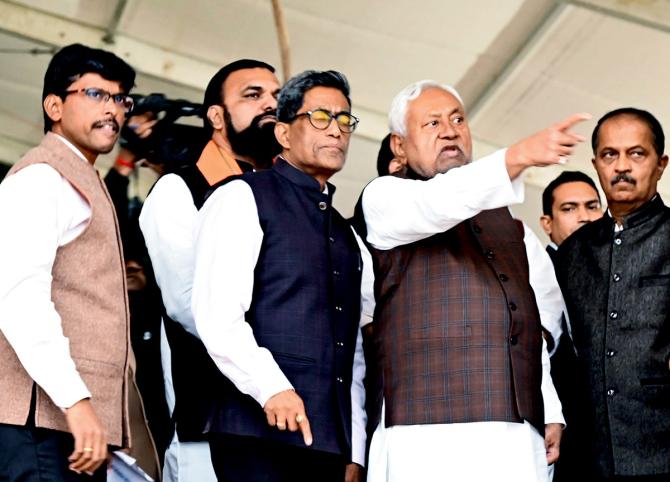
This is a massive sweep by the NDA. Would you call it a pro-Nitish Kumar vote?
This was a massive sweep, typically seen during a wave, but such a wave went unnoticed by the hundreds of media personnel and activists who had been reporting and working in Bihar over the past few months.
The mandate is undoubtedly a vote for Nitish Kumar.
In fact, the BJP's hesitation to project him as the chief ministerial candidate appears to have triggered a late surge of support, even a sympathy wave, among voters who felt he was being side-lined.
What do you think Nitish Kumar did that gave him such a mandate? Other than the freebies.
The NDA's victory reflects Nitish Kumar's enduring influence over the Bihar electorate, rooted not just in material incentives or freebies but in his image as a non-polarising, pragmatic leader.
Despite his frequent shifts in political alliances, he is widely perceived as someone who prioritises governance and development.
Voters seem to value his ability to maintain relative stability and deliver on developmental promises, which reinforces trust in his leadership beyond short-term social policy measures.
In a capitalist, Islamophobic America, an unapologetic Muslim and a socialist called Zohran Mamdani could win the prestigious New York mayoral election by promising solutions to the problems people of the city face.
How do you compare this with the Bihar election?
Zohran Mamdani won the New York mayoral race, the richest city in the world's wealthiest country, on a platform focused on affordability, free public transport, and a democratic-socialist vision aimed at inclusivity.
In stark contrast, Bihar was won by the wealthiest party in one of the country's poorest states.
This paradox highlights a key feature of contemporary Indian politics: Material deprivation does not automatically translate into support for parties advocating economic redistribution.
Instead, voter behaviour is shaped by a mix of cash transfers, identity politics, narrative framing, and perceptions of stability and security.
Feature Presentation: Aslam Hunani/Rediff







 © 2026