
'Our politics is transparent -- it's about ensuring farmers don't die by suicide, about ensuring agriculture remains viable, about ensuring food security for the nation.'
'If that's politics, then yes, we do politics.'
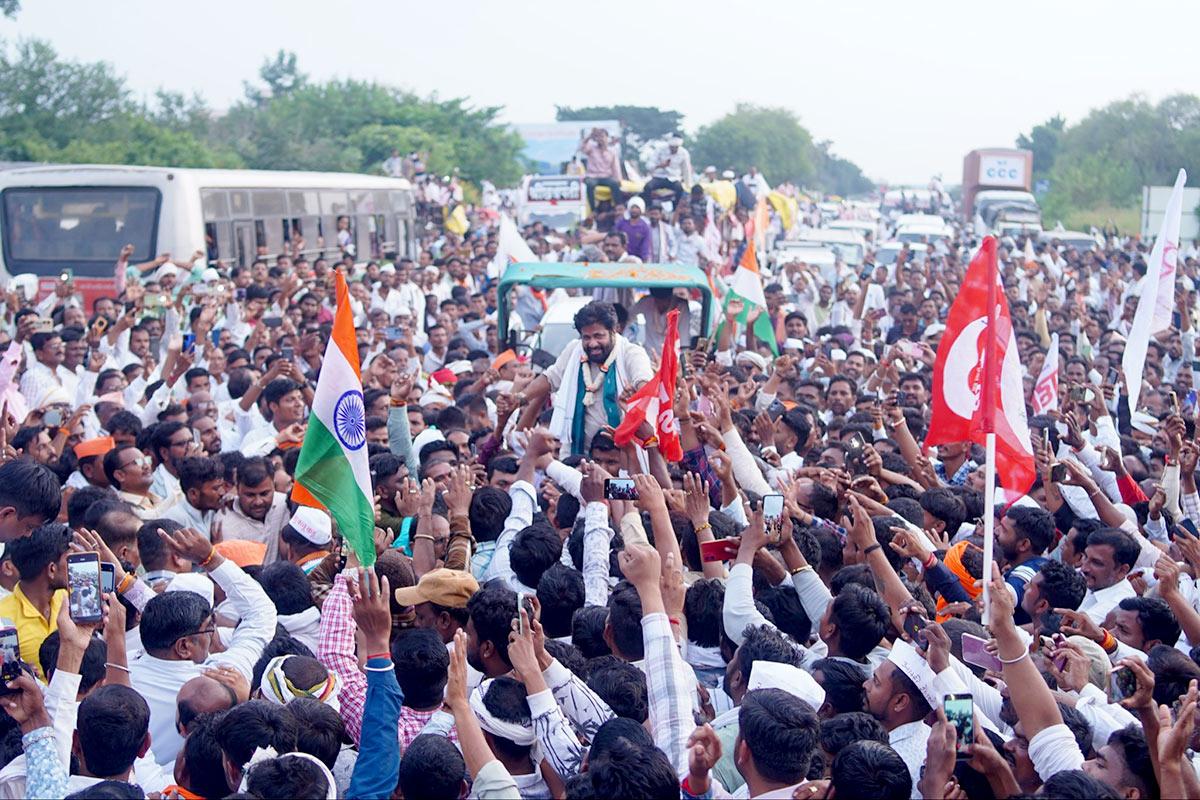
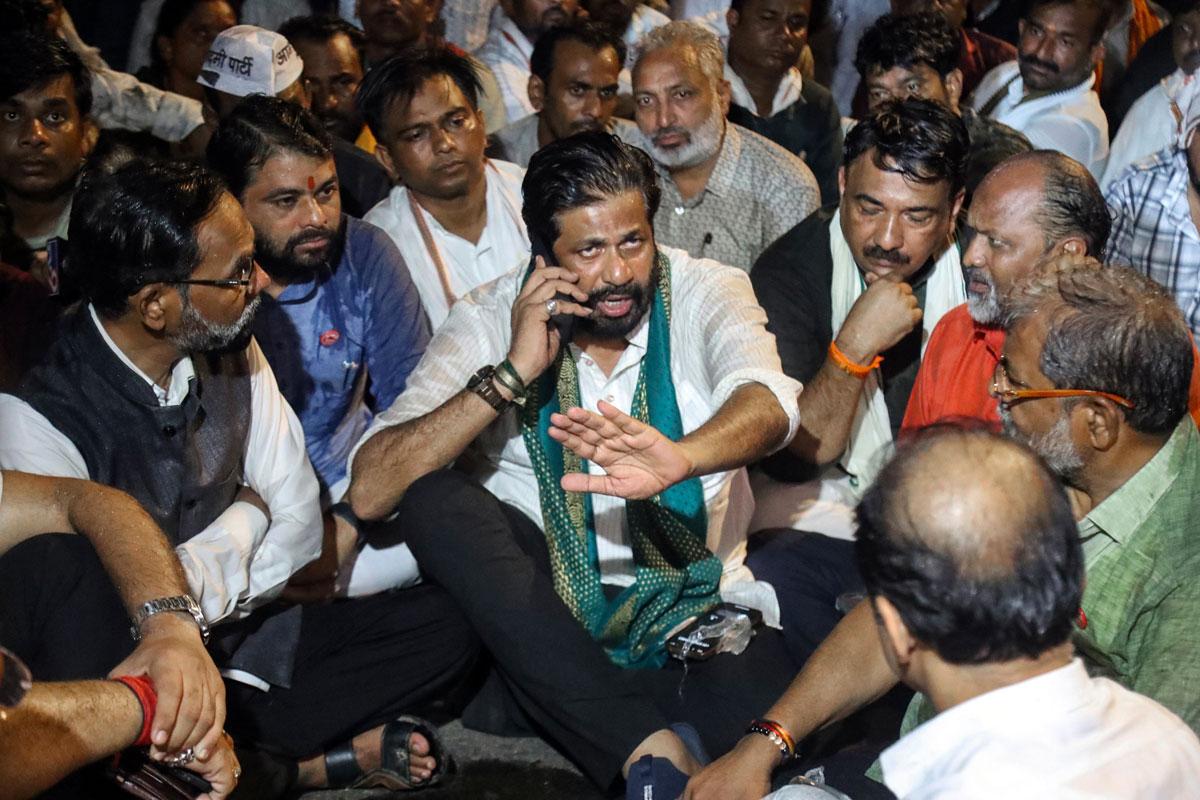
Former Maharashtra minister of state Omprakash alias Bachchu Kadu has emerged as an unlikely but powerful voice in Maharashtra's escalating agrarian crisis.
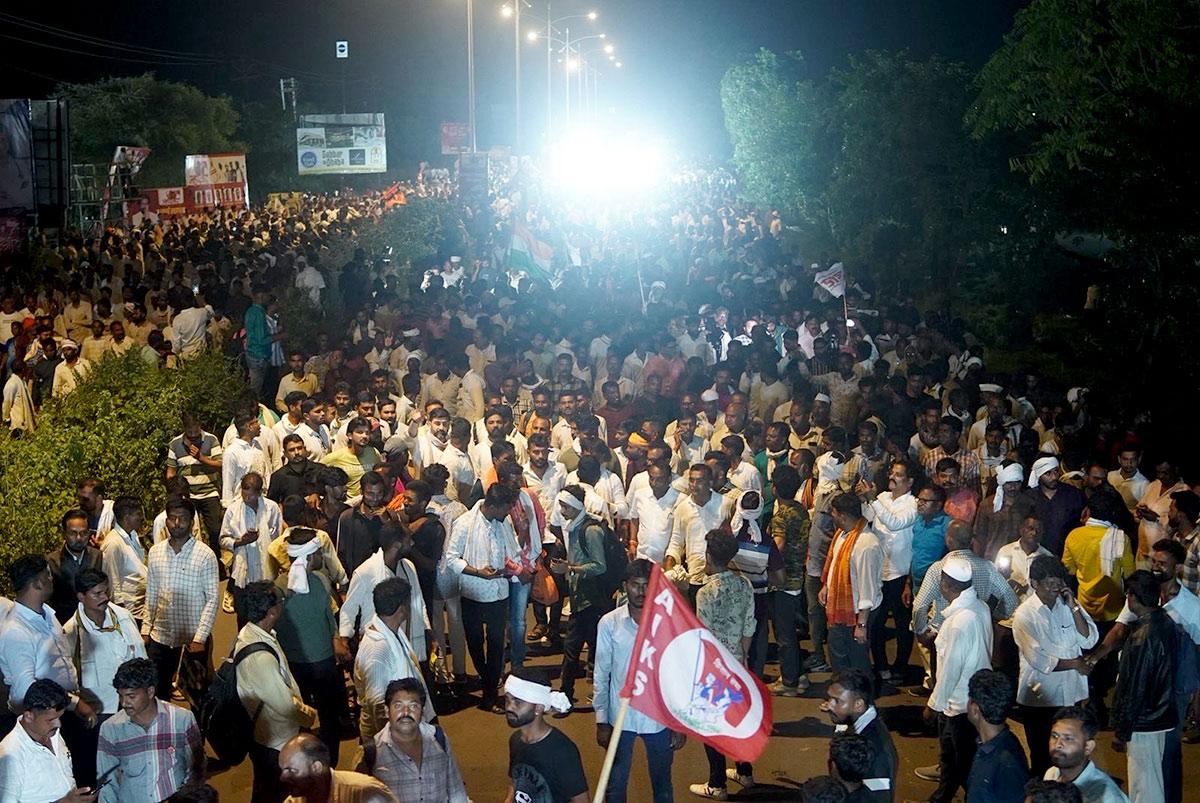
The Amravati-based politician, who has reinvented himself as a grassroots farmer leader, recently led the Maha Elgar Morcha -- a massive farmers' protest that blocked the Nagpur-Hyderabad National Highway (NH-44) for two days, bringing traffic to a standstill and forcing the state government to the negotiating table.
The agitation, which united farmers across caste and community lines, demanded immediate relief measures including a revision of cotton's minimum support price from Rs 8,000 to Rs 11,000 per quintal, operationalisation of procurement centres, and reduction in cultivation costs through guaranteed wage schemes.
The protest gained national attention when the Bombay high court took suo motu cognisance of the highway blockade and directed protesters to vacate the premises.
Kadu and his coalition -- comprising the Prahar Sanghatana, veteran leader Raju Shetti and former MLA Wamanrao Chatap's Swatantra Bharat Paksha -- tells Prasanna D Zore/Rediff that though he has complied with the order of the high court's orders by shifting the protest to nearby grounds, he has vowed to intensify the movement if the state government fails to deliver concrete, time-bound solutions to address Maharashtra's deepening farm distress.
Do you feel the agrarian crisis in Maharashtra has reached critical proportions? Your primary demands focus on reducing the cost of cultivation.
Could you elaborate on the specific policy changes you seek, particularly concerning the inclusion of all farm labour -- from sowing (perni) to harvesting (kapni) -- under a guaranteed wage scheme?
The agrarian crisis is Maharashtra is really serious and one can see it across different regions of Maharashtra.
Our core demand is the immediate reduction of the cost of production (utpadan kharcha). This requires all agricultural labour -- from sowing to harvesting -- to be brought under a guaranteed wage framework.
We propose that the labour component be covered under the MRHS (a state-specific or enhanced employment scheme) or a similar state-enhanced employment scheme.
This is crucial because the farmer's cost of input is escalating dramatically, nullifying any potential profit. When input costs rise but output prices remain stagnant or fall, the farmer is caught in an impossible squeeze.
A clear, comprehensive policy on cost reduction is an urgent necessity -- not just for individual farmers, but for the survival of agriculture in Maharashtra.
On the issue of Minimum Support Price (MSP), you've highlighted a significant disparity between your recommendation and the government's announcement. What was your recommended MSP for cotton (kapas), and what was the price declared by the central government?
We recommended a price of Rs 11,000 per quintal for cotton based on careful analysis of production costs, market trends, and fair compensation for farmers' labour. However, the central government announced only Rs 8,000 per quintal.
This Rs 3,000 gap is not just a number -- it represents the difference between survival and bankruptcy for thousands of cotton farmers.
We firmly demand an immediate correction to bridge this gap, ensuring the farmer receives a price commensurate with their investment and labour. Without this correction, we're essentially asking farmers to sell at a loss.
You emphasised the need for immediate action on procurement infrastructure. What is the status of the requested procurement centres (kharedi kendra), and what specific action are you seeking from the government?
We need the government to immediately open and operationalise all necessary procurement centres across cotton-growing regions. This is a prerequisite for ensuring farmers get a fair price for their produce, especially those affected by unseasonal rains and low market rates.
Even if the government announces an MSP, what good is it if there's no mechanism to purchase crops at that price?
Farmers are forced to sell to private traders at exploitative rates because government procurement infrastructure is either non-existent or non-functional. This must change immediately.
Your Maha Elgar Morcha was a powerful display of unity, but it involved blocking the Nagpur-Hyderabad National Highway (NH-44). We understand this caused significant public inconvenience.
Do you believe the collective inconvenience was a necessary means to ensure the farmers' voice reached the government?
While we sincerely regret the inconvenience caused -- which was only for a couple of days -- the trouble faced by the farmer is a perennial one. It impacts their entire future, their children's education, their family's survival.
The temporary disruption was necessary to amplify an issue that has been ignored for far too long.
We don't take the decision to block a national highway lightly. But when all other avenues -- representations, petitions, peaceful protests -- are exhausted, what choice do farmers have?
The success is that the agitation effectively delivered the farmers' message to the government. Sometimes, disruption is the only language power understands.
Do you believe the Maha Elgar Morcha successfully transcended caste and community lines, uniting farmers purely on agrarian issues?
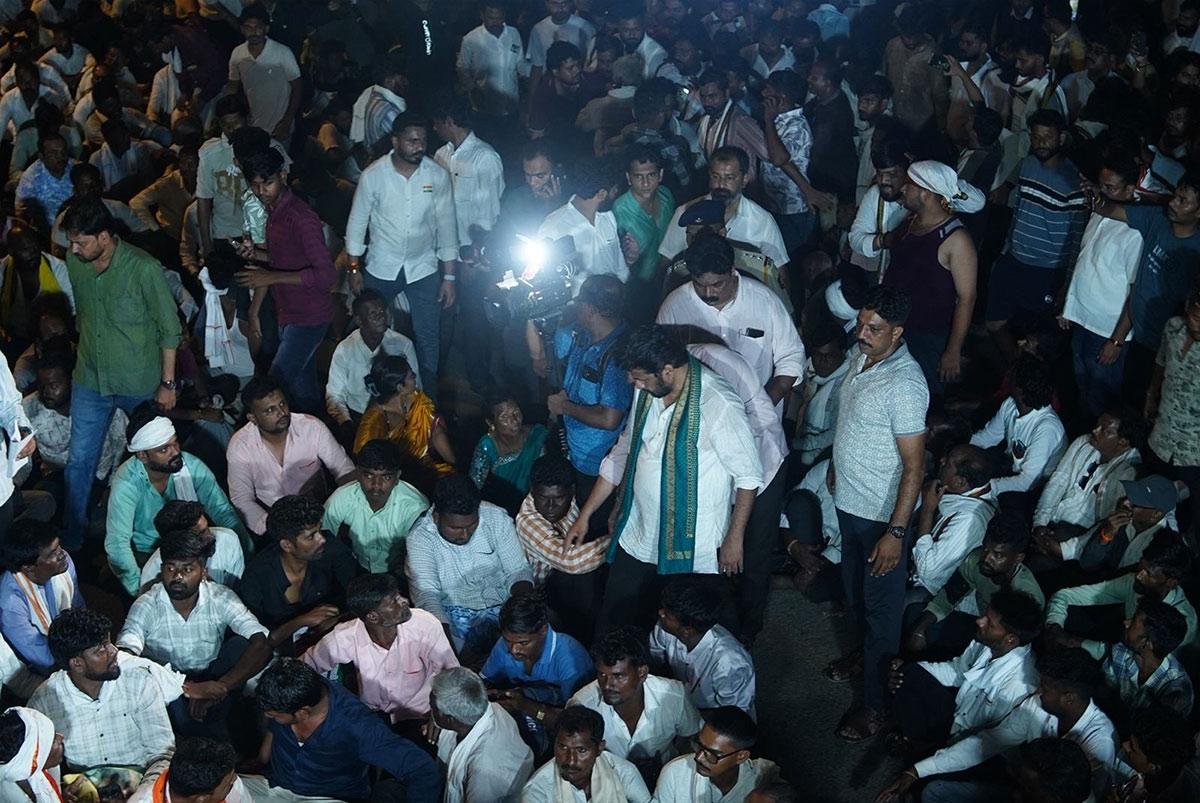
Absolutely. Despite the current atmosphere dominated by caste dynamics -- such as the OBC versus Maratha narrative that often divides us -- the collective distress of the farmer served as a powerful unifying factor.
When a farmer commits suicide, it doesn't matter if he's Maratha, OBC, Dalit, or Muslim. His family suffers the same way. His children go hungry the same way.
This unity we've achieved has provided immense moral strength to the community, particularly to those contemplating suicide. They now see that someone is fighting for them, that they are not alone. This collective strength is perhaps our greatest achievement.
What was the exact message you wanted to convey to the farmers and the people of Maharashtra through the name Maha Elgar Morcha? What does 'Elgar' represent?
'Elgar' means a united roar -- a loud, collective proclamation that cannot be ignored. The name represents our belief that only when the people unite and raise their voice together can they shake the foundations of an indifferent system.
The question isn't whether the government is rigid -- it's whether the people are rigid, whether they have the strength to stand firm on their demands. The Maha Elgar Morcha is that collective roar of Maharashtra's farmers saying: We will not be silenced, we will not be ignored, and we will not back down until justice is served.
Do you believe that past farm loan waiver schemes in Maharashtra have repeatedly failed to provide lasting relief. In your assessment, where does the greatest systemic failure lie in these debt relief policies?
The greatest failure is that these schemes only treat the symptom, not the underlying cause.
A loan waiver removes current debt, but the system fails to provide the subsequent two years of necessary support -- working capital, guaranteed prices, input subsidies -- to prevent the farmer from immediately falling back into debt.
It's like treating a patient for severe illness and then immediately discharging them without nutrition, medicine, or follow-up care. They'll fall sick again. That's exactly what happens with loan waivers.
The farmer is debt-free for a few months, then has to take another loan for the next season, and the cycle continues.
You proposed an alternative model, citing the Karnataka government's debt-free commission. How would establishing a similar commission in Maharashtra offer a more robust and sustainable solution?
A debt-free Commission would fundamentally change how we approach farm debt. Instead of blanket waivers that often benefit those who don't need it while missing those who do, this commission would allow genuinely distressed farmers to apply for debt relief directly.
The commission would verify the farmer's financial crisis -- examine their landholding, family situation, crop failures, medical emergencies -- before recommending the loan for waiver. The loan would be treated like a court case until the commission determines if the farmer is genuinely in trouble.
This mechanism provides a transparent, legally sound, and needs-based solution, ensuring relief reaches the most deserving individuals. It's targeted, fair, and sustainable.
Critics often allege that farmer movements are politically motivated, that leaders like yourself engage in politics by invoking caste and religion, or that there are financial motivations. How do you respond to such allegations?
We say that politics should be based on issues of farming. Yes, politics should be the soul of this movement, and agriculture should be the focal point. What's wrong with that?
When industrialists lobby for their interests, it's called 'business advocacy.' When farmers organise for their survival, it's called 'playing politics.' This double standard must end.
Our politics is transparent -- it's about ensuring farmers don't die by suicide, about ensuring agriculture remains viable, about ensuring food security for the nation. If that's politics, then yes, we do politics.
Which parties and organisations have joined forces in the 'Elgar Morcha' this time? Can you elabourate on this coalition?
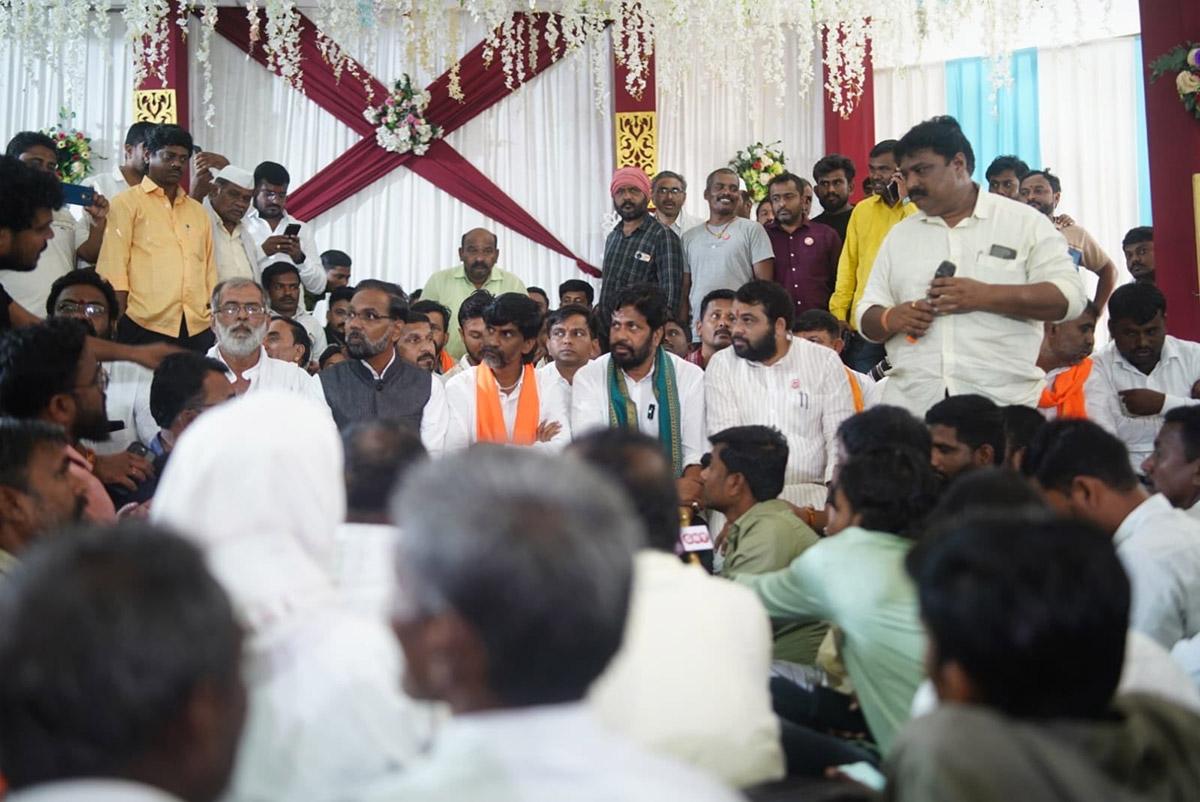
We have built a broad coalition that includes the Prahar Sanghatana, veteran farmer leader Raju Shetti, and established organisations like that of Wamanrao Chatap (former president of Shetkari Sanghatna). Four to five major organisations have come together.
What's significant is not just the number but the ideological diversity. We have groups from across the political spectrum united on one issue: Justice for farmers. This isn't about partisan politics -- it's about agrarian survival.
Following your discussions with government representatives, what is the next course of action? Will you now focus on policy advocacy at the legislative level, or are you preparing for a more aggressive mass agitation?
We have come for dialogue because the government hasn't offered a time-bound programme for addressing our demands, particularly on the loan waiver issue. They've not given us any dates and timelines, but still we've agreed to the talks.
However, if the government fails to provide concrete assurances and set enforceable deadlines, our next course of action will be more aggressive.
Our primary focus is on preparing for an even larger, widespread mass agitation across the state to force genuine policy reform. We've learned that governments respond to pressure, not petitions.
There's a perception emerging that through this agitation, you've established yourself as a significant new voice in Maharashtra's farmer movement. Do you see yourself as a new farmer leader, and what does this responsibility mean to you?
A new strength is slowly emerging, yes. The voice is breaking out. But I don't see this as about Bachchu Kadu becoming a leader -- I see it as the collective voice of Maharashtra's farmers finally finding an outlet.
For too long, farmers have suffered in silence. If this movement has given them hope, if it has prevented even one farmer from taking his own life, if it has united communities that were divided, then it has succeeded.
Leadership is not about personal glory -- it's about being the voice of the voiceless. That's the responsibility I carry, and that's the responsibility I'll honour.
What is your final message to the farmers of Maharashtra and to the government?
To the farmers: Unite. Your individual voice may be weak, but our collective roar -- our Elgar -- is unstoppable. Don't lose hope. We are fighting for you, and we will not stop until justice is delivered.
To the government: The time for tokenism is over. The time for empty promises is over. Give us concrete solutions, give us timely action, or prepare for a movement that will shake every corner of this state.
The farmer has been patient for too long. That patience is running out.
Photographs curated by Manisha Kotian/Rediff, Anant Salvi/Rediff






 © 2025