

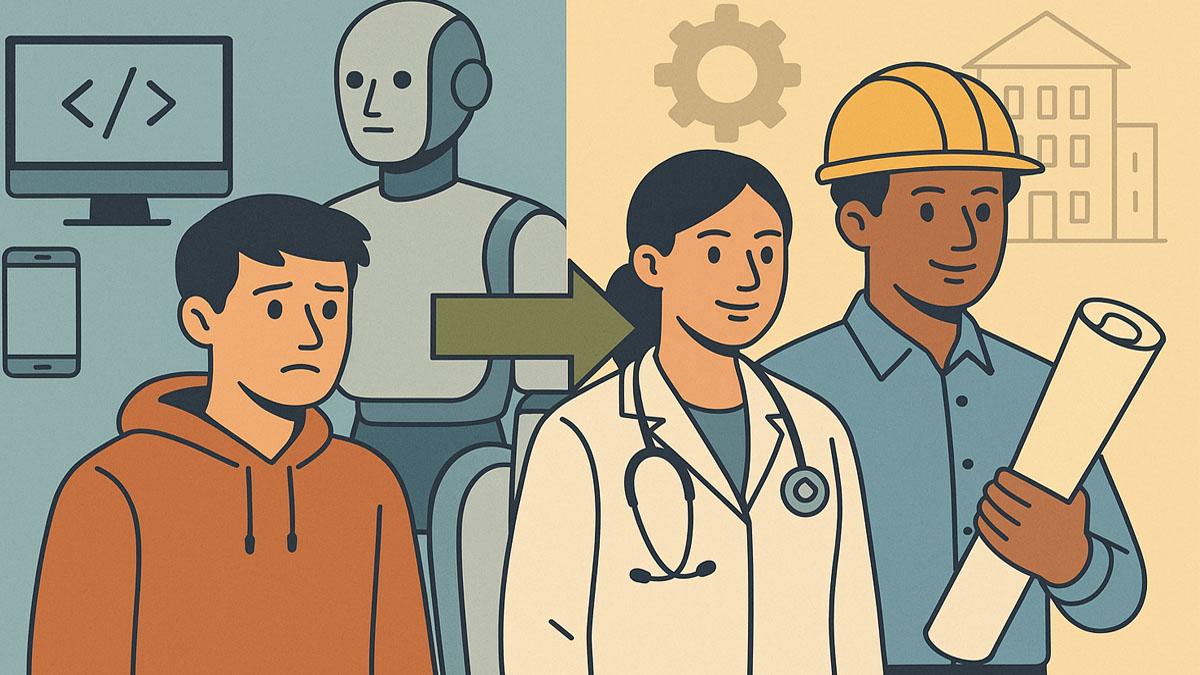
'When AI comes in, coders in Bangalore or Hyderabad will lose their jobs.'
<
From Nvidia to Microsoft to Alphabet to Open AI to Meta to Amazon, every big to small company and major venture capital firms like Sequoia Capital to Founders Fund to Andreessen Horowitz to Tiger Global is investing big in AI now.
According to Sundar Pichai, the trillion-dollar AI investment had elements of irrationality, and if the AI bubble were to burst, every company would be affected.
Along with this is the news of all the major companies laying off employees in their thousands.
Will the investment in AI result in huge job losses and unemployment, especially in India?
"Once AI becomes more powerful, not just IT services but other jobs like in financial services, legal, media, journalism to name a few, will also get affected. Many white collar Indian workers who do repetitive jobs could become redundant thanks to AI," Saurabh Mukherjea, Founder and Chief Investment Officer, Marcellus Investment Managers, tells Rediff's Shobha Warrier.
One million tech jobs are already lost in 2025 so far which is said to be the worst in decades after the dotcom burst in 2001, global recession in 2008-2009 and the pandemic.
Is the obsession with AI the major or the only reason for the job losses?
Indian IT firms have already announced some layoffs, and there is more to come with AI becoming more powerful.
Once AI becomes more powerful, not just IT services but other jobs like in financial services, legal, media, journalism to name a few, will also get affected.
Many white collar Indian workers who do repetitive jobs could become redundant thanks to AI.
So, the job losses are due to AI?
This is not a new phenomenon. Every 10 years, you see a new wave happening.
Between 2000 and 2010, India's factories got automated. As more and more automation happened, a lot of blue collar jobs were lost.
AI is nothing but automation of offices. Like the automation of the factories resulted in blue collar factory workers losing jobs, automation of the offices will result in white collar office workers losing their jobs.

You said 20 million Indians would lose their jobs before Christmas...
I spoke about 20 million Indians losing jobs in the context of the India-US trade tariffs imposed by the US president, and not AI.
The sectors that are going to be affected by trade tariffs are textiles, leather exports, gems and jewellery, sea food, etc.
Because exports to the US are getting jammed, we will end up with 20 million people losing their jobs unless a Indo-US Free Trade Agreement is signed in the next few weeks.
The amount of money tech companies are investing in AI is huge, and like Sundar Pichai said, if the AI bubble were to burst, all the tech companies would suffer and nobody would escape....
Is there an excessive supply of chips? No, there is a shortage of high-performance GPUs which are needed to power AI processing.
Is there an excessive supply of data centres? Globally, including in India, there is a shortage of data centres.
We have to realise that the world needs much more chips and data centres than what is currently available.
Then we come to the Large Language Models (LLM). Yes, there are multiple LLMs created by companies like Microsoft, Google, etc. The world will, perhaps need 2 LLMs and whichever company creates them, whether it is Microsoft or Google will become the bedrock of the new tech world, and those companies will benefit.
Unlike a real estate bubble when everybody suffers when the bubble bursts, when the AI bubble bursts, specific LLM providers will suffer, and not chips or data centres as there is a shortage of both.
So, when the AI bubble bursts, not everybody will lose.
The LLM that will become the default for the companies and individuals the world over, they will be in a very good place with very good money in the next 10 years or so.

Everybody including the US stock market fears about an AI bubble burst like the dotcom burst....
I am not an AI expert, but AI is being used in every part of our lives now, from IPhones to the robotics used in hospitals.
So, in my opinion, much like the Internet, AI will become a part and parcel of our daily lives.
Therefore, I don't see the so-called AI bubble in the same way as some of the commentators.
Even when the dotcom burst happened, the Internet became a daily part of our lives. I see a similar AI situation.
In fact, I feel more money needs to be spent to ramp up chips production and more money needs to be spent on data centres to increase their capacity.
 IMAGE: Saurabh Mukherjea
When white collar workers are going to lose their jobs, when these people do not have the money to spend, who is going to consume what the companies are going to produce using AI? Job losses means loss of consumers, right?
Whether it is electricity in the 1890s or AI today, every technology has two layers to it.
The first layer is the substitution effect, and the second layer is the complementarity effect.
The substitution effect kicks in first.
When Thomas Edison discovered electricity, it was clear that candlemakers would lose their jobs. Likewise, when AI comes in, coders in Bangalore or Hyderabad will lose their jobs. And that is the substitution effect.
But the more exciting effect of technology is the complementarity effect. Like Hollywood was born years later on the back of electricity.
Similarly, I feel AI will create new opportunities and new jobs in 3-4 years' time.
Today you can see the substitution effect with job losses in Bangalore or Hyderabad.
But the complementarity effect will be AI creating more jobs for India in a few years' time than it taking the jobs away.
But the job losses will come first, and the job creation will come only later.
- Part 2 of the Interview: 'A Big Chunk Of India's Office Workers Will End Up Becoming Part Of The Gig Economy'
Feature Presentation: Aslam Hunani/Rediff










 © 2026