

The future of India will be shaped and decided by the choices the RSS makes now, argues Colonel Anil A Athale (retd).

- Part 1 of the column: RSS@100: The Challenges Ahead
Sometime in mid-1991, I had the good fortune to have an extensive discussion with RSS ideologue, the late advocate Bal Apte, during an overnight train journey from Solapur to Pune.
The point I made was that the RSS has consciously chosen to be a 'Rashtriya' (national) and NOT a Hindu organisation, then why its insistence on Hinduism? Is not Bharatiya or Indian more representative of what the RSS stands for?
Mr Apte agreed that Bharatiyata or Indian-ness indeed described the RSS ideology more accurately.
But the RSS, at that time a virtual political untouchable, felt it would not yield under pressure to make this change.
The situation today is a sea change from the 1990s.
The RSS and its affiliate, the Bharatiya Janata Party, is a dominant force in national politics.
Indeed, Dr Mohan Bhagwat, the current head of the RSS, has been at pains to claim that the term 'Hindu' includes everyone born in Bharat.
Unfortunately, over time the term Hindu has been associated with a narrow definition of adherents to a faith.
Even adherents of other Indian faiths like Buddhism, Jainism and Sikhism do not accept that they are Hindus.
The RSS' refusal to accept this reality and Bharatiyata as opposed to Hindutva threatens the core RSS belief and objective of national unity.
Eventually, the RSS wants to attract and include followers of foreign born faiths like Islam and Christianity.
Dr Bhagwat has been on record on this issue. India cannot be great or fulfil its destiny with over 20% of its population not on board.
Historically, Buddhism, Jainism or Sikhism were revolts against Sanatan Dharma's ills and orthodoxy.
How will these people accept the 'Hindu' label, whatever the RSS may say?
The term Bharatiyata is far wider than the term Hindu that has come to acquire a narrow interpretation over time.
The RSS' refusal to accept the logic of accepting Bharatiyata over Hindutva is the biggest obstacle to national unity.
The RSS' reluctance to change is strange. Its founder, Dr Keshav Baliram Hedgewar, was himself a 'revolutionary' in his time.
Despite criticism by the Hindu Mahasabha at that time he stuck to his model of a caste less and modern organisation devoted to making a patriotic citizen.
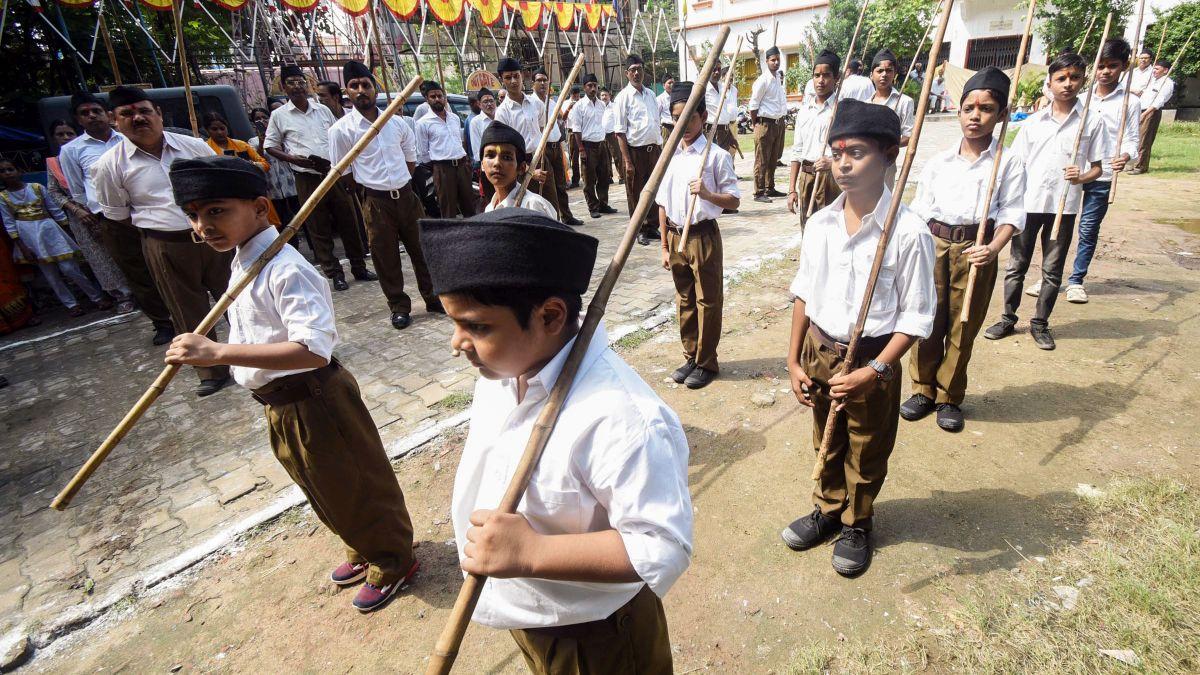
His adoption of khaki shorts as a dress when the bulk of Indians worn a dhoti was a clear message.
Even Gandhi and Ambedkar accepted and admired the fact that the RSS did not practice caste discrimination when it was rampant in India in the 1920s.
Partly this lacunae is due to ideological and semantic confusion between the terms civilisation and culture. In Indian languages both are bundled under the term 'Sanskriti'.
It is necessary to make a clear division between culture or 'Sanskriti' and civilisation or 'Sabhyata'.
India indeed has a one 'Sabhyata' or civilisation, but several cultures.
Thus, there is a distinct Tamilian, Bengali or Marathi culture, with a distinct language, dress, food, rituals, arts and regional favourite deities. Thus, we have Vitthal in Maharashtra, Karthikeya in Tamil Nadu, Durga in Bengal etc.

Yet, Shri Ram or Shri Krishna are all India civilisational figures, The RSS was right in terming the Ayodhya reconstruction as a civilisational project and not a religious one.
Rejecting Shri Ram is like modern Egyptians, mostly followers of Islam, disowning the pyramids or pharaohs.
Even the ideological founder of Pakistan referred to Shri Ram as 'Imam E Hind'.
But having achieved the goal of re-establishing civilisational pride the RSS needs to move beyond rituals.
Like the RSS itself, much of India and its majority population is trapped in history. Practices like imposing the choice of husbands on girls runs counter to the concept of 'swayamwar' (bride's choice of husband).
This is well documented and part of Shri Ram's marriage to Sita, yet we have instances of 'honour killing' due to a girl exercising her choice of groom.
We also have a proliferation of temples and huge wealth locked up in them in form of gold and at the same time no charity work or public education and preservation of dharma, the activity associated with temples in ancient times.
Due to long period of oppressive foreign rule, many restrictive practices have crept in India.
Hinduism, that accepts universal divinity of all, has temple entry restricted at some places to Hindus only.
I encountered this when because of my looks I was denied entry to the Jaganath Puri temple.
The RSS has to take up these issues and rescue Indian civilisation from falling into the trap of excessive rituals.
Rituals are not Hindutva as defined by the Bhagavad Gita, the concise guide to our civilisation.
One of the tragedies of India has been that Hinduism, not being an organised religion, there are very few institutions to spread the message of the Gita, the core of our civilisation.
Interestingly, the Gita itself is a 'secular' document, in the sense it is a theosophical dialogue between two great Indians.
British Governor General Warren Hastings, who pioneered the translation of the Gita into English, turned to it when he was being tried in British parliament. In his letters to his wife Hastings mentioned that he found solace in the message of the Gita in times of stress.
Indonesia, a Muslim majority country, has thriving scholarship on the Gita; a statue of Krishna and Arjuna adores the presidential palace square in Jakarta.
It is difficult and preposterous to suggest an agenda to a 100-year-old organisation, but the future of India will be shaped and decided by the choices the RSS makes now.
On its course correction to Bharatiyata from Hindutva and shedding of ritualism and practices twill depend the future of India.
Colonel Anil A Athale (retd) is a military historian and author of Let the Jhelum Smile Again (1997) and Nuclear Menace The Satyagraha Approach (1998).
His earlier columns can be read here.
Feature Presentation: Aslam Hunani/Rediff








 © 2026