

India emerged from the war militarily bruised and strategically altered.
The United States, under the guise of friendship, had succeeded in achieving what open alignment never could: The psychological and political repositioning of India within the Cold War order, points out Dr Kumar.

During the darkest hours of the 1962 War, when India was caught unprepared and the Soviet Union seemed inclined toward China, the United States appeared to rise as a true friend.
American transport aircraft landed in Kolkata with supplies, and messages of solidarity poured in from Washington.
For many, it was a moment of reassurance, when the world's oldest democracy seemed to stand by the largest in its hour of need.
However, that friendship must be seen in the light of the preceding decade, when American policy had quietly laid the groundwork for the very crisis it later seemed to help resolve.
Tibet: The First Pressure Point
When India refused to align with the Western bloc in the early years of the Cold War, the United States began searching for alternative levers to influence its foreign policy, first to pull India away from the Communists and later to weaken the idea of Asian solidarity that Nehru championed. Very early, Tibet was identified as one such lever.
The 1956 Tibetan uprising provided the opportunity. For Washington, Tibet was not merely a remote cultural region but a strategic frontier that could be used to create a wedge between India and China, whose partnership had symbolised post-colonial unity.
The CIA quickly recognised the potential of exploiting the unrest to redraw alignments in Asia.
India's proximity to Tibet and its civilisational ties made it an unavoidable factor in the unfolding game.
Even though New Delhi had no intention of being drawn into great power rivalry, it was inevitably pulled into the equation as the unrest intensified.
From then on, the United States viewed Tibet only as a strategic instrument.
Its concern was never for the Tibetan cause or their struggle for freedom, but for the opportunity the situation offered to weaken China and influence India's choices.
Pakistan: The Willing Partner
Pakistan, meanwhile, had been a willing partner in nearly all of Washington's covert operations in South Asia.
From the early 1950s, its intelligence services worked closely with the CIA, allowing American aircraft, radio stations, and surveillance facilities to operate from its soil.
This partnership gave the United States forward bases close to China and the Soviet Union, while Pakistan gained access to advanced weapons, training, and diplomatic support that elevated its regional standing.
Several covert missions related to Tibet and reconnaissance across the Himalayas originated from Pakistani territory.
The arrangement allowed the United States to run operations that directly impacted India's security environment, often without New Delhi's knowledge.
1959: Widening the Rift
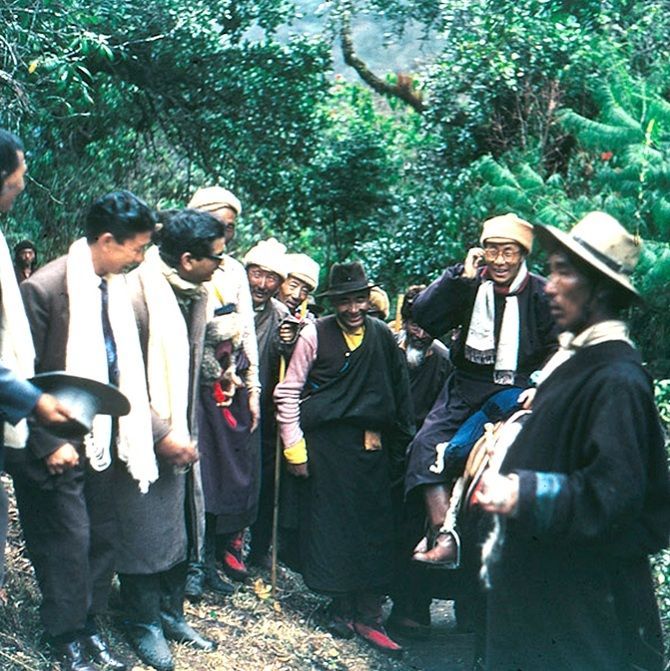
The Dalai Lama's flight to India in 1959 changed the situation decisively.
Open suspicion now marked India-China relations, and Washington saw the perfect chance to widen the rift.
The CIA expanded its funding and logistical support to Tibetan resistance groups, training and equipping them for operations against Chinese control.
Declassified CIA documents from that period reveal the intent clearly. The goal was to deepen mistrust between India and China so that the two Asian powers could never form a united front that might challenge American influence in Asia.
The CIA's presence in the region increased rapidly, with operations stretching from Tibet to Nepal and through Pakistan into India.
Under the pretext of countering communism, Washington quietly built networks of information and influence that penetrated India's media, political circles, and bureaucracy.
Shaping the Narrative
To harden the divide between India and China, Washington needed to shape public perception. The territorial dispute offered the perfect theme.
Early CIA assessments had noted that both countries could have resolved their border issues through negotiation. Yet, the media narrative told another story.
Through selective briefings, friendly correspondents, and international coverage, stories were amplified that hardened opinion in India and simultaneously built up a global image of Chinese aggression.
In India, public emotion made any compromise politically impossible. Negotiations began to appear as weakness, and calls for firmness grew louder.
The result was that diplomacy was slowly replaced by confrontation. The United States had succeeded in turning a negotiable dispute into an unbridgeable divide.

Inside View: Ambassador Galbraith's Disquiet
Even within the American establishment, some viewed these covert manoeuvres with unease.
Ambassador John Kenneth Galbraith later recalled how murky the CIA's operations in India and its neighbourhood had become.
Activities ranged from influencing local media to discreetly supporting political factions and election campaigns.
Much of this, Galbraith noted, was beyond the knowledge or control of the State Department.
While Galbraith maintained cordial relations with Nehru, he recognised that the CIA's growing influence in South Asia often contradicted the diplomatic messages coming from Washington.
The agency was not merely gathering intelligence; it was shaping the political environment to ensure India's foreign policy leaned away from Moscow and toward American interests.
Diplomatic Isolation: India in a Tight Corner
By the early 1960s, India found itself in a diplomatic bind. On one side, the US-backed rearmament of Pakistan had triggered an arms race that diverted India's scarce resources.
On the other hand, India's growing dependence on Western economic aid limited its ability to act independently, as the USSR was not in a position to provide economic assistance.
The contradictions were striking. The same United States that armed Pakistan in the name of collective security, consequently pushing India into an arms race, was also supplying India with food and economic assistance.
New Delhi was aware of the imbalance but could do little. Any protest risked jeopardising the very aid that had become essential to its development plans.
In this environment, India's room for strategic autonomy shrank sharply. The non-aligned posture that Nehru had worked so hard to sustain was weakened by economic constraints and security pressures that had been deliberately constructed by the same power now claiming to be India's friend.
A Conflict of Perception
By 1962, the stage was set. China, observing India's increasing proximity to the United States and its support for the Tibetan refugees, concluded that India was now part of a Western strategy to undermine its control in Tibet.
In Beijing's eyes, New Delhi had ceased to be neutral and had become an extension of American policy in Asia.
This perception, carefully nurtured through years of covert action and media influence, brought the two Asian neighbours to the brink of war.
Both sides believed the other had betrayed its trust, when in reality, both were being manipulated by forces that operated from outside the region.
The Perfect Moment for the 'Friend' to Arrive
When war finally broke out, the United States moved quickly. The same power that had quietly worked to create the rift now arrived as the rescuer.
Military supplies, advisors, and diplomatic support followed in quick succession.
In public, Washington presented itself as India's steadfast ally, standing with democracy against aggression.
In private, it achieved what a decade of persuasion had failed to do: It drew India decisively into its orbit.
Conclusion: The War Beyond the War
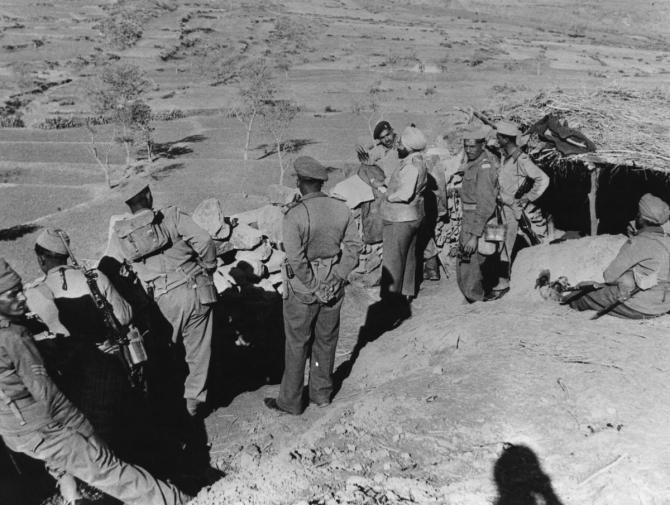
The 1962 conflict was fought across Himalayan ridges, but its roots lay in the realm of perception and manipulation.
It was a war preceded by a decade of covert shaping, in which aid, propaganda, and diplomacy were used as instruments of influence.
India emerged from the war militarily bruised and strategically altered. The United States, under the guise of friendship, had succeeded in achieving what open alignment never could: the psychological and political repositioning of India within the Cold War order.
History often records who fought the battle, but rarely who engineered it.
Dr Kumar is a Research Scholar who has extensively researched the 1962 Sino-Indian conflict and the Cold War dynamics.
Feature Presentation: Aslam Hunani/Rediff






 © 2026