

Monday's protests in Nepal may become the forerunner to many more agitations in future since social media interests and national efforts to regulate them will often be in conflict, alerts Biswajit Dasgupta.

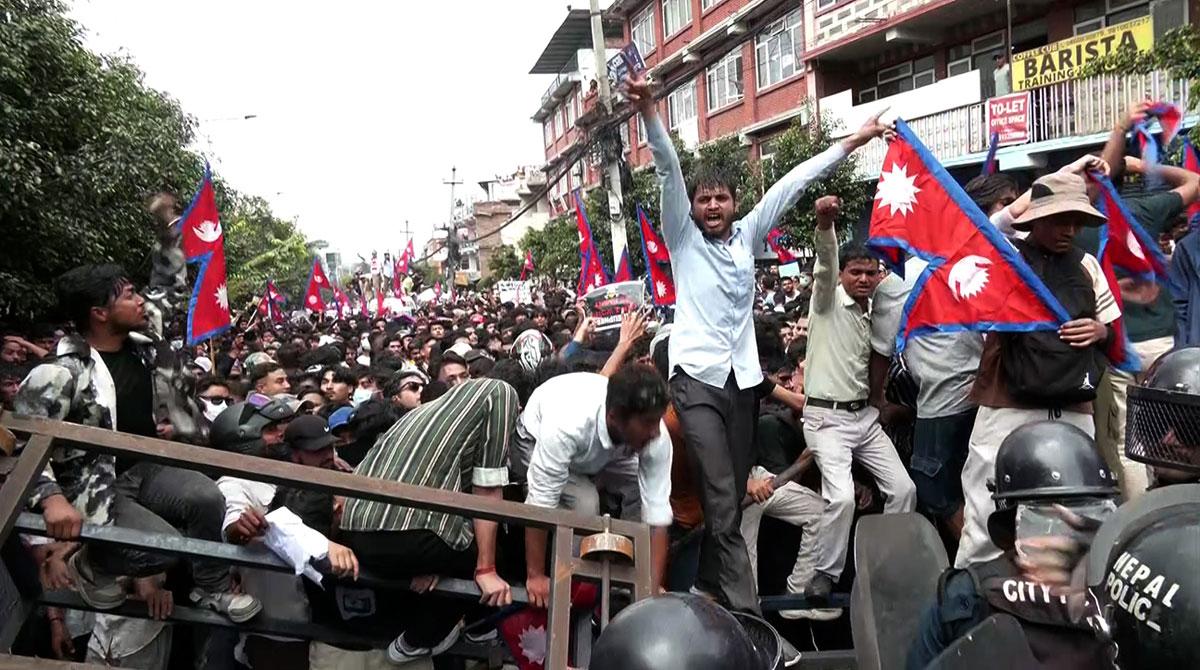
The responsibility for the massive protest staged by young citizens of Nepal as a response against the social media ban by the Nepalese government has been laid at the doorstep of Gen Z.
It has left 19 dead and hundreds injured at the time of writing this piece.
It has got the government in a huddle to try and decrypt this rather unprecedented happening.
Some media reports suggest that its fallout has the potential to endanger the government in power.
A theory doing the rounds is that the monarchy-backers wielded the silent hand behind the youth protest.
Like every other protest, it is likely to be the result of a cocktail of reasons. For the moment, let us take the reason for the protest at its face value.

Assuming that the protest was indeed in response to the ban on social media platforms, it is perhaps the first time that a protest on such a massive scale has been staged for this reason anywhere in the world.
The protest stirred passions of the public so hard that the police was unable to control crowd behaviour without resorting to opening of fire.
The police would normally do so in case of extreme violence or in self-defence against a violent mob.
In India, such action is taken only after authorisation by the competent civil authority such as the district magistrate -- and such authorisation is rare because, after all, the police is pitted against the citizens they are mandated to protect. That is how a normal democracy works.

Without going into the merits or otherwise of the police firing on the Nepalese protesters, it will be wise to analyse the possible causes of such a public outburst with the aim to draw lessons for the future anywhere in the world, other than totalitarian regimes or dictatorships in which citizens have very few rights, if at all.
Social media is all-pervasive today. The addiction to gadgets, especially to smartphones, is a direct result of the effects of social media.
The smartphone is the gadget that embodied the term 'convergence' many years ago when the word was still considered to be tech jargon.
Several kinds of technologies came together and converged into a single hand-held device called the smartphone.

The smartphone and other smart devices have since become inseparable parts of life.
The newer the generation, the more inseparable it is. Often, device addiction, especially among the younger generations is perceived as something bad and of which one must feel guilty.
What is the ideal duration that one should spend on smart devices? How much screen time is too much? There are no direct answers to these questions but what can be said with conviction is that the number activities that we accomplish today over our smartphones with great efficiency is many times more than what one could even dream of achieving in pre-smartphone days.
So, what is packed into the smartphone? While speaking on the phone is one of its many functions, the preferred methods of communication have transformed.
Verbal communication has ceded way to digital communication in the form of email, texts, emojis and other such means of conveying thoughts and ideas.
The first time I learnt that using capital letters in text messaging could be considered offensive as that was interpreted to be the equivalent of shouting or raising your voice, I thought it was a joke, but I'm more careful now.
Conversations have also become longer because talk time is cheap -- almost free.
Talking for an hour or more at a stretch is considered par for the course; something one wouldn't ordinarily do in earlier times of rapidly swelling STD or ISD bills.
Talking and texting aside, we read news, surf online material, watch TV and OTT shows, carry out bank work, order food, work from home, pay shopkeepers, listen to music, record audios and videos, take pictures, engage with the world over the Internet, run and manage our social media accounts, conduct online businesses, give vent to our creativity through writing and other material hosted on a raft of platforms, make friends and sometimes, even meet life partners online.
In fact, every activity that we once performed offline is now performed online. So, is it at all surprising that we indulge in increasingly more screen time? And is all of it necessarily bad?
It is however, undeniable that social media is also a huge distraction when significant time is spent doing fruitless work and therefore, the onus for responsible use rests with the individual.

Returning to the crux of the matter -- why did the protests in Nepal take place at all? Discarding conspiracy theories and just considering the matter at hand and the people involved, it is a function of three factors.
First, the government felt that the social media platforms were not complying with national regulations and needed to be shown their place. This was the over-riding factor.
Governments normally comprise people of an older generation whose dependence on social media is not so debilitating; and hence the trade-off between inconvenience and regulation, perhaps, weighed in the favour of the latter.
Second, the younger generation felt suddenly crippled, considering that most of their work came to a halt owing to their huge online dependence.
Third, the Nepalese government did not take the public into confidence before the ban and did not anticipate the kind of public reaction that the ban generated.
If there is any lesson to be learnt, it is this -- dependence on online connectivity today is critical to delivery of public goods and services.
A decision to upset that must be preceded by shaping the public environment and concurrently engaging with social media operators.
This protest may otherwise become the forerunner to many more agitations in future, since social media interests and national efforts to regulate them will often be in conflict.
Photographs curated by Manisha Kotian/Rediff
Feature Presentation: Rajesh Alva/Rediff







 © 2026