

Like his father Karunanidhi and AIADMK rivals MGR and Jayalalithaa, Stalin would like to confine his real political work to Tamil Nadu, and not want to take after the late Congress leader K Kamaraj and take up a national role, even if to create greater political space for son Udhayanidhi, points out N Sathiya Moorthy.
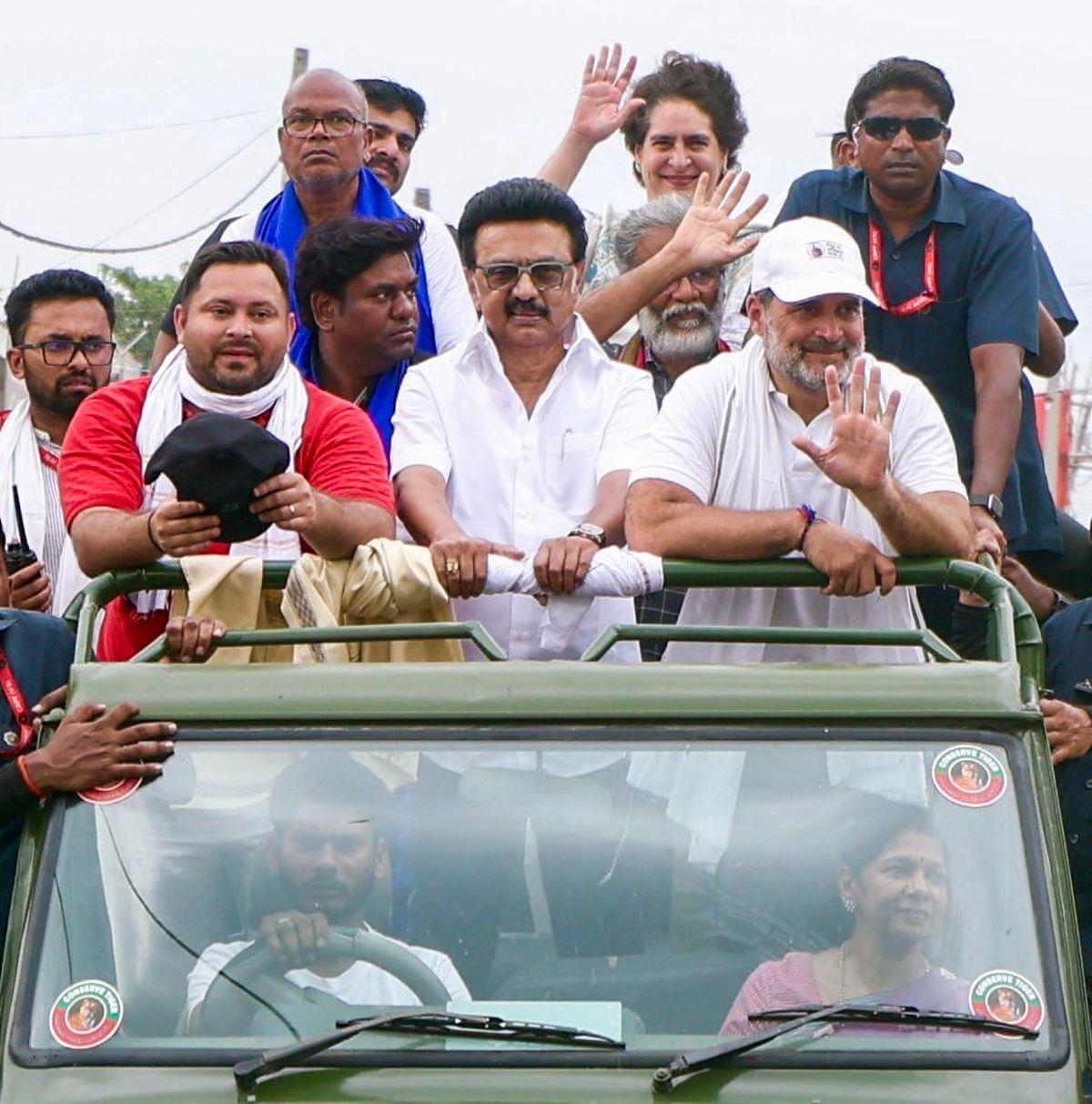
Through a short and pointed speech at Congress leader Rahul Gandhi's Voter Adhikar Yatra in poll-bound Bihar, Tamil Nadu Chief Minister M K Stalin may have created a record for Dravidian leaders in delivering a Tamil piece in the Hindi heartland.
Unintended or otherwise, it was Stalin's arrival statement on the national scene though he, as among the senior-most political leaders in the country, having been around since the early 1970s, does not intend staking prime ministerial claims, now or ever, not certainly against a Nehru-Gandhi, not certainly against the Congress ally in the state.
The Bihar speech was also a continuation of Stalin's staunch anti-BJP, anti-Modi stance in native Tamil Nadu, which he and his party have propagated without any let-up or slowdown through the past decade and more.
If anything, he has sharpened his attacks, and also their frequency.
Stalin and the DMK have been highly critical of the BJP's Hindutva agenda with its myriad sub-texts.
To this, they have added 'federalism issues' with equal purposefulness after coming to power in 2021, on issues where the BJP-ruled Centre, they felt, was acting unilaterally, despite Prime Minister Narendra Modi's early promise of strengthening 'cooperative federalism' in the country.
Both Hindutva/secularism and federalism derive from the DMK's uncompromising ideological position since inception in 1949. Throughout, they continue to be saleable politico-electoral products in Tamil Nadu.
The DMK feels they have begun resonating elsewhere, too, Rahul Gandhi's anti-SIR yatra across Bihar being the more recent one.
What more, on return from his 'successful' Bihar trip, Stalin wrote to non-BJP chief ministers, to stand together on federal issues -- something that he has been highlighting from time to time, on multiple aspects of the same.
Like his late father and DMK patriarch M Karunanidhi's initiatives of the kind vis-a-vis the National Front (1989) and the United Front (1996), Stalin is likely to call an INDIA bloc conclave in the state, as assembly polls are due in Tamil Nadu, and also neighbouring Kerala and Puducherry in the South, as also West Bengal and Assam, next summer.
Stalin's increasing interest in national issues and, now, national platforms, is deliberate. One reason is plain and simple ideological, against the RSS-BJP duo, and aims at the short, medium and long terms.
The other reason is of shorter shelf-life.
By addressing Biharis in Bihar, the chief minister has sought to reassure them all that their migrant brethren were all safe under his care -- and were not getting beaten up, as a mischievous BJP supporter, first in Tamil Nadu, later another one in Bihar, had portrayed in social media posts two years ago.
But more important for the DMK and Stalin is the anti-incumbency against the state government.
It is a short-term factor and is palpable, and has consequences for the future of the party, and also for the up and coming leadership of the leader's son and heir-apparent Udhayanidhi Stalin in his time.
Hence, Stalin's immediate effort is to try and make the assembly poll Modi-centric for the fourth time in a row since 2014, and not Stalin-centric, as the rival BJP-AIADMK alliance especially has been trying to project.
As may be recalled, the BJP lost all four elections in Tamil Nadu that it fought under Modi, with the late AIADMK boss and chief minister Jayalalithaa opening the account in 2014.
The DMK won the three that followed, in 2019, 2021 and 2024.

In doing so, Stalin has deliberately side-stepped AIADMK predecessor Edappadi K Palaniswami, who is also the self-proclaimed chief ministerial candidate of the party-led BJP-NDA combine next year.
Invariably, Stalin has let his second-line leaders to respond to criticism by EPS and other AIADMK leaders, who speak less and less of ideology, and more and more of the 'mounting people's problems' and also political corruption -- a 'cover' for the party's revived alliance with the Modi-BJP duo, and in that order.
In doing so, and early, Stalin has also obliterated early chances of next year's poll turning into an 'Udhayanidhi versus Vijay' personality battle between two youthful leaders.
Udhayanidhi Stalin is also the deputy chief minister of the state, positioned thus for better things, first in the party and then in state politics.
Actor-politician Vijay, who announced a new party TVK last year, is seen by some as the emerging 'regional third force' to neutralise the two Dravidian majors that have outlived their utility -- and also the BJP with its anti-secularist, anti-federal and anti-Tamil agenda.
Whether Stalin's strategy on this score succeeds or fails, he has taken a lesson from his late wily father and DMK patriarch M Karunanidhi's copybook.
In the early 1990s, the father succeeded in converting what was predicted to be a post-Karunanidhi battle for supremacy in the DMK, between Stalin and popular party orator Vaiko (V Gopalswami) into one between self and the latter, in his lifetime.
Thirty-plus years down the line, Vaiko's once-promising MDMK is a mere appendage of the DMK parent under the very same Stalin.

Yet, Karunanidhi would not hand over the reins to his politician-son, whom he recognised much more than the other, in M K Azhagiri, now retired.
Karunanidhi's logic was that at the end of the day, Stalin would have to become acceptable to the voters on his own steam and strength, and by hoisting his son also outside the party would not do any good to either the DMK or Stalin.
Stalin's strategy now hinged on the DMK winning the assembly polls hands down, without having to depend on the Congress, communist and regional allies for a majority.
Stalin does not seem to be overly perturbed on seat negotiations just now.
His joining Rahul's yatra also helped silence motivated rumour-mongers in the state, who predicted the Congress going with Vijay's TVK, and sections of the state unit who were keen on a share in power, like the BJP's Amit Shah unilaterally declared in the case of the BJP's AIADMK alliance.
At his airport news conference before emplaning for Germany, Stalin also sidestepped a question on more parties (especially those from the AIADMK alliance) crossing over.
'Whether or not more parties are joining us, more voters are gravitating towards us,' he said, as if reading out from a prepared text.
For all this, however, the immediate question is on how Stalin is going to neutralise 'anti-incumbency'.
Does he believe that flagging 'secularist nationalist' questions against Modi and the BJP alone would do the trick?
The DMK's body language says so. The party's whisper campaign, more than the rival BJP-AIADMK's IT campaign, has won the 'perception war' for the DMK just now.
That in the current format of a four-front election, which also involves actor-politician Seeman's NTK, which has been increasing vote-share in recent times, the DMK would have a walkover.
More aggressive the Modi-Shah combo becomes, including on the corruption and Hindutva front, greater are the chances of the DMK combine's poll victory.

That way, the DMK seems to have been convinced that every act of the Modi-Shah BJP Centre is a pure act of 'political vendetta and pent-up frustration of the past decade'.
It is immaterial if it was on the Hindutva front or on the federalism front.
Thus the poll narrative has taken a curious turn, without anyone realising or acknowledging. It is now for the DMK's rivals, collectively or separately, to turn the torch on multiple layers of 'anti-incumbency' afflicting the ruling party in the state.
How they go about it will define/re-define the course of the poll campaign and hence the poll results.
That will also be the measure on the success of Stalin's current strategy, which too is evolving with each passing day, to meet new contingencies, especially those created by the BJP-led Centre.
After all, like his father and also AIADMK rivals MGR and Jayalalithaa, Stalin would like to confine his real political work to Tamil Nadu, and not want to take after the late Congress leader K Kamaraj and take up a national role, even if to create greater political space for son Udhayanidhi.
Whatever might have been the perception when Kamaraj left his chief minister's job to don a national role as the Congress president, analysts later concluded that his deserting state politics with its own Dravidian model of social dynamics was the beginning of the end of the Congress in the state.
N Sathiya Moorthy, veteran journalist and author, is a Chennai-based policy analyst and political commentator.
Photographs curated by Anant Salvi/Rediff
Feature Presentation: Aslam Hunani/Rediff







 © 2026