
If he cannot do it this term by using his bureaucracy and experts from different fields, it will be a tragedy, asserts Ramesh Menon.
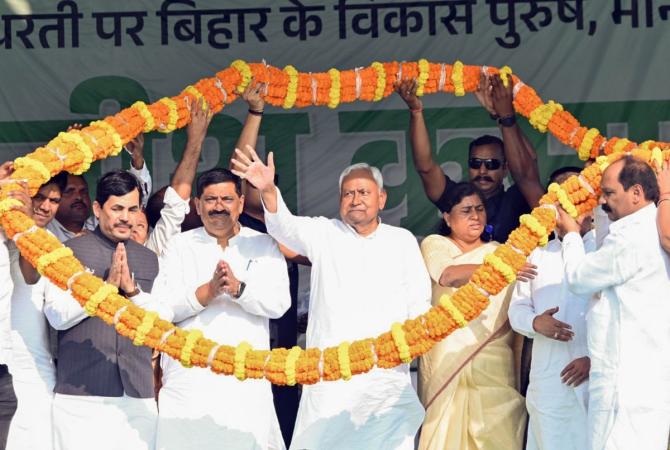
Will the new National Democratic Alliance coalition of Bharatiya Janata Party-Janata Dal-United and other small parties in Bihar be able to change the future of India's poorest state, ravaged by backwardness, poverty, caste differences, and political opportunism? It is not an easy question to answer.
While the ruling coalition has pulled off a landslide victory, what remains to be seen is how the BJP will treat Chief Minister Nitish Kumar in the months ahead. After 20 years in the hot seat, he has been struggling to stay relevant. He may project wellness, but health issues are catching up. Moreover, the BJP is getting impatient and wants its own man in the chief minister's chair.
However, unseating him will not be easy, as the BJP does not have a charismatic leader acceptable to all. The BJP needs Nitish. And Nitish needs the BJP.
Nitish, however, emerged as the man without whom Bihar cannot be won. This would be his fifth term, making him India's longest-serving chief minister.
It will also be the tenth time he will take the oath, as he has switched sides numerous times depending on which way the wind blows to keep himself as head of the government.
The NDA scripted a comfortable two-thirds majority, bagging 202 seats. The BJP won 89 and the JD-U won 85. The seven-party Mahagatbandhan won just 35 seats, with the Rashtriya Janata Dal managing 25, down from the 75 it won in 2020. The Congress has a measly six seats in the 243-member house.
It was the worst show by the Opposition in 15 years.
The NDA got 45 lakh more votes than the Mahagatbandhan. In the last election, the difference was just 11,150 votes.
For the NDA, this win was crucial as elections are due soon in other states like West Bengal and Assam.
Based on caste identities, the NDA sculpted a diverse and large coalition. The BJP had the support of higher castes and the business community. The JD-U received support from the Economically Backward Classes, non-Yadav OBCs, Mahadalits, and now women as a dedicated voter group.
Bringing the Lok Janshakti Party (Ram Vilas) into the NDA fold helped increase its vote share. In 2020, the BJP had encouraged its leader, Chirag Paswan, to go it alone so as to cut the JD-U's wins, as it wanted to emerge on top and claim the chief minister's post.
The NDA managed to consolidate its core vote bases. Its women-centred schemes and cash doles helped. The turnout of women in this election was 71.6 per cent, an all-time high.
Voters were not affected by incumbency and wanted the same coalition once again. As is the norm, the BJP was its aggressive self, not leaving any gaps in its election machinery.
The Mahagathbandhan, on the other hand, suffered from a lack of clear messaging beyond identity appeals. In many seats, alliance partners were fighting each other and their traditional strongholds were eroded. The coalition of Yadavs and Muslims, along with the Congress and the Left, was not enough. The waning image of the Congress in Bihar did not help matters.
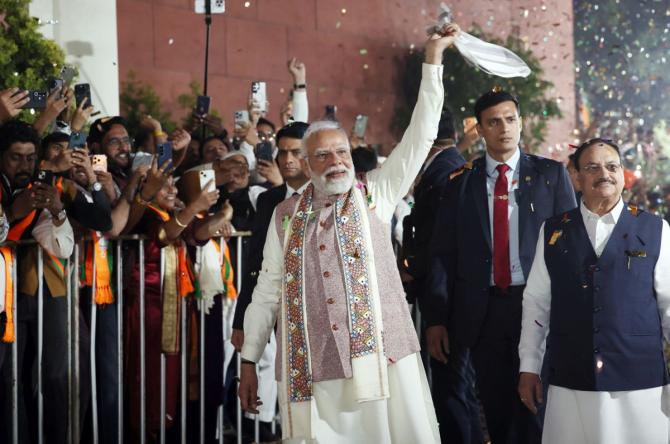
The NDA landslide will help it increase its numbers in the Rajya Sabha, further strengthening its strong-arm role in Parliament. It is an opportunity for Prime Minister Narendra Modi to bring in some tough economic and policy reforms. Whether he would do that remains to be seen.
The win also steadies the central government, which was dependent on parties like JD-U for survival.
Bihar today stands at a crossroads, unable to shed its persistent label as one of India's most backward states, lacking robust industries, significant tax revenues, or strong development indices. The long-standing struggle is to turn potential into progress.
For decades, Bihar has battled deprivation, poverty, and apathy.
The state is known today for exporting labour to other states. There are no jobs, and so the populace is ready to go anywhere to earn a living, improve their lives, and send some money home. According to the 2011 Census, 75 lakh Biharis live outside. That was 14 years ago. Today, the figure will be much higher.
According to the Periodic Labour Force Survey, the unemployment rate in Bihar was 15.2 per cent in 2023-24.
Its per capita income is the lowest. In 2022-2023, as per the Reserve Bank of India, it was just Rs 38,278 -- barely 34 per cent of the national average of Rs 205,324.
All these years, irrespective of which government ruled, scant attention was paid to promoting industry, creating jobs, stamping out corruption, containing rising communalism and casteism, ending political violence, and holding out new hope to stop migration.
Bihar fared very poorly on development indices compared to other states. It will probably take decades for Bihar to reach the present development indicators of a state like Kerala.
The literacy rate of around 61.8 per cent (Census 2011) is far below the national average of 73 per cent and way below states like Mizoram, Kerala, and the southern states.
The Nitish Kumar government did some good work when it rode into power in 2005. There was an eagerness to prove himself. There were new roads, bridges, electricity, and a crackdown on crime. He could erase the 'Jungle Raj' label that Bihar had when Lalu Prasad Yadav was in power.
There were reports of reverse migration happening as Biharis who worked as low-paid daily wage labourers outside saw new hope and wanted to get back to cultivate their small holdings or eke out a living in their homeland.
However, that ray of hope was short-lived. Nitish, who was seen then as one of the best chief ministers of India, slid into apathy, taking his reign for granted.
Cash doles to voters with minimal expectations repeatedly helped him retain power.
Many Biharis returned home before the elections, hoping for more revdis -- the freebies that Modi once derided.
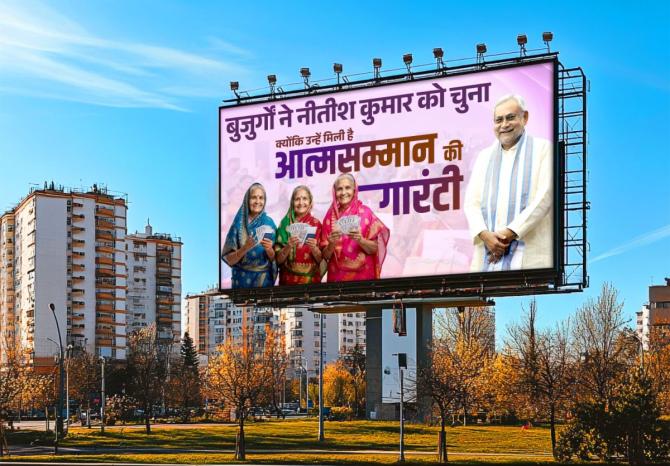
Ironically, it was doled out by the BJP-JD-U coalition, which ensured Rs 10,000 was deposited into the accounts of 75 lakh women on the eve of the elections.
Women turned out in large numbers to vote, breaking all previous records. No prizes for guessing whom they voted for.
Bihar's debt, at about Rs 3.6 lakh crore, amounts to nearly 40 per cent of its Gross State Domestic Product -- among the highest in India. How can such a state afford the numerous doles the ruling dispensation is promising? This is a question no one is asking.
These huge amounts that will have to be allocated to service the doles promised are certainly not going to help get out of the strangulating debt trap that Bihar is caught in.
Bihar's GSDP growth has fluctuated sharply in recent years, from 10.2 per cent in 2021-2022 to just 1.3 per cent in 2022-2023, reflecting the state's vulnerability to monsoon swings and weak industrial activity. Despite occasional spurts, its economic base remains fragile and heavily dependent on agriculture and remittances.
It is a grim picture that even the World Bank acknowledges in its assessment titled , which describes the task as 'enormous due to persistent poverty, complex social stratification, unsatisfactory infrastructure, and weak governance'.
No one wants to invest substantially in the state as there is no guarantee of returns.
The Mahagatbandhan coalition offered a government job to 2.76 crore families. Sounded impossible.
At a conservative estimate, this exercise of creating a job for each of the 2.76 crore families would cost around 7 lakh crore rupees. Bihar's budget for 2025-2026 is Rs 3.17 lakh crore.
The state suffers from weak industrialisation and low linkages between agriculture and value-added sectors. For example, only about 5.7 per cent of the workforce in 2022-2023 was engaged in manufacturing.
However, economic indicators or grim realities in Bihar do not drive electoral behaviour. What matters instead are caste, identity, historical grievances, and regional divides.
It is deep caste and sub-caste stratifications that influence access to resources, political mobilisation, and service delivery.
The politics of identity has always held sway over development issues. So, politicians have concentrated on building vote banks rather than building the state or delivering services.
In 2001, the Lalu Prasad Yadav government commissioned a survey on the socio-economic status of Muslims in the state. It found that almost 50 per cent of the rural Muslim population in Bihar lived below the poverty line. About one-fifth of land-owning Muslims leased it to rich cultivators as the holdings were so small.
A caste survey in 2023 showed that 73 per cent of the Muslim population in Bihar was backward. Successive governments have seen Muslims only as a vote bank.
Prashant Kishor's Jan Suraaj Party may not have won a single seat, but he will be remembered for being the only one who offered no freebies and raised the right issues like fighting poverty, increasing literacy and the quality of education, creating job opportunities by building new skills, stopping distress migration, and building the state.
Out of the 238 seats Jan Suraaj contested, it lost its deposit in 236.
Prashant Kishor is a long-distance runner, and he will stay. Maybe it will take him a decade or more to break into the complicated game of winning elections in Bihar.
The coming five years will not be easy in Bihar. What are the challenges ahead for the new government?
To begin with, it needs to break away from the politics of patronage and dynastic control to whip in a new political culture. Traditionally, elites have captured power and called the shots.
The Periodic Labour Force Survey says that 49.6 per cent of Bihar's workforce is in agriculture, forestry, and fishing. So, the agricultural markets must be strengthened.
Give a new meaning to governance by strengthening public service delivery, clearing infrastructural backlogs, and cracking down on crime and corrupt practices. Also, focus on the quality of governance, introduce reforms, and create jobs.
Promote reverse migration by developing new jobs and small business opportunities.
Revive a crumbling healthcare system. Government hospitals and public health centres are in bad shape. There is a shortage of over 35,000 doctors. The poor cannot even dream of visiting an expensive private hospital.
Create an ecosystem where the state can continue to grow while it also concentrates on neutralising inequalities.
Revitalise the bureaucracy to think differently and galvanise action on the ground.
Agriculture, which at present is at the subsistence level, must move to diversification. There is huge potential there for growth and exports from the state.
Human capital has always been underutilised in Bihar. With an improvement in educational standards, it can be leveraged along with skill development.
It will have to figure out how to generate Rs 28,000 crore to fulfil a slew of election promises.
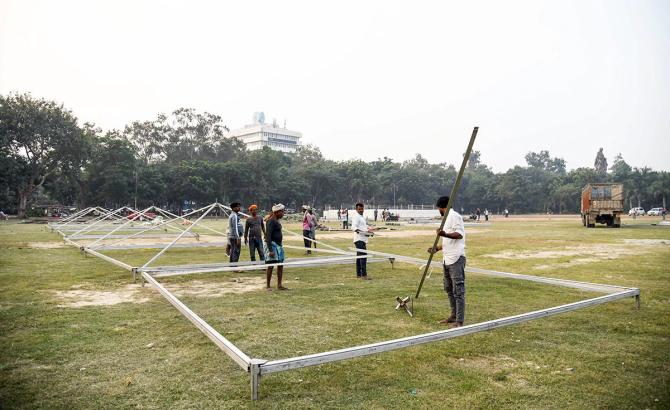
Nitish has an opportunity of a lifetime to transform Bihar. If he cannot do it this term by using his bureaucracy and experts from different fields, it will be a tragedy. Bihar has been known to surrender unspent funds to the Centre, which reflects poor execution and imagination. This has to change.
Bihar's story is ultimately about the urgent need to transform deep-rooted governance issues and political complacency into effective action. The main question is whether leadership can convert resilience into a broad-based revival, addressing the root causes of underdevelopment rather than merely offering short-term relief.
In a state where underdevelopment has long been political collateral, the real test of this election will be whether the new government can turn power into performance and transform hope into a reason for Biharis to return home.
Ramesh Menon is an author, award-winning journalist, educator, documentary filmmaker, and corporate trainer. He authored Modi Demystified: The Making of a Prime Minister.
Feature Presentation: Aslam Hunani/Rediff








 © 2025