

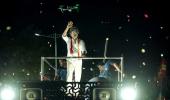
Vijay, despite the loud message from his delayed arrival at the road-show/stampede venue, and more so his continued inaccessibility for fans-turned-cadres after graduating from a super-star to a political party leader with electoral ambitions, refuses to change. Or, so it seems, observes N Sathiya Moorthy.

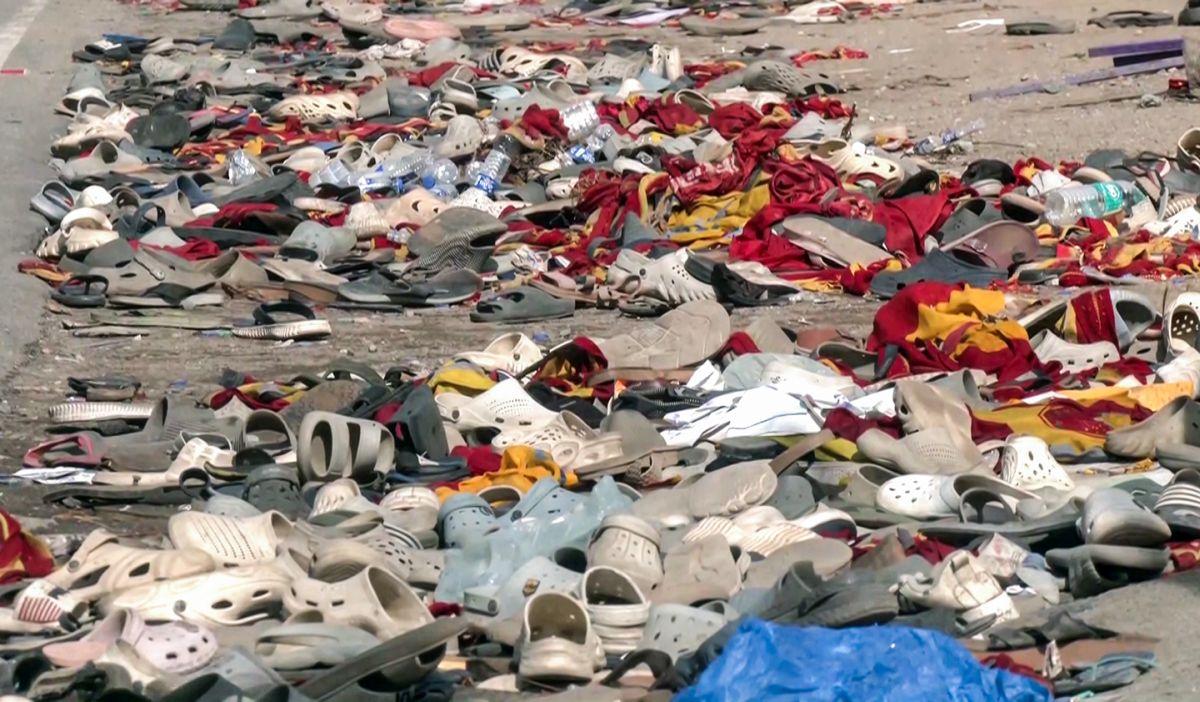
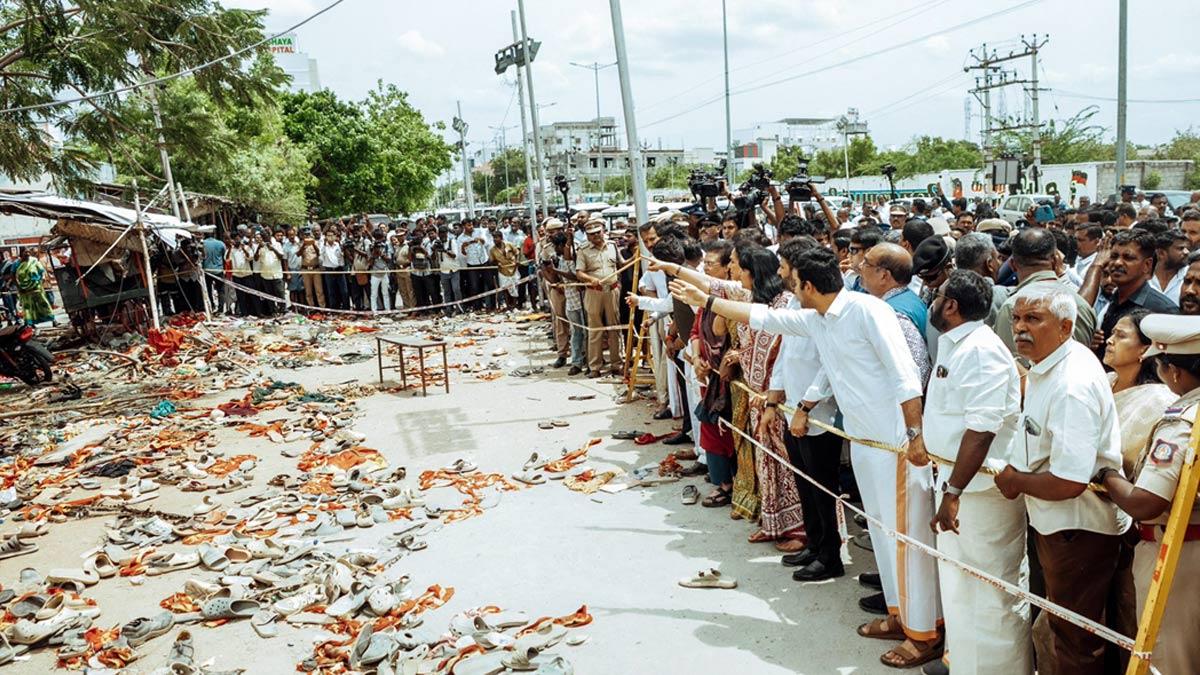
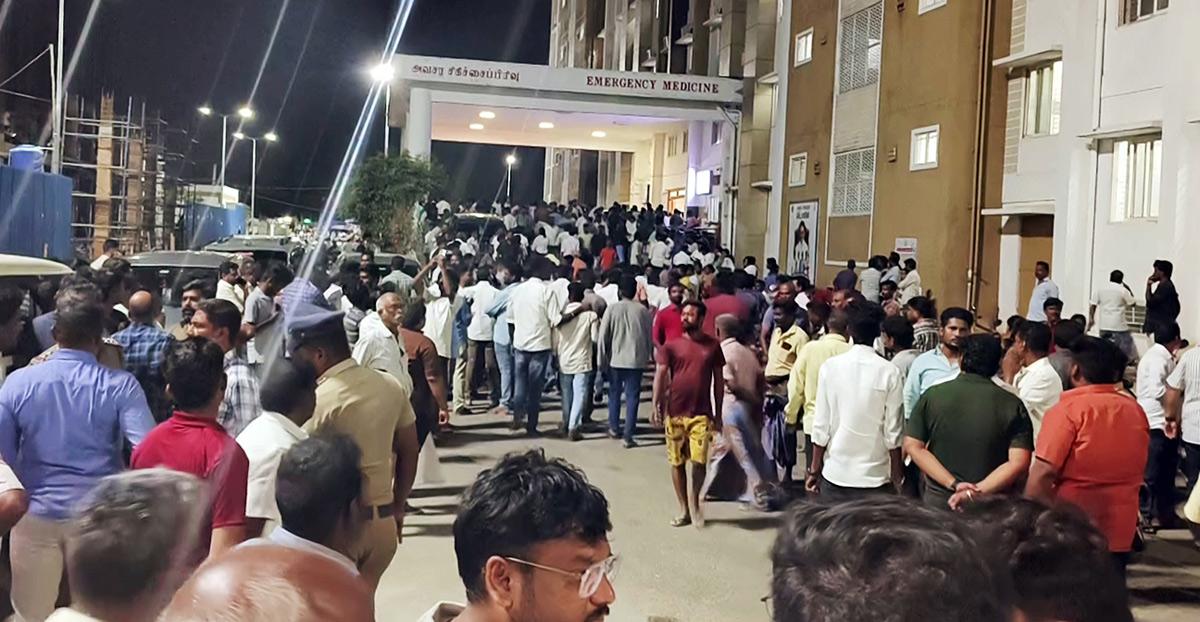
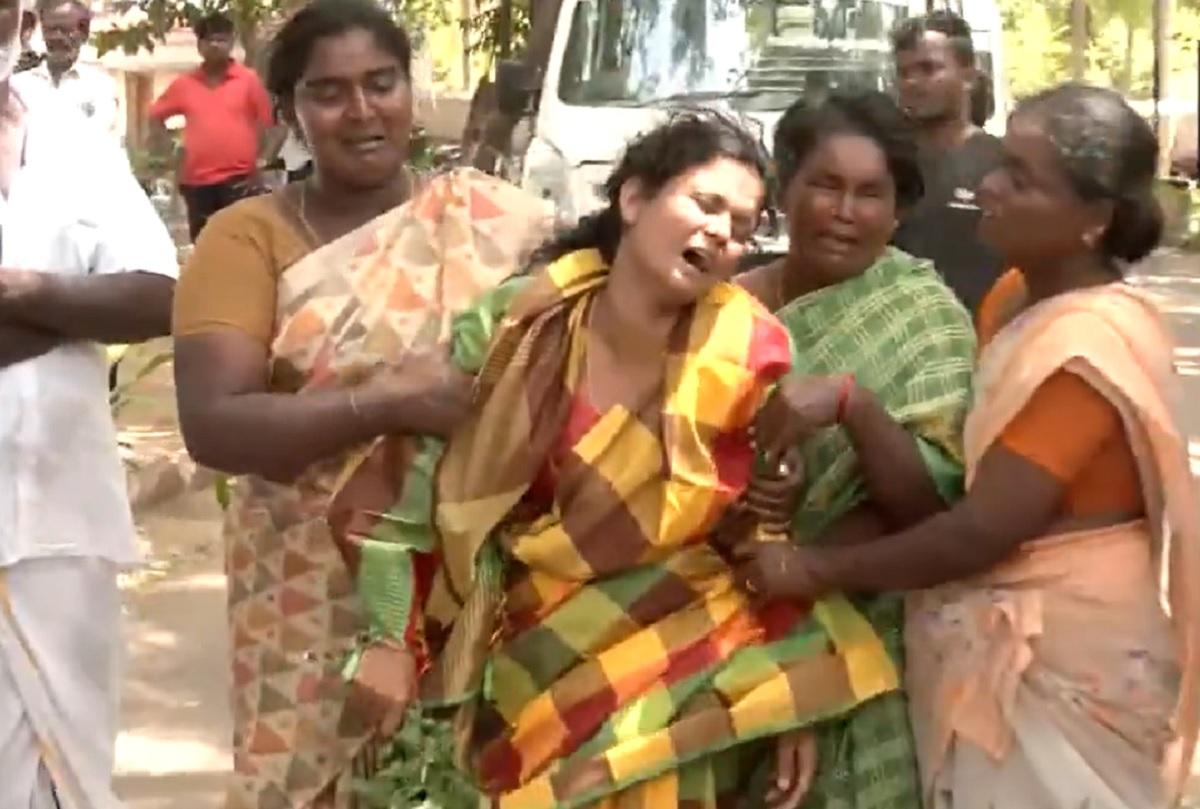
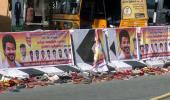
In these weeks after the Karur stampede in which 41 people lost their lives at actor-politician Vijay's road-show, the question has erupted if the TVK founder, if elected chief minister as desired, would be running a government by some kind of remote-control, AI, Alexa or whatever.
By the same token, increasing questions are being asked about the post-stampede handling of the evolving situation by Tamil Nadu's DMK Chief Minister M K Stalin, and his legal team arguing the case against a CBI probe, supervised by a panel headed by a retired judge of the Supreme Court.
The reasons are not far to seek.
Vijay, despite the loud message from his delayed arrival at the road-show/stampede venue, and more so his continued inaccessibility for fans-turned-cadres after graduating from a super-star to a political party leader with electoral ambitions, refuses to change. Or, so it seems.
Stalin, for his part, continues to give the impression that an inefficient and at times motivated bureaucracy is running the political administration, which is his exclusive responsibility as CM.
And the Karur stampede shows how and why -- not that others involved, starting with the Supreme Court but not excluding the BJP ruling the Centre and the AIADMK Opposition in the poll-bound state, have covered themselves with glory -- or so it seems.
Post-Karur, Vijay's idiosyncrasies not only as an aspiring chief minister but even going by his insular and insulated behaviour once he attained superstardom have been well 'documented', by the social media and Tamil TV talk show guests through the past weeks in particular.
How not just in Karur but in every one of his political roadshows, Vijay had arrived late, and was surrounded not by a cadre force to secure his personal safety, or even the police, but by a bunch of bouncers who have lately been identified only with superstardom across the country.
How, not only Vijay but his entire team 'scooted' from the Karur venue, that too all the way to the safety of their respective homes in distant Chennai, rather than standing their ground, owning up moral responsibility, apologising to the victim's families, and encouraging their cadres to assist the victims and their families in their grave crisis.
How weak Vijay's politico-legal team was that TVK General Secretary 'Bussy' N Anand and another top aide, C T R Nirmal Kumar, had told the courts that they had no responsibility for organising the roadshow, after the police had added their names to the FIR, along with those of district-level functionaries, and hence they were entitled to anticipatory bail.
This was so when their court petitions had claimed that the stampede was an 'accident' even when Vijay, through his delayed four-minute video, had declared it as a 'DMK conspiracy'.
The list goes on.... All of them culminating in the current question: Will Vijay, if elected chief minister, be moving with the people or would run a remote-controlled administration, and with ministers as inexperienced as his party leaders now are.
Even MGR, who otherwise was known to have had the pulse of the people in his fingers, was not as erratic or unpredictable until after he suffered a stroke in 1984 and lived on for another three years and as chief minister.

The same cannot be said of Stalin, whom Opposition AIADMK chief ministerial aspirant and predecessor Edappadi K Palaniswami had begun taunting months ago, as being inefficient and ineffective.
If prima facie Stalin was seen as taking charge of the ground situation even as it was evolving, and even flying down to Karur in the middle of night to personally satisfy himself that all was as well can be under the circumstances, it stops there.
At different levels in the party, there is an increasing disquiet and dismay bordering on acknowledgement that the chief minister has not been able to instill or inspire like-mindedness, especially in the top bureaucracy, which he seems to trust more than his veteran ministerial colleagues.
Plain and simple, Stalin is not as inspiring as his late father M Karunanidhi, or fear-instilling as arch-rival Jayalalithaa, both as chief ministers.
Or, that is the kind of verdict that is evolving within the DMK's ranks -- but no one is talking.
With the Karur stampede as only the latest instance, it is being pointed out how the CM did not take any official, whether the district collector or the superintendent of police, to task, even if for political optics and nothing more.
There were intelligence input-gaps in the police inputs and/or follow-up action.
None at the top rung has been made to pay for it, just as in the past cases of near-similar seriousness, including the Kallakurichchi illicit liquor tragedy where 68 people lost their lives -- and that was not the only one.
That Stalin did not consider it worth his while to visit the place even weeks later is still being held against him.
Political opponents have revived their comparison in the matter, post-Karur, insinuating a conspiracy that never possibly was there.
In comparison, neighbouring Karnataka's Congress Chief Minister Siddaramaiah had the DGP and Bengaluru police commissioner, among others, suspended over the IPL stampede that claimed 11 lives earlier this year.
It may or may not have been the answer, but it did help cool agitated nerves across the state.
Then there are those who quiz why the CM did not order Vijay's detention -- which demand could have been outlandish, yes.
But the government has failed to convince those who argue that at least all four named in the FIR should have been arrested.
In this case, however, no seeming attempt was made to trace Bussy Anand and Nirmal Kumar while the other two lower-level cadres languished in prison.
Wonder of wonders, the day after the Supreme Court took away the probe from an SIT suo motu constituted by the Madras high court to the CBI, the two worthies overnight made their public appearance -- cocking a snook at the state police and the political administration.

It did not stop there, though.
The Supreme Court's order for a CBI probe under supervision was passed by a two-judge bench of Justices J K Maheswarai and N V Anjaria. It derived from two separate sets of petitions.
The CBI probe was based on separate petitions from parents of two who had lost their lives. The TVK-centric petitions demanded a probe monitored by a retired Supreme Court judge.
The Supreme Court heard the petitions two or three days after they were filed. By then, neither the police, nor the government's legal team in the Supreme Court had cared to screen the antecedents of the two independent petitioners.
All of it mattered when on the morning of the eve of the Supreme Court hearing, a YouTube channel in Karur showed the mother of a victim that her husband, who had filed for a CBI probe, was estranged from the family for six or seven years, and did not even attend the child's funeral.
She implied that the father had no moral or possibly even legal responsibility to file the petition that he was believed to have filed. No response has been heard from the other side, since.
In the other case, the very man, the father of a dead child, went in front of television cameras to declare that he did not sign any petition to the Supreme Court.
He had been told -- by who, the police is yet to declare, if already found -- that it was for seeking a government job for a family member, and that was it.
If and if only the police, egged on by the government's legal team in the Supreme Court, had tried to track down those petitioners on day one, they would have had all the material in their hands while a respectable panel of senior advocates appeared before the Bench, to argue the case.
By implication it also means that the Delhi-based senior advocates might not have been seen the basic court documents for them to ask those preliminary questions about the antecedents and authenticity of the two independent petitioners.
So, when the Supreme Court passed the formal orders, after a two-day weekend -- and it read like the obiter dicta or oral queries to the state at the last hearing -- all that the government's senior advocate A Wilson could do was to refer to the 'new findings'.
The court then sort of converted what otherwise looked like a 'final order' into an 'interim order' with leave for the state to file its counter, but without setting a date for the next hearing.
If and if only the government had registered its reservations at the appropriate time in the appropriate way, it could have been -- it's still a big 'could' -- able to convince the judges to 'complete' the preliminary hearings in full before passing an interim or final order.
Incidentally, questions are also being raised about the judges naming retired judge Ajay Rastogi to head a three-member panel, the other two members being senior Tamil-knowing IPS officers but not from the state cadre, to supervise the CBI probe.
There may be no substance in the argument against the CBI probe, taking it all away from an SIT headed by a non-Tamil state cadre IPS officer, Asra Garg, inspector general of police.
Court-ordered CBI probes, for which there is a legal provision flowing from a Supreme Court order in 2000, always happen that way.
But to brand all IPS officers from Tamil Nadu as capable of being biased or influenced has left a bad taste.
Otherwise, Dravida Kazagham activist and advocate Arulmozhi has come up with a 'revelation'. That Justice Ajay Rastogi, chosen by the bench to head the supervisory panel, had attested to the Gujarat government's powers to grant remission to all 11 lifers in the gruesome Bilkis Bano murder case at the height of the Gujarat riots 2002.
As she has pointed out, a division bench of the same court was 'revolted' by such an order that they cancelled the single judge's verdict.
The implications for the present case was not mentioned, however.
It is particularly so, when the Supreme Court order also mentioned that they had already obtained Justice Rastogi's clearance for heading the supervisory panel, when the bench could have heard the state on this point, which had been flagged by the TVK in its petition.
As and when the Supreme Court bench gets to hear the case after the state government had filed its affidavit and other related processes too are completed, a question may arise over the credibility and the consequent admissibility of the two private petitions on which the CBI probe had been ordered in the first place.
The Supreme Court, while sort of admonishing the single bench headed by Justice N Senthil Kumar at the main bench of the Madras high court for passing orders without hearing the TVK, also quashed the suo motu appointment of a special investigation team of the state police, pointing out that there was no specific prayer in the matter.
If it now turns out that the Supreme Court is convinced that the two independent petitions demanding a CBI probe were fraudulently obtained, would the CBI probe hold -- especially after the CBI team had taken over the case papers from the SIT and had commenced its work?
In such a situation, what probe, or what kind of probe would the Justice Rastogi-headed committee get to supervise?
Even without it, questions have been raised about the desirability and admissibility of a panel ordained by the Supreme Court and not under the criminal procedure codes supervising (and directing) any criminal investigations, if not created through an Article 142 order of the Supreme Court.
This is especially so as three days after ordering a CBI probe into the Karur stampede, the very same bench of the Supreme Court, comprising Justices Maheshwari and Anjaria, held that higher courts should 'exercise their power or ordering a CBI probe sparingly, cautiously and in exceptional circumstances'.
In its October 16 order, flowing from allegations of favouritism in staff recruitment in the Uttar Pradesh legislative council, the bench also observed that 'Constitutional courts must exercise some degree of judicial discretion before burdening a specialised central agency with matters that do not satisfy the threshold of an exceptional case'.
If through all these, it also turns out that the Supreme Court order was burdened by the way the Karur stampede 'shook the conscience' of the nation, as Justice Maheshwari observed, could it then flow that Justice Senthil Kumar in the high court too was similarly moved, as he openly admitted, to pass suo motu observations and also orders?
What then is it all about, for the Tamil Nadu assembly polls due by next summer?
Going by the current phase and pace, through over-exposure and otherwise, the Karur stampede may have lost much of its electoral steam -- barring the unanswered questions that are being flagged about the organisational skills and structures of the TVK in general and Vijay in particular, to be entrusted with governance of a large and complex state such as Tamil Nadu.
This has already led to the next set of social media rumours and debates about the ruling BJP at the Centre adapting/cajoling the TVK into a 'bear-hug' of an electoral alliance, that too in the revived National Democratic Alliance with AIADMK's Edappadi as CM candidate.
With the TVK not having any MLAs -- the Election Commission has since clarified that it was not even a registered political party, as yet -- the AIADMK and the BJP, bent over backwards in the four-day session of the state assembly, to defend Vijay and Co, and charge the ruling DMK even more, for the stampede deaths and the aftermath.
Not that anyone other than a diehard Vijay fan had believed that the TVK could win a majority of seats in the 234-member state assembly, for their man to become CM, but the post-stampede politico-legal travails has made it less of an attractive proposition, even more.
However, yesteryear actor and AIADMK Propaganda Secretary Gowthami has since clarified that even if the TVK joined the NDA, Edappadi alone would (have to) be their chief minister candidate.
Theoretically, Vijay fans still argue that going it alone with smaller allies, the TVK could still hope to become the single largest group, and Vijay could become CM, with support from or coalition with other anti-DMK parties.
Post-Karur, the DMK seems to be their sole adversary -- and there is no mention of the BJP being the 'ideological enemy', as Vijay used to reiterate at every turn.
According to them, it may thus be in 'everyone's interest' if Vijay contests on his own, with smaller allies like T T V Dhinakaran's AMMA, and consider post-poll options, when the public mood would have veered away from the TVK's current anti-Hindutva ideological peg.
Yet, barring a couple of thousand diehard fans, not everyone believes that Vijay and the TVK already have 20 to 25 per cent vote-share, as propagated -- and that the figure would only surge ahead during election time.
To them all, the numbers just do not add up, especially going by the past presence and poll performance of such other star-politicians with greater social accessibility, political agenda and electoral acceptability.
Even now, some of TVK's votes may be 'hidden' in the eight per cent polled by another actor-politician Seeman's NTK.
It's otherwise the same vote-share, which since the first general elections in 1952, has always gone to a 'fresher'.
It's different from the 'swing voters', who form a class by themselves, and whose ratio has only been increasing.
Does it all mean that EPS and the AIADMK-BJP combine -- call it NDA, if you wish -- stand a better chance than Stalin or Vijay, if the latter were to go it alone? Not exactly, not so far.
While EPS as chief minister handled the Covid crisis fairly well all-round, memories of his rule still abound in controversies down to the village and panchayat levels.
This makes it less of an option compared to the incumbent DMK regime, where again anti-incumbency, from an urban viewpoint abound.
For EPS to win back power, he has to win all those 30-plus per cent of 'non-committed' voters, whose predictable swing from one end to the other end of the electoral pendulum.
The ruling DMK strongly believes that it has arrested the swing this time, near-exclusively through individual-centric subsidies -- especially in the form of free bus travel and monthly monetary support-schemes and also the free breakfast scheme, all aimed at women voters.
The DMK has to prove its belief on the ground. It is more so because those women voters, once forming MGR-Jaya duo's committed vote-bank, are also Vijay's fans at present.
It remains to be seen, if in the absence of hard-nosed politics that convinces these women voters, they would switch sides to the TVK.
That is not the only problem of the AIADMK and/or the TVK, in the BJP's company.
While the saffron party was sort of blunting popular apprehensions over forced Hindutva and also denial of the state's rights by the Modi-led Centre, from time to time, the BJP has been going off tangent, making a mess of the little gains that they might have otherwise achieved.
The latest is the imagery that the BJP has already pushed Vijay and the TVK to the wall, with little scope for resistance. It's not on in the popular Tamil perception of the present generation.
Earlier, the BJP soiled its copy-book through an avoidable religious controversy centred on the Muslim community, in the hill-town of Tiruparankundram, with its temple for Lord Murugan.
A division bench of the Madurai seat of the Madras high court has barred calling the hill by any other name. It has also banned animal sacrifices (in the dargah) up the hill.
N Sathiya Moorthy, veteran journalist and author, is a Chennai-based policy analyst and political commentator.
Feature Presentation: Aslam Hunani/Rediff







 © 2026