
The recipe for Indian higher education institutions to succeed in global markets is excellence in academics, promoting contemporary socially relevant material, and enabling individuals learners to realise their full potential, suggests N Ravichandran.

A recent news item reports that a premier institute of management launched its branch campus in the Middle East. About a year earlier, an Indian Institute of Technology opened a branch campus in Africa.
This article is neither an analysis nor a critic of these decisions. This article presents a few pointers and challenges worth reflecting on in the context of the globalisation of Indian higher education institutions.
Globalisation of Indian higher educational institutions (IHEI) is a two-way process like any other commercial and trade activity.
IHEI is regulated by multiple agencies. Given the current state, radical reform in the regulatory framework would be a prerequisite (this is a work in progress by the government) to attract the best global institutions to India.
Globalisation means exploring global markets for IHEI and allowing international higher education institutions to access the student community, professionals and managers in the Indian subcontinent.
Globalisation of education is not a new phenomenon for Indian knowledge systems.
Historial records indicate free and regular exchange of scholars and ideas including exchange visits by scholars for intellectual gatherings in India and other countries.
The King's Court, in particular, often served as an assembly of several distinguished scholars with regional roots and national presence.
Academicians are global resources/entities. They compete with the very best in the world.
Globalisation, when appropriately implemented, will only enrich knowledge creation, propagation and transmission to the benefit of the (Indian and) global community.
Globalization of Indian higher education institutions needs to be understood from the nature of the dominant subject area that the higher education institutions deal with.
The broad subject areas include engineering and science, including medical sciences, humanities (law, architecture, etc), liberal arts (literature, languages, sociology, psychology and philosophy) and management.
In the context of science and engineering, the globalization effort is fairly straightforward.
It is broadly equivalent to accessing a new market for a standard product or scaling up operations.
Skills, concepts, exploration, abstraction, and research advancement are independent of the local context in these streams.
The challenges relate to addressing a new market segment, market expansion, value for money (pricing), revenue and profitability.
The core decisions relate to investment (size and spread), revenue opportunity, value (revenue, numbers and ticket size), pricing, and resource deployment (physical, academic and support staff).
The behavioural aspects of project implementation and brand acceptance are far from being trivial issues.
Excellence in execution is critical to determining the ultimate success -- or failure -- of a project.
Academic product expansion and transplantation of a product to an international market is not equivalent to the global operations of multinational companies (Coke, Pepsi, McDonald's, Pizza Hut, KFC, Subway, Starbucks), even though MNCs replicate the standard operating procedures across markets.
This raises an interesting question. Why Ivey League schools (MIT, Caltech, ETH, Illinois) have not set up their operations in multiple markets.
The key to this dilemma is that the product is the foundation.
The standard operating procedures ensure efficient delivery. The ecosystem enables brand protection.
The value proposition by IHEI also decides the venture's feasibility, economic viability and impact of institutions while moving to global markets.
The impact may vary depending on the predominant focus of the value--whether it lies in skill propagation, dissemination of standard concepts, application of concepts to critical societal challenges, or knowledge creation.
Depending on the value proposal, the supporting ecosystem has to be deployed.
Indians often aspire to be a part of the global Ivey League institutions. Indians value mobility and are more adaptable. The reverse may not be true.
IHEI, when operating in global markets, need to address the lesser aspiration among the global community to be a part of Indian higher education institutions.
Notable exceptions include yoga, Indian medicine, oriental philosophy, Indian languages and Vedic philosophy.
Let us now look at the challenges involved in Indian higher education institutions specializing in social sciences.
In this category, the challenges are fundamentally different.
Contextualization of the product and mix of academic material is critical.
The ideal combination is basic universal concepts at 20%, local content 50% and international/multinational/global narrations 30%.
This composition applies to academic areas like social sciences, commerce, economics, management and philosophy.
This composition would vary in the context of liberal arts, performing arts like music, dance and sculpture, yoga, etc, because of their unique content.
The compelling reason is State Bank of India and American Express operate differently.
Access to the global market for them is constrained by the proven efficiency of their standard operating procedures.
Toyota Production System and Six Sigma are concepts applicable to a wide range of organisations in the global context.
But they need to be tweaked to the work environment and the behavioural aspects related to the shop floor employees.
In complete contrast is the dictum that only way of making a Japanese car is the Japanese way.
Such an approach is valid when it comes to courses in the Indian knowledge System (like yoga, Indian medicine, philosophy, literature and Vedic studies).
Every other academic area would require local adaptation.
So, given these complexities, what are the options or pathways available for Indian institutions to globalize their operations?
- Take an aspirational product or a brand and explore based on need and suitability, whether this product can be presented to the global markets.
- Work towards an optimal mix of appropriate audience, faculty and the content in the global context.
- This model is followed by Ivy League schools (in management) in their own country operations. The product has a global perspective but is not present in global markets.
- Focus on complementary strengths like relevant academic material, teaching excellence and relevant/appropriate research.
To accomplish globalisation of IHEI, mindset changes are essential.
- Indian higher education institutions (privately funded) are no longer enterprises with acceptable fairness, transparency, efficiency and profitability. In public institutions, the mindset that operations feasibility is good enough needs to change.
- Excellence in academics is the key. Liberal investment on an academician's growth is the winning proposition to compete in the international market. Everything else will follow.
- Contrast this with the reverse situation in the Indian context i.e. excellence in infrastructure is the key and everything else follows.
- Academecians should be encouraged to explore curiosity, nurtured to develop a curious mind and explore what is appropriate in their geographical context.
The demand-supply equation in Indian higher education institutions favours institutions, which means the demand is far higher than the supply.
In the Indian context, it is usually the institutions that select the students and take a lot of pride in rejecting many applicants.
In the global context, it is the students who choose the institutions.
Therefore, when Indian institutions move to global locations, they should be prepared to face this reality.
Given the geopolitical shifts the world is experiencing, IHEI are presented with a great opportunity to attract students from all over the world and nurture them into global talent.
If IHEI fail to seize this unique opportunity, the responsibility will rest with them.
The recipe for Indian higher education institutions to succeed in the global markets is excellence in academics, promoting contemporary socially relevant material, and enabling individuals (learners) to realize their full potential.
When these three major attributes are appropriately blended, IHEI stand a great chance to shine globally.
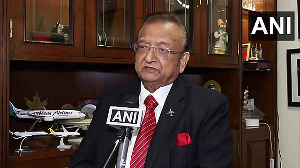
Dr N Ravichandran is a retired professor at the Indian Institute of Management Ahmedabad and was the fourth director of IIM Indore.
Feature Presentation: Aslam Hunani/Rediff










 © 2025