

'Personalities are temporary, policies provide for stability.'
'With the former, when personalities change so does the nature of the relationship.'
'Policies and structures, on the other hand, are idiot-proof, as well as maverick-resistant,' explains Saisuresh Sivaswamy.
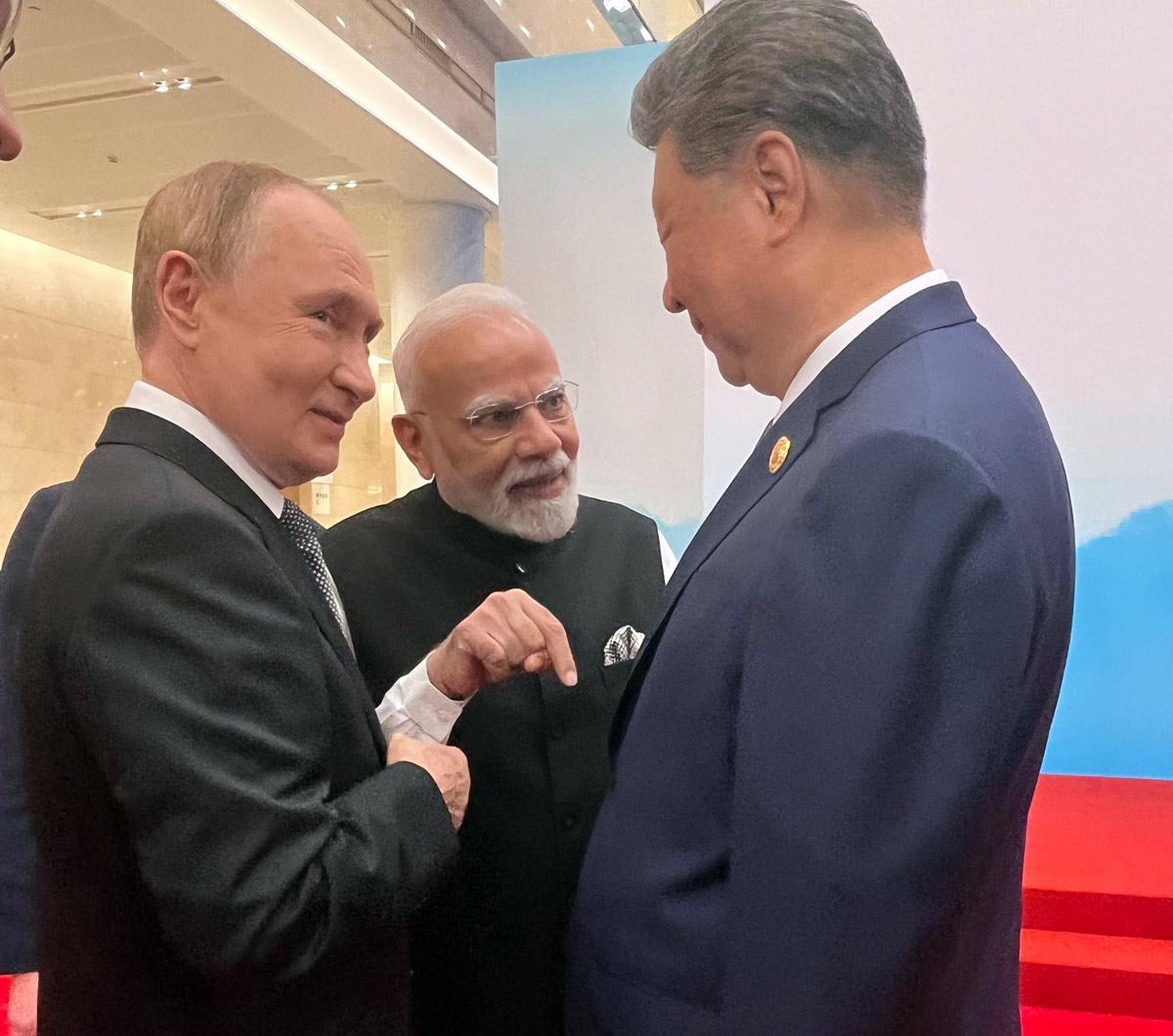
If there is a lesson to be learnt from US President Donald Trump's tariff tantrums that have singed India badly, it is that the limitations of personalised style of diplomacy practised by Prime Minister Narendra Modi since 2014 have been shown up.
Of course, the government will not be caught dead admitting as much.
Even as an incredulous public saw the bonhomie in Tianjin among Prime Minister Modi, Chinese President Xi Jinping and Russian President Vladimir Putin, as if to cock a snook at Trump, the closest the government has come to explaining the sea change in India's international relationships came from Defence Minister Rajnath Singh.
At the NDTV Defence Summit last week, Singh expounded on what is the cornerstone for all nations in their dealings with others: 'There are no permanent friends or enemies, only permanent interests.'
Since this is as basic a primer in international diplomacy as what they teach children in elementary school, did the Indian government err in substituting friendship with leaders in place of time-tested policy?
The answer is an unequivocal yes, but to be fair to the incumbent government, Prime Minister Modi had little choice but to embark on the path he did which, critics would aver, has brought India to the sorry pass where it finds itself.
When Modi was first elected prime minister in 2014, he became only the second provincial leader in Indian history to occupy 7 Racecourse Road/Lok Jankalyan Marg. All others have been part of the central government in various capacities or, like in Rajiv Gandhi's case, at least been part of the parliamentary structure.
The first incumbent without any awareness of or involvement with Delhi's power structure, H D Deve Gowda, was not very interested in external affairs, perhaps because 1996 was also the time when India was not punching above its weight. He was happy to leave the heavy lifting to his foreign minister I K Gujral who would go on to succeed him as prime minister.
By the time Modi got to occupy the most important job in the country, India had changed, the elephant had metamorphosed into a tiger. Not fully grown yet, but the potential to occupy Pride Rock was evident.
And along with India, the word too had changed unrecognisably. The old blocs had collapsed, a new kid on the block heralded his arrival next door, and there was limited room for ideological shibboleths of the past.
It was this world that Modi, a stranger to Delhi's ways and hither-to totally uninvolved in the global great game, stepped into in 2014.
The options before him were two-fold.
One, as with the previous incumbents, adopt a laissez faire policy towards foreign policy, put the ministry under a domain expert and simply provide the broad brush strokes.
Or, grab the bull by its horns, wrestle it to the ground, and make it his own.
It was not very different from what he was faced with in Gujarat in 2001 when he first became chief minister with absolutely no legislative experience.
Thirteen years later, when he stepped up to Delhi, Gujarat was firmly in his thrall, and continues to be so even 11 years after he moved out.
What he lacked in experience, he had made up with administrative overdrive and personal outreach, and thus was the cult of Modi born.
And this was the same template he adopted on moving to Delhi.
All prime ministers have to handle some nettles in foreign policy. Pakistan and China, both of who have fought wars with India, for one, and balancing the US and China/USSR for another.
How one handled them defines one's prime ministership, since the dealings also impact domestic politics to varying degrees.

If Dr Manmohan Singh had not visited Pakistan once in his 10-year term, despite his birthplace being there, he must have had strong reasons for it. And that should have warned Modi of the pitfalls of getting into an embrace with Islamabad. The experience of his party's first PM, Atal Bihari Vajpayee, should have made him more cautious, but the urge to make history often proves stronger than the pull of wisdom.
The trouble with putting all your eggs in one basket is that the basket could unravel, or the eggs could break under pressure. And this is exactly what happened for Modi with Pakistan's Nawaz Sharif and China's Xi Jinping.
With Sharif, Modi was so over-invested that when he was ejected from power India had no leg to stand on. And Pakistan continued to the graveyard of vanities it has been since the early days of the Republic.
With China Modi overplayed his hand, thinking that he could strike a balance between the conflicting interests of Washington, DC, and Beijing, till Galwan exposed the wiles and guiles involved in playing Chinese checkers.
What helped Modi survive these foreign policy disasters was his strong, ultra-nationalistic domestic constituency.
And the fact that he continued to enjoy warm relations with the Western bloc, particularly with Washington, DC, through three of its presidents.
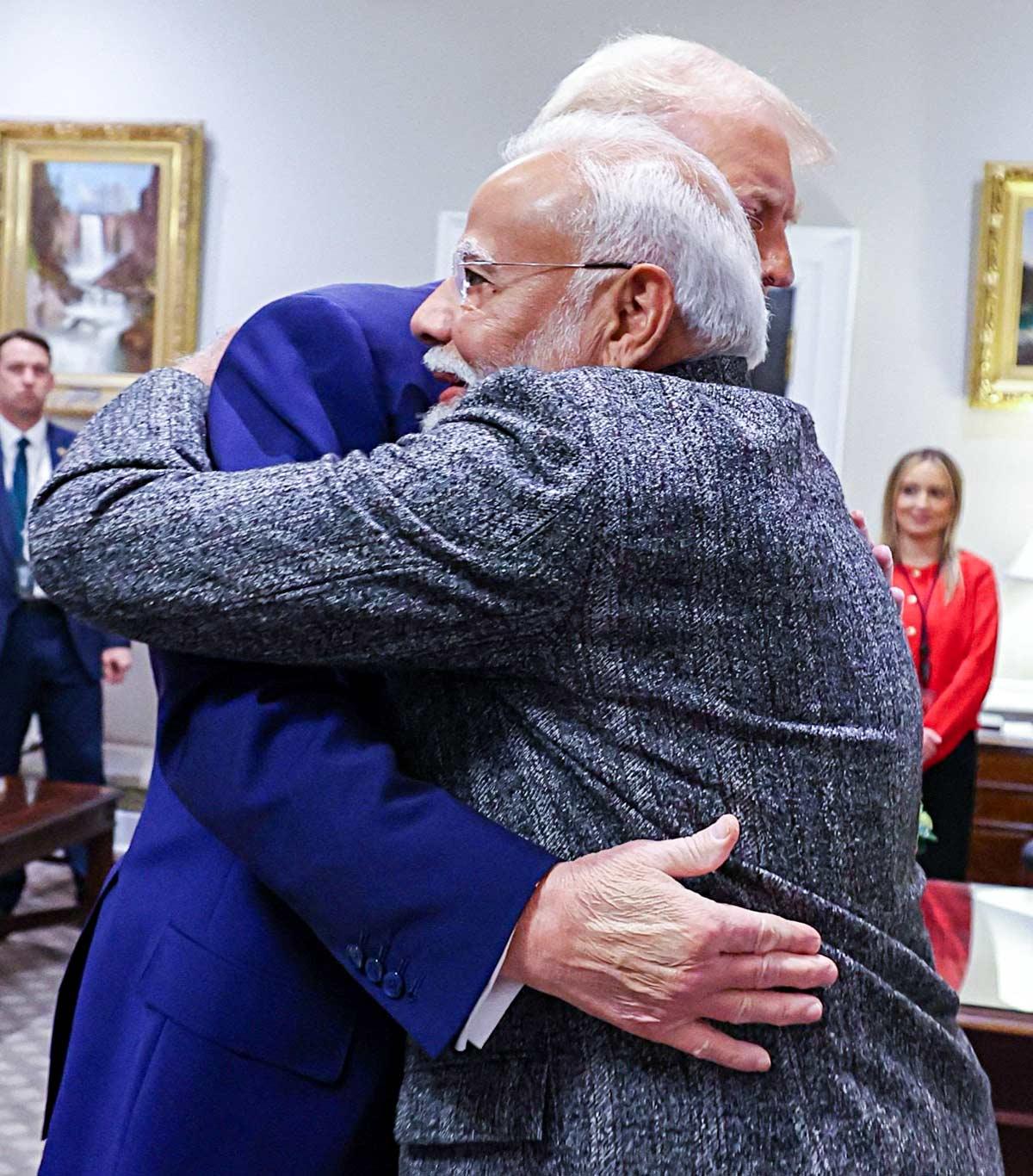
So far his personalised diplomacy had stood him in good stead, and the unravelling happened only because of his inability/failure to factor in caprice in the present occupant of 1600 Pennsylvania Avenue.
Maybe Modi did factor it in, but also figured that Trump's whimsy would play second fiddle to Washington, DC's need for India as a counterbalance to China.
If reports are true, the break in the Modi-Trump ties has Pakistan at the centre. Trump wanted credit for the cessation in hostilities between India and Pakistan post-Operation Sindoor, and a Nobel Peace Prize nomination, which Modi was unwilling to provide.
If true, Modi was right in his refusal. Agreeing to Trump would have cost him his domestic capital, nurtured so carefully with his image of a strongman who stares down superpowers.
So will the prime minister's Tianjin overtures to both China and Russia, see a reset in India's diplomatic outreach?
It could. But the downside cannot be ignored either, especially with China.
The takeaway from the debris that the once promising India-US ties has been reduced to, is this.
Personalities are temporary, policies provide for stability.
With the former, when personalities change so does the nature of the relationship.
Policies and structures, on the other hand, are idiot-proof, as well as maverick-resistant.






 © 2026