

Thanks to a close one's illness, I have seen quite a few hospital rooms in the past half a year or so.
They have revived my respect for life reinterpreted via its essentials, notes Shyam G Menon.
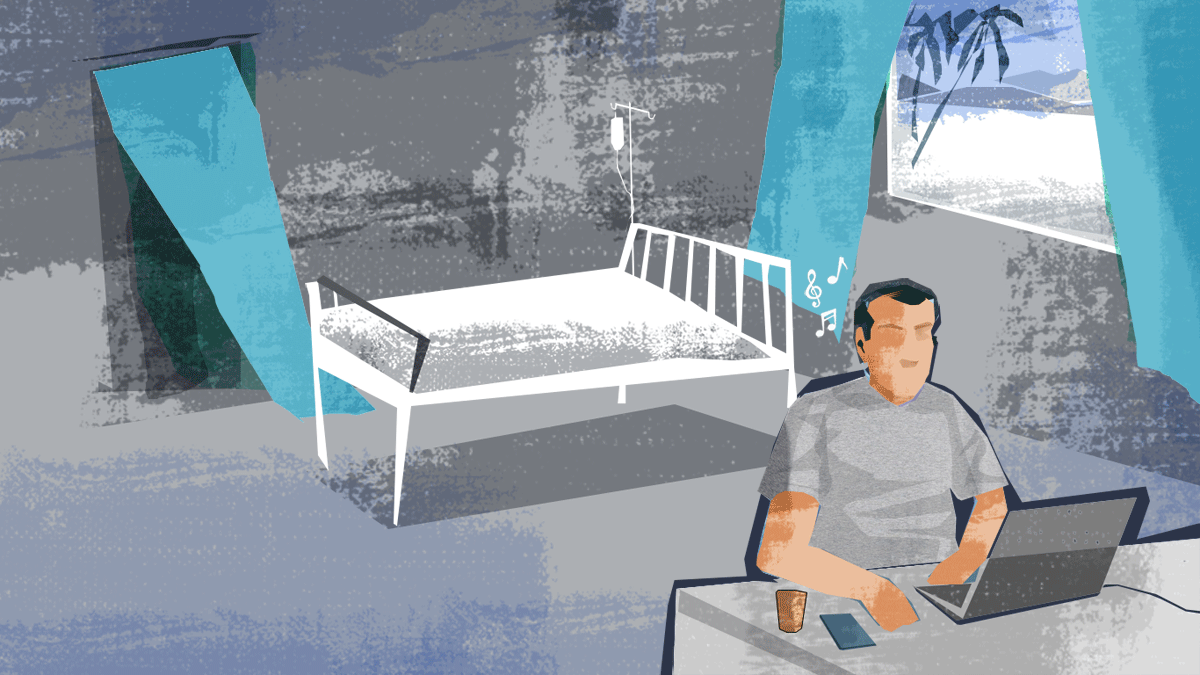
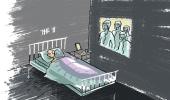
Hospital rooms are simple and compact.
They are adequate for a main bed hosting the patient and a slightly smaller one for the bystander.
Designed back from ease of providing medical care, the typical hospital bed ticks several boxes.
It is adjustable, can be wheeled around and can host attachable medical equipment.
Indeed, all the critical furniture in the room -- basically those relevant to the patient - can be adjusted and wheeled around.
A couple of cabinets present may be used to store stuff.
To a side on the wall is a television. Its screen size, I discovered from experience, fluctuated depending on whether the room allotted was a regular one or a deluxe.
The bathroom attached to the room is as compact as the room. And like the room, very clean.
I have often wondered if a small pantry or a kitchenette may be fitted in the main room.
If one plans and designs creatively (like the Japanese do in restricted spaces), it is possible -- that is my conclusion.
Same was the case as regards storage. In a different context for example, the bystander's bed could have a bottom hold capable of storing more belongings.
Probably because I have lived for many years in a small apartment in Mumbai, a city of limited space, I am at home in hospital rooms.
I don't, as Keralites used to big houses often do, recoil at the sight of limited space.
My only worry in hospital rooms is with reference to plug points.
I can't live without music. Both my mobile phone and Bluetooth speaker require periodic charging.
I believe in the healing power of music. So, the music I play at low volume in a hospital room is for the patient too.
Indian classical music -- Hindustani and Carnatic -- are wonderful. Add occasional forays into Western classical, jazz and soft rock; one has a sense of eternal universe by restless, shape-shifting molecules and atoms in the room, instead of an atmosphere of tragic mortality.
Music is one of our greatest discoveries. I use the word discovery because we just don't know who else on Earth senses it and to call music our creation would be terribly arrogant because what we are doing is -- harvest the available and rearrange it for melody and rhythm suiting us.
There's also another angle. Like much of the arts, looked down upon for being generally pointless in these times of careers by technology and management sciences, music engages for no distinct purpose.
Speaking for myself, I think that's why music is so fantastic. Its pointless peace and contentment. Likely therapeutic.
I can do without phone calls. But no music? That's like a prized attachment to universe, severed.
Then, there is that other indispensable of contemporary life -- the laptop.
In days of Work from Home, a slight modification to Work from Hospital Room is most viable.
As a matter of fact, I started writing this piece on my laptop, in a hospital room.
A couple of plug points in the hospital room, in addition to the ones reserved for medical use, make me happy.
Finally, hospital rooms are supported by shared, general facilities -- every big hospital has a cafeteria, a central kitchen and a housekeeping division. And herein, we must emphasise a major element.
At one level, as one reflects on the above descriptions, one would sense the borderline between a hospital and a hotel, blurring.
It is true to an extent. We have seen wellness packages and medical tourism grow.
The blurring of boundaries between the two industries is felt especially from the bystander's perspective.
That is a role requiring one to be around the patient while at the same time, spared the pain of illness and those dreaded jabs with needles.
If anyone says that hospital rooms increasingly feel like a no-frills, budget hotel room, I won't question it. But there is an attribute, which will always ensure the hospital room doesn't get abjectly confused with a hotel room.
Given they cannot ignore the paramountcy of being functional and focused on patient's needs, hospital rooms are never opulent or luxurious.
In their case, added investments are usually on the side of patient comfort (sensible comfort) and medical care. That sensibility spills over to the support services too.
The menu at hospital cafes and the food on offer at their kitchens are the practical, healthy sort.
They don't belong to the realm of indulgence. They stop short of it. And yet, fact is, there's a world of relevance available in that practical paradigm.
As we joked in one of the rooms we occupied -- if an electric motor and a steering wheel could be attached to the bed, already capable of flexing and tilting at the touch of a button, one could drive off.
Drive through town in a celebration of life by its bare necessities.
Cock a snook at all those in their fancy, expensive motorised steel cages on wheels. Here comes me on my hospital bed!
It is not hard to comprehend why hospitals flesh out life's necessities so well.
Illness is occasion to discard the luxuries of life. With apologies to the flourishing home delivery-industry, food is prime example.
Heard of someone battling a disease and gorging on rich, extravagant foods at the same time?
I remember what the owner of a leading bakery in Thiruvananthapuram told me of how, years ago, the southern city perceived bread.
It took time for Kerala's capital to warm up to bread as regular food because it was associated with the simpler foods doctors recommended during times of ailment.
Disease is usually a period of retreat and recuperation for the body and mind. And as we retreat so temporarily into a healthier diet, barring exceptions, most external luxuries are also done away with.
Vanity, ego -- we park them at home and report to the hospital; the indulgent comforts of one's home grow distant. There is the already simple dress one reported to the hospital in, traded since for the still simpler hospital gown.
All those investments in fashionable clothes, gold and jewelry appear meaningless except perhaps in terms of what the proceeds from their sale may mean as capital to treat one's disease.
Life shrinks to the relevant.
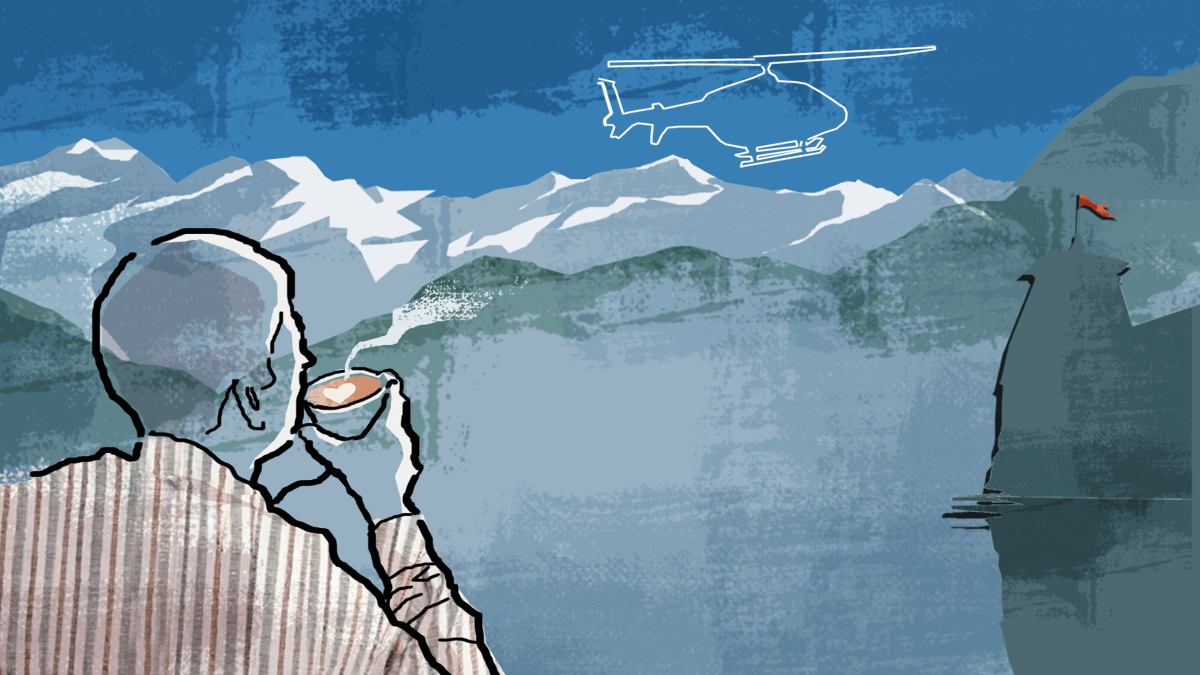
We shift from home to hospital, carrying with us only the indispensable things. Of course, what is indispensable varies from person to person.
Point is -- we identify exactly what we can't do without and typically, they aren't much; they fit into a suitcase or a backpack.
A bulb lights up in the brain of the contemporary consumer. Didn't think one could do with so little -- isn't it?
Why then do I accumulate so much stuff in my life?
Even at a mental level, a fog caused by an excess of the human predicament and habits therein, lifts, and a sanitised vision emerges wherein one's existence is shown for exactly what it is.
Consciousness in a progressively ageing body passing through a universe we still know very little of.
A monkhood, an appetite for philosophy (a subject few aspire to learn these days) -- they take hold.
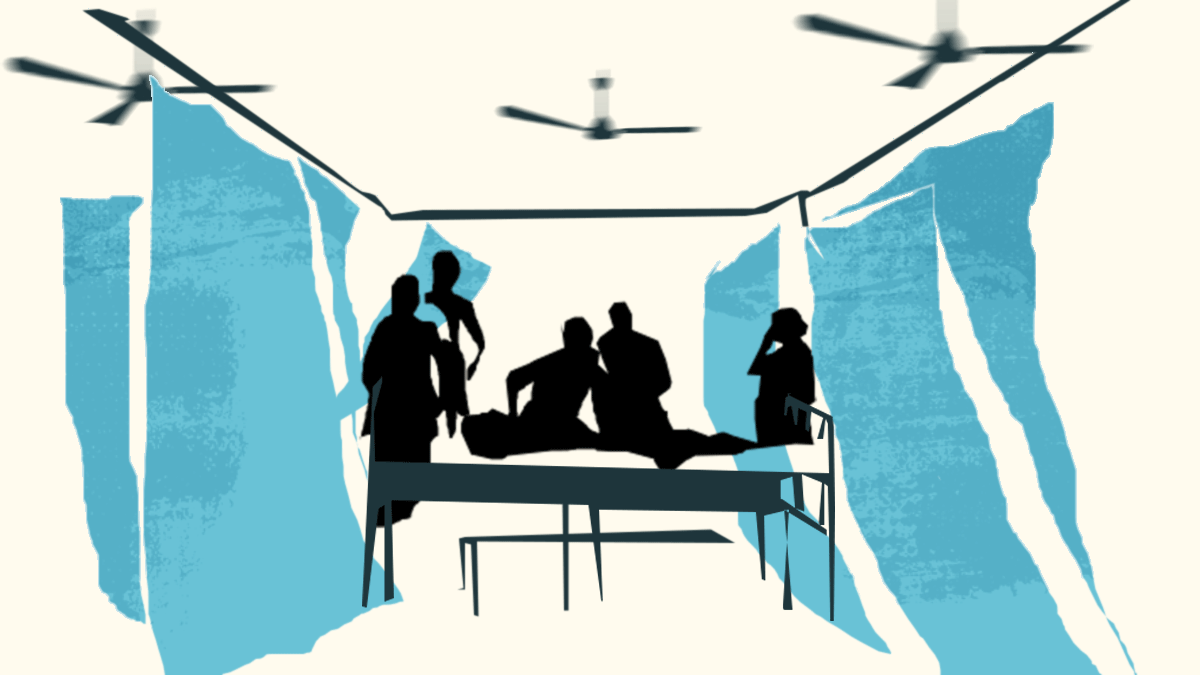
In a floor of several rooms or a ward of several beds, one becomes aware of total strangers (patients and bystanders) and their pain and suffering.
We value the hellos said. Even if only a few words are exchanged, in our mind, we fashion a community from that collection of strangers.
Thanks to a close one's illness, I have seen quite a few hospital rooms in the past half a year or so.
They have revived my respect for life reinterpreted via its essentials.
Step out of the room and the hospital it is housed in and one joins an urban life lost to selling a myriad luxuries and excesses.
When all one wants is a clean cup of hot coffee, one gets a cup of exotic coffee with fancy café, snooty snacks and ingredients of branding thrown in; the entire package costing a lot for the stamp of apartness promised.
When all one wants is something to satisfy one's hunger while waiting for a flight, one gets street food priced ridiculously high merely because it happens to be an airport and well, when one walked past the security guards at the entrance and into the gilded trap, one bid goodbye to commonsense.
When all one needs is a good, durable roof over one's head and rooms designed around life's necessities, one beholds villas and palaces positioned as the only route to certification by society that one exists.
When all one wants is a set of wheels to get from point A to point B, one gets a hunk of an SUV because it assures one dominance of the road.
When all one wants is a road, one gets a river of traffic bearing everyone and their SUVs. Its congestion by competitive consumerism.
When all one wants is to get away from everything and its excess, one is sold tourism and destinations spoilt by too much of it.
When all one wants is to live, one stares at medical bills that stretch one's capacity to afford.
When all one wants is to search for an alternative take on life, one is told the search is useless for all that was to be found has been found and only the subsequent monetisation and shifting dynamics of power in the human collective, remain.
When all one wants is spiritualism, one is gifted religion, pilgrimage and ritual - none of which, are always the same as being spiritual.
When all one wants is to find oneself, one is offered the identity of subscribing to a collective or a mob, both of which blank the self and the larger world, out. The list goes on.
Sometimes I feel, we must embark on a journey to rediscovering what truly counts for each of us.
Like visualising life from a hospital room.
Shyam G Menon, is a freelance journalist based in Mumbai
Feature Presentation: Ashish Narsale/Rediff








 © 2026