

The well-fought defensive battles in Aksai Chin and eastern Arunachal, in remote and forbidding locations such as Galwan, Rezang La, Gurung Hill and Walong, effectively halted Chinese advances not once but twice during the campaign.
These engagements, fought with grit and without adequate support, were not immediately known to the world in 1962, points out Dr Kumar.
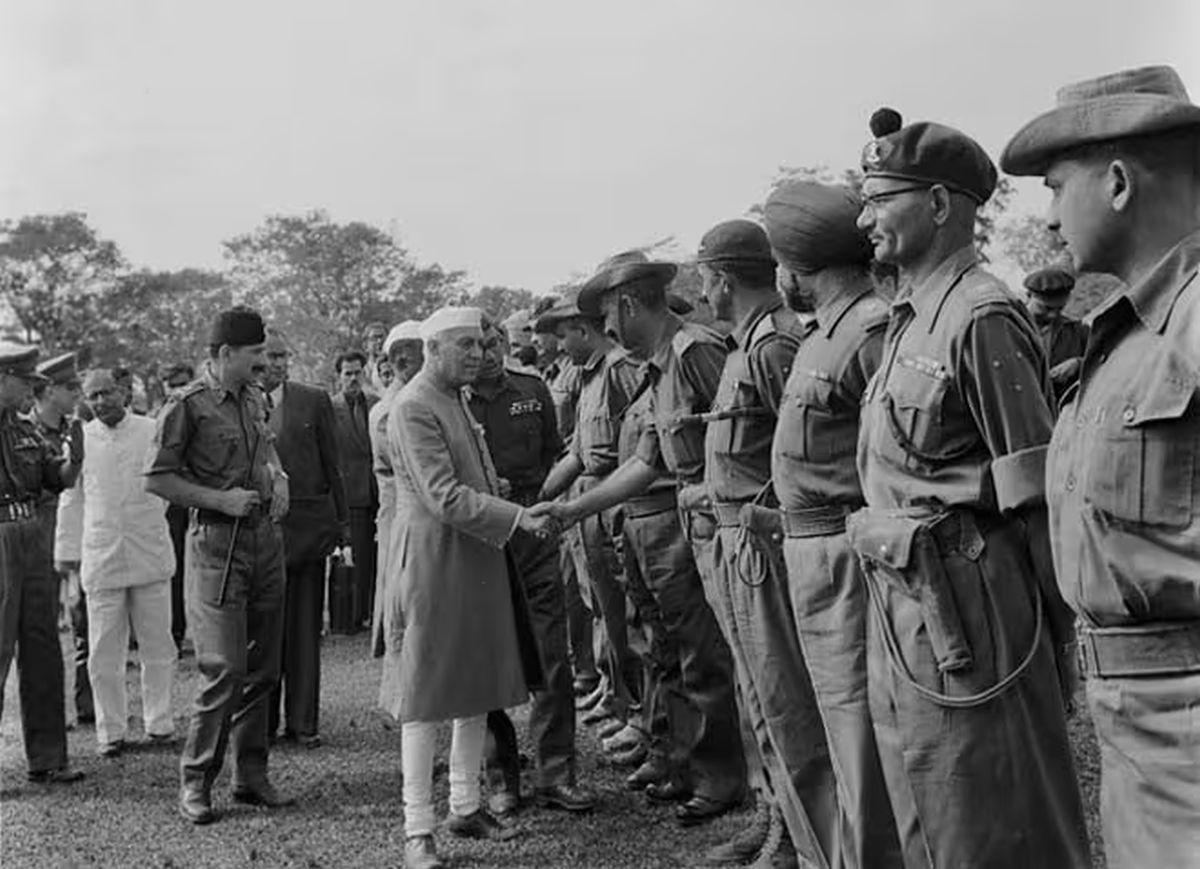
Amidst the Doklam crisis of 2017, China was quick to invoke the memories of the 1962 Sino-Indian conflict, an episode deeply etched in the annals of India's post-independence history as the only politico-military defeat.
While India did indeed absorb vital lessons from that tumultuous period, it is now a fitting juncture to reiterate the lessons we, too, imparted to China during those trying times.
On November 21, 1962, China declared a unilateral ceasefire and began preparing to withdraw.
Much has been written about the reasons for this decision, ranging from Beijing's desire to project itself as a principled power to the threat posed by the growing prospect of American support to India.
Mao Zedong's internal political challenges, his weakening position within the Chinese Communist party after the disastrous Great Leap Forward, and the practical difficulties of sustaining large-scale operations through the harsh Himalayan winter would also have influenced his decision.
However, one crucial aspect remains that has rarely been mentioned in most discussions: The lesson the Indian Army taught China on the battlefield, a lesson that would have profoundly shaped the thinking of the Chinese leadership.
It took India's political establishment half a century to acknowledge the valour and sacrifices of its soldiers during the 1962 conflict.
For decades, the war was remembered only as a national humiliation. It was only in 2012, when the Indian Army officially commemorated the fiftieth anniversary of the conflict, that the nation began to reflect on the strategic importance of the defensive battles fought by Indian troops at locations such as Rezang La and Walong.
These were battles that halted the momentum of the People's Liberation Army, even if they did not alter the overall political outcome.
The burden of a one-sided narrative
India's defeat in the brief conflict had an immediate and visible impact on its foreign policy and military establishment.
The political shock was immense, leading to a rapid overhaul of defence preparedness and foreign alignments.
Yet, what proved more damaging in the long run was not the defeat itself but the narrative that emerged around it, a narrative that painted India as naive, ill-prepared, and militarily incompetent.
The war was remembered through two contrasting but equally limiting frames. On one hand, it reinforced the image of an expansionist, disciplined, and battle-hardened Communist China.
On the other hand, it portrayed India as a pacifist State led by idealists who had sent an ill-equipped army to face an inevitable disaster.
Later, coinciding with the United States' outreach to communist China in the late 1960s and early 1970s, the narrative shifted again.
India was no longer portrayed as a victim but as the instigator of the conflict through the so-called Forward Policy.
This reinterpretation suggested that India's own actions provoked China's response, conveniently diverting attention from Beijing's long-standing designs on Tibet and its gradual push across the frontier.
In both narratives, however, one constant remained: the idea of India's military humiliation.
This version of history became deeply entrenched in the national psyche and in global understanding of the conflict, obscuring the fact that the Indian Army's conduct in several key engagements was both courageous and strategically significant.

Understanding defensive warfare
In defensive battles, success is not always measured by the ground held but by the delay and damage inflicted on the adversary.
A commander's task may not be to defend every inch of territory but to impose prohibitive costs on the enemy, to buy time, and to preserve the fighting potential for future phases of battle.
Tactical withdrawals and retrograde operations are not indicators of failure; they are integral to defensive warfare when faced with overwhelming odds.
In 1962, Mao ensured that at most points of contact with Indian defences, the force ratio heavily favoured China, often as high as 10:1.
The asymmetry in preparation, equipment, and logistics was stark. Yet, despite this imbalance, the Chinese suffered staggering losses, which they have never publicly acknowledged.
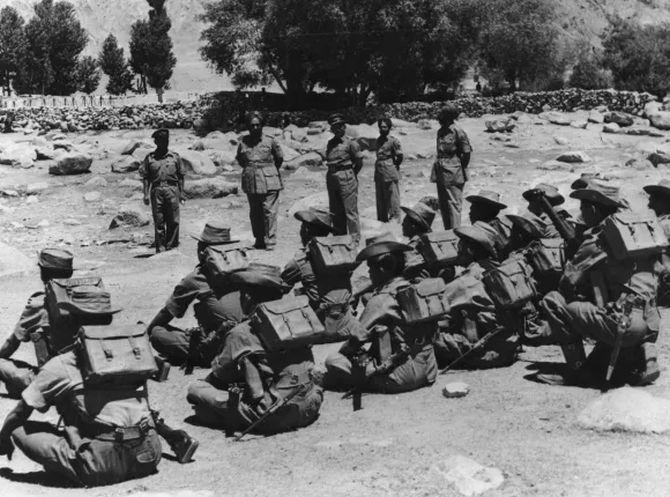
The Indian Army, operating under extreme disadvantage, demonstrated remarkable tenacity, inflicting disproportionate casualties and compelling the PLA to repeatedly pause and reorganise.
The untold side of the war
The well-fought defensive battles in Aksai Chin and eastern Arunachal, in remote and forbidding locations such as Galwan, Rezang La, Gurung Hill and Walong, effectively halted Chinese advances not once but twice during the campaign.
These engagements, fought with grit and without adequate support, were not immediately known to the world in 1962.
What dominated the headlines instead were the reverses along the Namka Chu axis and the early withdrawal from Sela, which together created the impression that the Chinese were poised to descend into the plains of Assam.
The larger picture, that Chinese columns had suffered enormous casualties elsewhere and were forced to halt, regroup, and even change commanders, went largely unnoticed.
Domestic and international media of the time, guided by incomplete and sometimes politically influenced information, painted a bleak picture of total collapse.
What got lost in the telling was that on multiple fronts, the Indian Army had held the line long enough and fiercely enough to force the PLA into a tactical pause.
Those hard-fought defensive stands, although not celebrated at the time, carried profound strategic consequences.
They slowed the pace of China's operations, imposed severe attrition, and exposed the logistical limitations of conducting sustained high-altitude warfare across multiple fronts.
Above all, they demonstrated that Indian soldiers, when given a clear purpose and ground to stand on, would fight to the last man and the last round.

Such battles inevitably leave an imprint on the adversary's mind.
While political narratives can be rewritten, battlefield experiences have their own lasting impact.
The PLA's leadership, despite its public posture, could not have missed the message that Indian resistance, even in its weakest moment, came at a cost China could ill afford to pay repeatedly.
These are the lessons that were never discussed in Beijing's official histories, nor acknowledged in most Western analyses that followed.
Yet, they remain central to understanding why China chose to declare a unilateral ceasefire when it did, and why subsequent border confrontations have been approached by the PLA with far greater caution.
With inputs from Colonel Anil A Athale (retd), who had compiled the official history of the conflict.
Dr Kumar is a Research Scholar who has extensively researched the 1962 Sino-Indian conflict and the Cold War dynamics.
Feature Presentation: Aslam Hunani/Rediff






 © 2026