

'Things may get much worse before they get better,' predicts Ajay Chhibber.
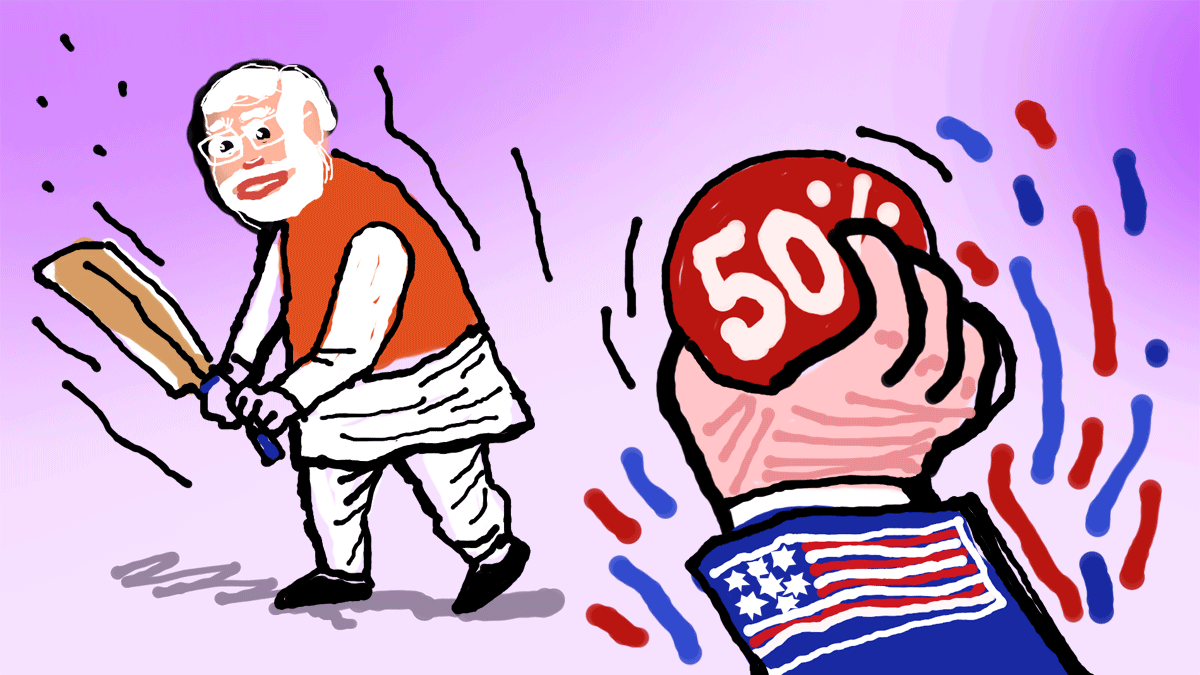
The gradual improvement in India-United States relations that began with President George W Bush and was deepened by every US President since then has been upended.
India is no longer seen by Donald Trump as a strategic partner in the geopolitical contest with China.
Mr Trump's punishing 50 per cent tariffs and repeated insults have pushed India closer to China.
The Indian prime minister attended the Shanghai Cooperation Organisation meeting last week after a seven-year hiatus and was welcomed by Chinese President Xi Jinping -- something that would have seemed very unlikely just a few weeks ago.
The US will eventually realise that India cannot be bullied, but things may get much worse before they get better.
Mr Trump is urging the European Union to impose sanctions on India.
Restrictions on H-1B and student visas are on the anvil, and Mr Trump has just scuttled a Quad meeting that was to be hosted by India later this year -- a grouping he had resurrected during his first term to counter China.
China emerges as the big winner from all of this.
US Treasury Secretary Bessent believes that a bilateral trade agreement (BTA) with India is still possible. However, Mr Trump may not allow it.
According to him, India has even offered zero tariffs on some items -- but that it's too late.
Personal reasons have also been cited for the rupture, including Mr Trump's reported pique over India's failure to acknowledge his role in the ceasefire with Pakistan, which he considers a Nobel-worthy achievement.
Mr Trump keeps hammering India's trade surplus with the US, but when you factor in what Indians spend on education at American universities (roughly $25 billion a year), royalties, defence purchases, and e-commerce revenues, India actually runs an overall balance of payments deficit with the US.
An appellate court in the US has ruled Mr Trump's tariffs illegal, but the case is expected to end up in the US supreme court -- which generally rules in his favour.
Two liquids -- oil and milk -- have been blamed for the delay in the BTA.
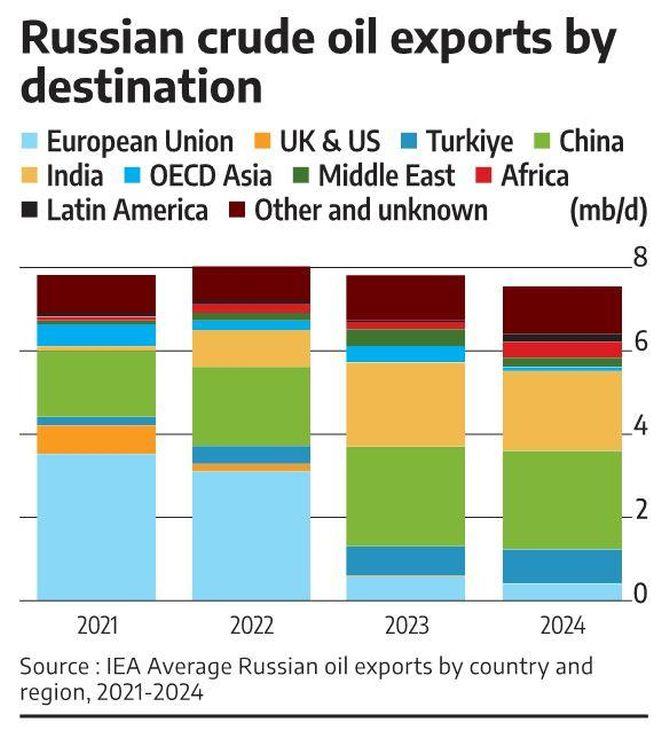
Mr Trump's extra tariffs on India's purchase of Russian oil make little sense, especially considering he just gave a red-carpet welcome to Putin in Alaska, and both the US and EU continue to buy gas, fertilisers, uranium, and palladium from Russia.
India, China, and Turkiye have absorbed most of the crude that the EU and US stopped buying from Russia -- without which global oil prices would have spiked.
So why single out India? (see chart).
The US must also get reasonable on agricultural products -- especially milk.
If the US provides huge production subsidies, which then force its milk producers to dump milk in global markets, it's unreasonable to expect India to allow such imports.
Doing so would severely affect the livelihoods of 80 to 100 million people engaged in livestock farming alone in the country.
Mr Trump's actions, including singling out Brazil and South Africa unfairly with very high tariffs, have pumped new life into the Brics grouping.
Now India and China are looking for ways to strengthen the group as they each chair the Brics+ meetings in 2026 and 2027.
How long this bonhomie lasts, of course, given the border dispute and China's desire to be pre-eminent in Asia, remains to be seen.
The famous American political scientist John Mearsheimer says past US policies brought Russia and China closer, and now Mr Trump's actions may push India into that bloc -- or at least much closer to it.
While Brics may offer India some geopolitical benefit, its economic benefits are small for now.
The Brics+ group, with a gross domestic product or GDP of $32 trillion (27 per cent of global GDP), does not offer the same market as the G7, with a GDP of over $50 trillion (45 per cent of global GDP).
Moreover, of the combined GDP of the Brics +, about $20 trillion comes from China, a market where India's exports struggle and are unlikely to rise substantially.
India's path to prosperity lies in increasing exports to, and attracting technology from, the G7 countries.
A trade agreement with the US and the EU is vital for that target.
Without it, India will not only lose its largest export market but also miss out on new investments in a China+1 world, which will now flow even more to Mexico, Vietnam, and other countries where tariffs into the US market are lower.
India can cushion some of the immediate impact of a 50 per cent tariff on exporters by allowing the rupee to depreciate against the US dollar, especially as inflation is running low.
Providing tax refunds and loan forbearance to exporters to the US, and eliminating tariff and non-tariff barriers on their required inputs, will also help.
A very important aspect of the wakeup call is the need to intensify domestic reforms to reduce the cost of doing business.
The much overdue but now accelerated GST reform -- to reduce the number of rates and lower them -- is very welcome.
Bring fuel into the GST fold to lower fuel prices in India, which remain above our main competitors -- despite access to cheaper Russian crude.
The cross-subsidisation of electricity and rail freight, which add to the cost of doing business, must also be reduced.
And once more, freeing up the labour market by removing the Industrial Disputes Act, adopting a more rational land-use policy, and reducing high banking margins should be a priority.
A trade deal with the EU and efforts to join other trade groupings like the Comprehensive and Progressive Agreement for Trans-Pacific Partnership (CPTPP), a well-planned drive to attract tourism where India underperforms hugely, will also show that India is open and ready to engage.
Albert Einstein said, 'In the midst of every crisis, lies great opportunity'.
India must keep trade negotiations with the US open -- without giving up its vital interests.
The rich and supposedly influential Indian American lobby in the US should also be mobilised to inject more sense into US policy towards India.
But Trump's geoeconomic quake may well turn out to be the shock that forced India into its much-awaited and badly needed second generation reforms that propelled it forward.
In the end, if India is stronger at home, geoeconomics will also swing its way.
Ajay Chhibber is distinguished visiting scholar, Institute for International Economic Policy, George Washington University.
His book Unshackling India (HarperCollins India) was declared the best new book in economics in 2022 by the Financial Times, UK
Feature Presentation: Aslam Hunani/Rediff







 © 2026