
Walking away is easier when nothing is at stake. It is far harder when you must break away from your core.
Those who manage to do this are truly admirable because it takes immense courage to choose yourself when that becomes the only path to survival, notes Aarti David.
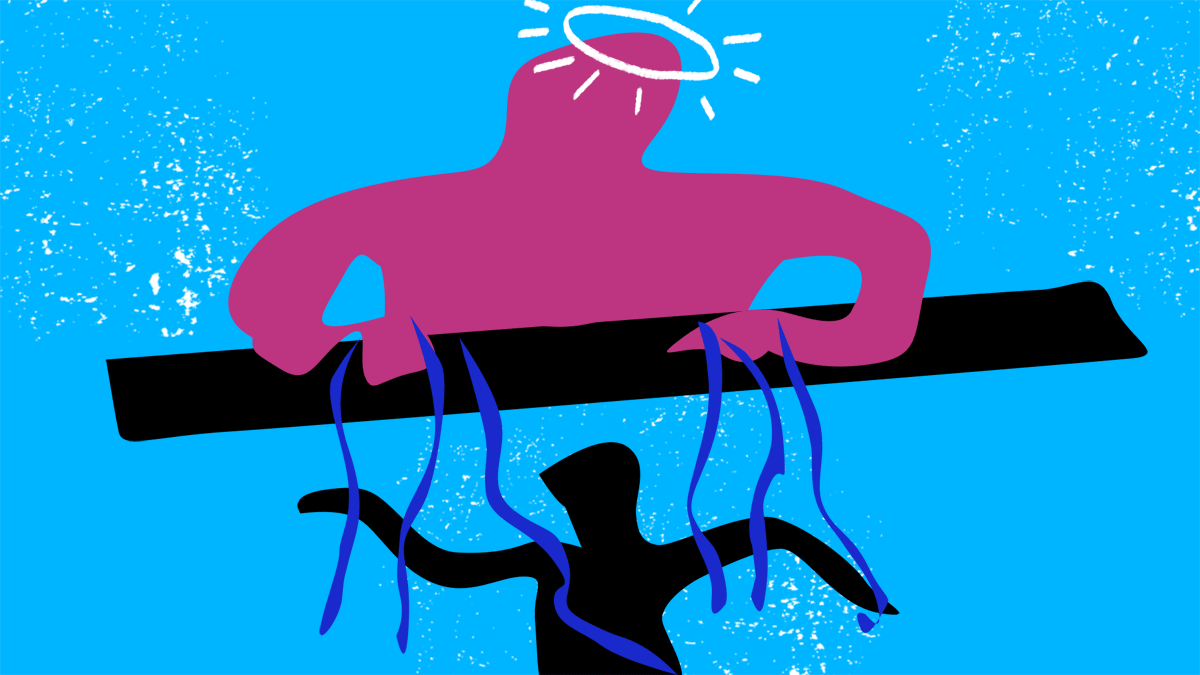
Some of us may have encountered a relative, friend, or someone in our circle who suffers from a God complex.
What is a God complex, you might ask?
It describes someone who believes they are the centre of everyone's universe and that without their intervention, everything would collapse; they feel superior to those around them and like to emphasise their own importance at all times.
What should one do when stuck with such people in life?
How do you tell them that you don't need their advice or recommendations?
How do you keep them from invading your everyday existence?
How do you explain to others that you're not hallucinating or imagining stuff, and that this person's concern, cloaked in care, is wrapped in sarcasm or disguised as statements meant for 'our own good', is in fact deeply hurtful and resentful?
When I was younger, everything seemed simple -- all black or white.
But as I grew up and understood the intricacies of the world, I realised that there are many shades of grey and that it is important to acknowledge those too.
Turning a blind eye doesn't erase uncomfortable truths.
Each of us builds a safety bubble where we feel at ease and at peace, yet that bubble cannot always protect us.
Cruelty doesn't only exist in the movies we watch or the books we read, where a villain or an evil character is waiting to attack or torment us.
Sometimes, unbeknownst to us, it lives within our closest circles. And those who torment us leave us completely shaken and confused.
So much so that we end up questioning ourselves for simply reacting to the pain we feel in that situation.
Let's face it, not everyone is confrontational by nature.
Many find themselves in a bind, unable to call out such people, no matter how much their behaviour has affected them.
They prefer to withdraw rather than be part of unnecessary drama.
But this avoidance often breeds suppressed emotions, which manifest in unexpected ways, making them reclusive, detached or wary.
The thing with narcissists or people suffering from a God complex is that they convince you the problem is 'you', not 'them'.
They twist the narrative so subtly and convincingly that you are left doubting your own judgment.
They conveniently portray themselves as the victim, making you seem like the aggressor.
And insist that your actions hurt them or, worse still, provoked them to act in a certain way.
Their communication is so calculated that no one around believes that they could be the source of such anguish.
Most such people appear to be extremely popular (no marks for guessing that) and have a charming personality.
That allows them the leeway to get away with almost anything. After all, isn't that how the world works?
Such people feed off others' vulnerabilities. They make you believe that you need them in your life, and without them, you would get nowhere.
They position themselves as indispensable to your life and decisions. They make you uncomfortable, yet somehow, there is no escaping them.
You find yourself questioning your own reactions and eventually feeling guilty for daring to say something at all.
I often wonder: How much is too much?
When does the water rise above head level?
And can we voice how we feel without it boomeranging on us?
A recent article in Britain's The Independent newspaper addressed the issue of family estrangement, with stories of children who walked away from toxic parents or siblings or parents who did the same.
And I found myself wondering what drives people to such extremes.
To never want to speak to or see their family and cut ties so completely that they no longer seek closure.
It's a sobering reminder that suppressed hurt eventually reaches a breaking point, and when it does, we may choose to remove these people from our lives entirely, without explanation or remorse.
And even though it seems heartbreaking and perhaps selfish at some level, it could simply be an act of self-preservation.
I'm currently reading Arundhati Roy's Mother Mary Comes to Me, where she writes, 'I left my mother not because I didn't love her, but in order to be able to continue to love her. Staying would have made that impossible...'
Maybe the real question isn't how much is too much, but how much of ourselves are we willing to lose before we stop such people or behaviours.
Each of us has an inbuilt radar, a sixth sense that signals when something is not right.
But when the signal comes from those closest to us, it shakes our very foundation. We freeze, unable to take any action whatsoever.
When going through life, we are all expected to adjust and relent.
It is automatically assumed that we will willingly compromise in every circumstance because that's how it's meant to be.
That's how it has always been done. Through generations, this is what we are taught within our families.
We always stick together, and breaking away from blood relations, especially your immediate family, is unthinkable.
It isn't something that is looked at kindly.
It is seen as a weakness and assumed that you might not have tried hard enough to maintain the relationship, or a failure to make things work.
A lot of talk also happens around how, in today's time, no one is willing to go the extra mile to keep things going or prevent them from cracking or breaking apart.
And that we are too influenced by the Western world and are too quick to react.
But is quietly accepting abuse of any kind, truly a testament to our endurance and perseverance or commitment to a relationship?
Walking away is easier when nothing is at stake. It is far harder when you must break away from your core.
Those who manage to do this are truly admirable because it takes immense courage to choose yourself when that becomes the only path to survival.
I only wish we didn't have to make such hard and life-altering decisions, and that the world had better people.
People not consumed by themselves but willing to lift others.
All it really takes to so little to make someone's day, just a bit of kindness, isn't it?
Like Rumi says, 'Listen with ears of tolerance. See through the eyes of compassion. Speak with the language of love.'
Feature Presentation: Ashish Narsale/Rediff









 © 2025