
 If people in India and China want to live the way Americans do, then we need five to six planets,' Yu Jie, program advisor in Beijing for the Berlin-based Heinrich Boll Foundation says. 'If people want to improve their lives, what shall we do?'
Jie voices her concern in a special programme, Global Watch, which premiered on PBS (Public Broadcasting Service) April 9. The 30-minute special seeks a global perspective on important issues in America, with a focus on how the United States is perceived abroad. It is available online at pbs.org/globalwatch
The influential Pew global attitude survey discovered that the world's opinion about America has declined since 2002, says Global Watch anchor Daljit Dhaliwal, who presents the programme from Los Angeles.
Of the 33 countries polled, opinion about the US has fallen in 26.
"We turn the camera on ourselves and ask the question: What does the rest of the world think of us?" she says.
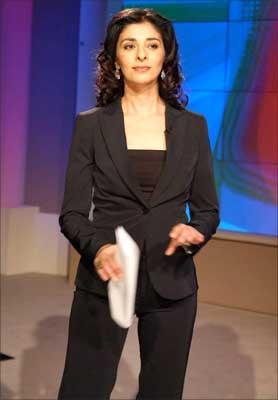
Britain-born Dhaliwal has lived in the United States for nearly six years. She anchors Foreign Exchange, a weekly half-hour international affairs discussion program on PBS since January; her predecessor Fareed Zakaria anchored it for three seasons. Dhaliwal, petite in a dark pantsuit, appears in front of giant screens in the Global Watch studio which is bat-hed in blue and purple.
The programmes' three segments feature field correspondents Gordon Corera, Mark Mullen and Judy Muller. It trains its lens on China, which questions American criticism on the environmental front, arguing that the United States is one of the chief polluters in the world; it looks at the US Presidential campaign through the eyes of foreign journalists covering it. It also explores why support for America's war on terrorism has eroded among its traditional Western European allies.
Michael Clarke, director of Britain's Royal United Ser-vices Institute for Defence and Security Studies, tells BBC security correspondent Corera that though Britain shares its basic outlook on the world with the United States, 'we do pay a certain cost for American mistakes.
If those mistakes are regarded as avoidable, if they are mistakes that come from what's often seen here as a gung-ho attitude with a cowboy mentality -- that's the way it's phrased here -- then those mistakes are regarded as unacceptable.' To a wide portion of the British public, the invasion of Iraq was such a mistake, the commentary says.
Muller reports on the journalists from 17 countries who attended the Democratic and Republican debates and were intrigued by the American election process. A Zimbabwean reporter was surprised to see Hillary Clinton and Barack Obama hugging. 'Could you have Robert Mugabe and Morgan Tsvangirai doing that?' he asked.

The programme is interspersed with opinions people across the world share online. Dhaliwal reads one from a girl who lives in Mosul, Iraq: 'There is no bright side in this war but in these four years I became stronger, an independent person. I realize how much I love Iraq. I didn't know how much Iraq means to me until I saw it destroyed.'
Global Watch would like to tap into emerging media if it gets the chance to expand, Dhaliwal says. While reports by expert journalists are crucial, it would also like to work with citizen journalists like bloggers and vloggers (who create video footage).
Dhaliwal hopes Global Watch will be received well enough to offer the opportunity for creation of more episodes. "There are so many interesting and compelling stories that we would like to tell, and a 30-minute special can only scratch the surface," she says in an e-mail conversation with India Abroad.
The feedback from colleagues and others in the industry has been extremely encouraging. "Some have commented it's overly critical and others feel we do not turn the cameras on ourselves enough," she says. "This is the kind of conversation we want to generate and hope to continue."
Conventional wisdom says people in the United States are not very interested in international news.
Dhaliwal feels otherwise; though there is a lack of international programming, she says, it does not mean people aren't interested. "I think some of our viewers may find it surprising that, when you look at the US from outside its borders, opinions about America aren't black and white. Perhaps one way is to have programmes that make issues and stories more relevant and interesting to people's lives.
"I'm really not one for conventional wisdom because I feel it is important to push the envelope," she adds.
Her experience as a broadcaster, she says, has shown her that there is an audience for international programmes, particularly on PBS, who are curious and interested in what's happening in the rest of the world. "So long as that's the case, we should carry on making programmes, with international content."
"It's odd in a way because you often hear similar things about how some Americans aren't interested or have lost faith in politics and their politicians, but how often do you hear anyone saying -- well, let's stopping covering the news out of Washington for that reason?"
Dhaliwal's parents migrated to Britain from Punjab and she studied at the University of East London. She began her broadcasting career as a regional news reporter trainee for the BBC.
During her 16-month secondment she reported for several newsrooms, including Northern Ireland. She later became an anchor for BBC World in London. In 1995, she moved to Independent Television News, where she anchored the daily World News for Public Television that reached viewers in the United States. She is also known in public broadcasting through the PBS series Wide Angle, where she introduces a featured current affairs documentary and follows it with hard-hitting interviews with experts in the field.
"I'm interested in how and why the 'big stuff' happens and how it impacts people," she says. "My preference is to cover global, political, social issues and to do that in a variety of different ways like interviews, reportage, documentaries."
That America loved her was evident when Esquire magazine listed her among the 'Women We Love' in 1999. The same year, she was on People's list of the world's 50 most beautiful people. There is an unofficial appreciation page for her on the web, where a photo gallery and clips from her interviews are available.
In 2002, Dhaliwal moved to Atlanta to anchor CNN International's Your World Today. Two years later, she moved to New York. "It's my kind of town," she says. "Also, at some point, in this industry -- at least for me -- all roads lead to New York."
"I think our traditions are very similar," she says.
"The American broadcast market place is much more crowded than the UK, which makes for more opportunities. There are also differences in how we use English but I'm getting used to that after living here for nearly six years.


 © 2026