Russian President Vladimir Putin on Wednesday handed over the reigns of Kremlin to his handpicked successor Dmitry Medvedev in a power-transfer exercise, which seems a formality as the former KGB officer looks set to wield control as the country's new prime minister.
One of the novelty of the transfer of power -- that took place in the Grand Kremlin Palace -- would be emergence of a 'joint rule' if not 'diarchy', with Putin moving to Bely Dom as Russia's new prime minister on May 8.
Putin, 55, after two consecutive terms totalling eight years stepped down at the peak of his popularity.
According to the latest opinion poll conducted last week, Putin's popularity rating stood at an admirable 84.7 per cent, the most-ever enjoyed by any outgoing leader of the country.
As a President, Putin has been credited with radically enhancing the international prestige of Moscow and putting Russia back in the team of global players. However, at an earlier occasion, Putin has said that the prime minister's office is the highest executive power in the country.
Putin got the reins of power from a feeble Boris Yeltsin, who in the backdrop of the war with Islamists in Chechnya realised the crash course of the former superpower and stepped down on the New Year eve in 1999 to give way to a younger leader, albeit loyal to him.
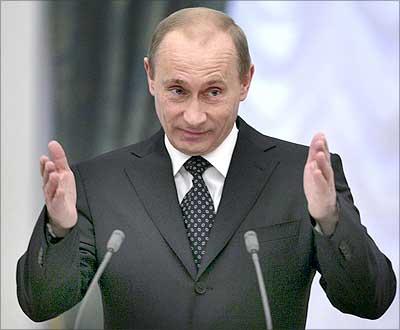
Image: Vladimir Putin speaks at a state awards ceremony at the Kremlin in Moscow on April 29.
Text : From Agencies | Photographs: Natalia Kolesnikova/AFP/Getty Images
Also read: President Putin's abs-olutely hot!
 Advertisement