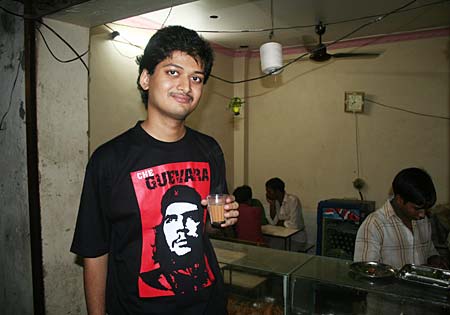
Kunal Nachane, 26
Banker
Brand-building textbooks across B-school campuses in India cover what we could call the most prominent capitalist institutions of our times -- Nike, Coca-Cola, Harley-Davidson and Ray-Ban. The concept of branding is in fact viewed as a supremely capitalist exercise, the corporate's insidious way of getting into the consumer's mindspace, to cajole, to persuade, to inveigle the woman on the street to buy their products.
Ironic, then, that history may well judge the most iconic brands of the last century to have been -- not the litter of FMCGs or the personality cults of the 'great' CEOs, the Welch's and the Gates, but the Communist icons -- Lenin, Chairman Mao and Che Guevara.
Today is the 40th anniversary of the day Bolivian soldiers, acting on CIA orders, mutilated, killed and decapitated Ernest 'Che' Guevara de la Serna in a schoolhouse in Bolivia.
The one-time foot-soldier of Fidel Castro's revolutionary army now has his image emblazoned on t-shirts, coffee mugs, tea coasters and lavatory seats. The famous Alberto Korda photograph stares at us on the backs of and from the hands of people whose closest association with socialism was probably singing karaoke at their 'College Social'.
What, then, is Che's legacy to modern India? While he continues to be a near-religious icon in most parts of Latin America and a symbol of counter-culture and protest in Old Europe, how do the people of a country that declares itself a 'Sovereign Socialist Secular and Democratic Republic' view him?
The answer is not easy to find or define. This is, after all, a vast country with, at the very least, a vast educated class, if not quite a vast intellectual class. In pockets of Kerala and West Bengal he's the feted darling of the chattering classes, to the Naxals an undiluted hero. But to the so-called progressive, urban Indian youth, brought up in the best traditions of the religion called Consumerism, ingrained with the idea that money equals success and that a flourishing career equals happiness, Che is little more than a footnote in the history textbooks. Few have heard of him, fewer know who exactly he was and fewer still about his ideals, beliefs or his life.
But Che, to me, will always be about much more than that. A man who lived life in shades of gray, and who I believe, was quite aware of it. He was anything but perfect, his methods often reported to be as brutal and repressive as the regimes he railed against, his intellectual arrogance a sharp counterpoint to his legendary empathy for the oppressed. As he said himself in the last words attributed to him, 'You kill only a man'. And yet, this man has come to outlive in spirit many self-proclaimed 'Gods'. He speaks to us from beyond the grave, his image still stands as the symbol of 'One Man Fighting Against an Empire' – ironically not unlike Gandhi, whose firm belief in non-violence so sharply contrasts Che's commitment to armed revolution.
I think his greatness -- and great he was -- comes as much from the trips he took across Latin America in the days before his notoriety as it does from the deeds of arms that he did to earn it. This was where the young Che saw how the people lived, when he learned to regard them as 'his' people, when he first began to think about what he could do to rescue them from their lives of voiceless desperation. It was here that Che the man became something more, because he chose to do more than just 'travel' through the countryside. He chose to see the people. All he did -- and this is incalculably harder than it sounds -- was open his eyes.
Which brings us back to India, where the few fortunate keepers of the light like to pretend there is no darkness in the lives of millions of our brethren. They -- or rather we -- hold on to our dreams while denying the less fortunate the right to have them. Our eyes remain closed, when they aren't blinded by the glittering lights of the boardwalks, the Malls and the coffee-shops. Trips to the hinterland are an exercise in learning how to use all the synonyms of the word 'quaint' afforded by the Thesaurus, pollute the landscape and take vacuous photographs while keeping our eyes wide shut. Oh, and yes, one might as well wear a Che Guevara t-shirt while at it.
Che's legacy in India stands heavily diluted. Few who know him understand him, while few who understand him dare to follow him. After all, when I wake up in the morning, I will dress in my best corporate suit, immaculate black trousers, waxed shoes and drive to a shrine of capitalism -- with my rebellious hair subdued, much like the rest of Indian youth has subdued the Che who resides in all of us.
Photograph: Dominic Xavier
Also read: A few days in Cuba
 Advertisement