Does mixed parentage lead to one thinking of oneself as always a bit of an outsider?
I think once you get over the trauma of being 'different', being of two different cultures allows you great freedom from normal constraints. You rarely fall victim to nationalism, racism, provincialism -- any of the 'isms', because you have never in a sense really belonged to any particular group. Not belonging can be incredibly liberating. It allows you to be at home anywhere and be a foreigner in your country. That kind of perspective can be both humbling and exhilarating.
The sea makes an appearance in a number of your poems (Undertow, The Day After the Death of my Imaginary Child, AJ, age 15). Is nature a more powerful source of inspiration for you than the preoccupations of daily life a number of poets seem to like turning to?
I grew up in Chennai, where it is impossible to escape the sea's influence. As a child, I spent most weekends at the beach, swimming, and continue to do so as an adult. So, in a sense, it has been the one constant in my life. (Pablo) Neruda, as a poet, is obsessed with roots -- all his poems seem to me to be of exile, of longing to return to the place of his birth, to Chile. I feel similarly about the sea.
With all my comings and goings, all my travels, Chennai has always been the place of return. And, being a port city, it allows these comings and goings, encourages them almost, in a way no landlocked city can do.
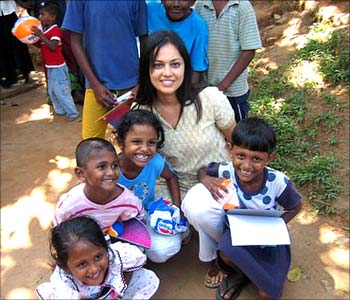
Image: Tishani in Sri Lanka, post the tsunami in the seaside town of Galle.
Also see: 'Most of our writing is abysmal'
 Advertisement