he Supreme Court on Thursday sought to put an end to the controversy over judicial overreach by observing that a recent order of a division bench was not binding on it.
"We are not bound by the two-judge bench order," a three-judge bench headed by Chief Justice K G Balakrishnan said.
Justice Balakrishnan's remarks came when a lawyer, who had filed a public interest litigation, told the bench about news reports relating to the December 6 order of Justices A K Mathur and Markandey Katju, which had stated that the apex court in several judgments in the past had interfered by going into the domains of executive and legislature.
Allaying the lawyer's apprehensions, the bench entertained his PIL relating to the condition of widows in Vrindavan and Mathura and issued notices to the Centre and Uttar Pradesh government.
The Supreme Court had on Monday cautioned the judiciary against encroaching on the legislative or executive domain like passing directions on nursery school admissions or improving conditions of hospitals, lest it led to chaos.
"Courts cannot create rights where none exists, nor can they go on making orders which are incapable of enforcement or violative of other laws of settled legal principles," the apex court said.
"They must remember that judicial activism is not an unguided missile, failure to bear this in mind would lead to chaos. Public adulation must not sway the judges and personal aggrandisement must be eschewed," a bench of Justices A K Mathur and Markandey Katju recalled former chief justice A S Anand as having said.
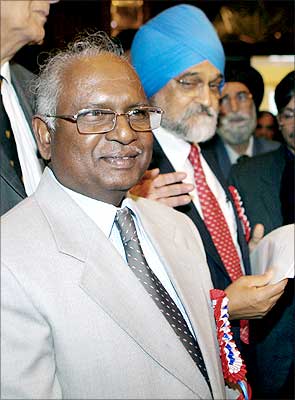
Image: Chief Justice K G Balakrishnan
Photograph: Raveendran/AFP/Getty Images
Also See: K G Balakrishnan's journey to the top
K G Balakrishnan, first Dalit Chief Justice of India
 Advertisement