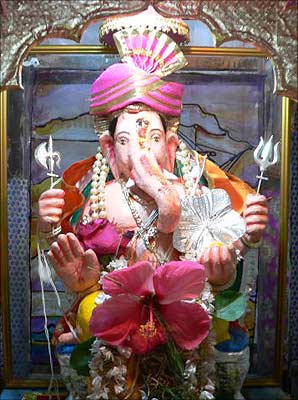
rom the home of Samir Gaonkar, Goa.
Samir would like to offer a description of how Ganeshotsav happens in Goa:
He says: Think Goa and one conjures up images of sun, surf and sand. Few people know that about 65 per cent of Goa's population is Hindu. Tourists who flock to the beaches and rave parties miss the wonderful scenery and culture interior Goa offers.
The fortunate few who do venture into the Goan heartland, especially the temple belt, will love the clean temples and typical village life. The festivals and the pomp and pageantry that accompany them are an integral part of Goa (and the Konkan belt).
Goans celebrate all Hindu festivals and a few local ones to boot. But Ganeshotsav in Goa is bigger than even Diwali. Schools are closed. Hotels and many other establishments work shorter hours. One can feel the devotion in the air.
In Goa Ganesh Puja is a family affair and having a sarvajanik celebration is not that important. It's a time for families and chakar-mani (people working away from home) to return to their roots. Although there are community Ganesh mandals -- typically each town has very few which are limited to markets and bus stands.
The one-and-half-day and five-day Ganesh Puja celebrations are more common than the seven-day or ten-day ones.
The makhar (the area where the Ganapati is kept) is decorated a day or two earlier. Many homes have very intricate decorations. Some go as far as creating mini-versions of the scenes and lighting effects created by the bigger mandals in Maharashtra.
Above the makhar is the matoli. This wooden frame is fixed to the ceiling from which hangs a variety of fruits and vegetables which is kept until the day of the immersion and taken down later to be distributed as prasad.
The matoli is a typical Goan feature of Ganeshotsav. It is not seen in Maharashtra.
The room where Ganesha is kept is also decorated with a variety of patakas (square pieces of paper cut in various designs and pasted on a string).
The first day sees Ganesha being set up by the priest. This is an elaborate affair taking two hours or more. Every day thereafter puja is held in the mornings and evenings. This is not a five minute job but happens according to the shastras.
Those taking part in the puja -- women or men -- have to wear a sowla (a special dhoti) after taking a bath. The devotee, now purified, is not to be touched by others until the puja is complete. Although this may sound a bit harsh and orthodox, it is exactly as per the guidelines laid down in the scriptures.
The daily rituals end with arati, typically for each of the main gods including Shankar, Parvati, Vitthal, and Datta.
A special part of the festival is the feast that follows the puja. Although fish is a staple in the Goan diet, people abstain from their favourite food during Ganesh Puja. The food is cooked without onions and garlic since it is first offered to the gods and then eaten as prasad.
Goan spicy specialities like Khatkhate (the Goan version of Avial or Undhiyo) and Mugachyo Gathi (pulses cooked in a coconut gravy) are served with sweets like Mangane (harbhara dal cooked in jaggery sweetened coconut milk), Payas (rice cooked in sweetened milk), Panch Khaji (a kind of Modak prepared in five shapes), Ukdiche Mmodak (sweet rice dumplings) and Sanna (idlis with sweetened coconut milk) are part of the spread.
The last day is a sombre affair. Folks are saddened by the thought of saying farewell to their favourite god. The visarjan is typically done in the temple tanks or small rivers and the clay idols wash away easily to the chants of Ganapati Bappa Morya, Pudchya Varshi Lavkar Ya (Hail Lord Ganesha. Do return earlier next year) and Ganapati Challe Gavala Chain Pade Na Amhala" (Lord Ganesha is going home leaving us restless).
More features on Ganesh Puja:
Ganeshotsav home
 Advertisement