When the Tibetan railway was started in 2001, the Chinese leadership said it was essential for 'political' reasons. Integrating Tibet into China, opposing 'splittism' and promoting unity were cited as reasons. More importantly, whenever a railway line has been constructed in China, it led to a massive exodus of Chinese from other parts.
This was the case with the Sichuan railway of the 1920s, when huge numbers of Chinese migrated to the coastal areas. The railway line from Xinjiang and Qinghai led to not only an increase in the Han migrants to these areas, but also the displacement of locals from their livelihood.
When the Chinese started constructing roads in Tibet, local Tibetan shopkeepers lost their jobs to Han Chinese even on streets of the capital Lhasa.
It is not clear how many of the millions of 'visitors' to Tibet by the railway will settle down, although Chinese scholar Ma Rong estimated that Han migration in Tibet takes the form of seasonal migration of one-to-two years (with a majority of migrants in this category), short-term and long-term migration (the latter said to be in minority).
It is not without reason that the Dalai Lama cautioned that this railway would result in 'cultural genocide' in Tibet. Tibetan groups equate the systematic resettlement of Han-Chinese in Tibet as something akin to the problems between Israel and Palestine or even of Tamils in Sri Lanka.
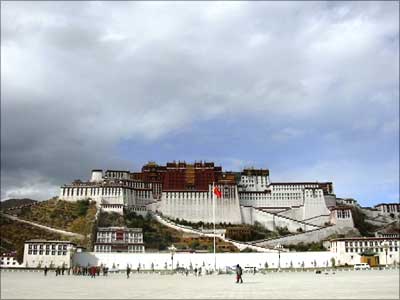
Image: The Chinese flag flutters in front of the Potala palace -- the former capital building of Tibet -- in a stark reminder of Beijing's control.
Also Read: Is the Chinese Dragon smiling?
 Advertisement