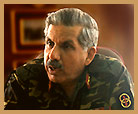
'There's no question of withdrawing from difficult posts during winters'
Major General Mohinder Puri's 8 Mountain Division was among the first of the forces to be sent across the Zojila Pass when the Kargil conflict broke out. He's credited to have contributed significantly to the Indian victory.
Now based outside Leh, his division forms part of the newly-created 14 Corps. He spoke to
This was the first winter after Operation Vijay. How would you compare it with the previous ones in terms of military preparedness?

We assumed the responsibility some time in the middle of August. So we had about three months to get prepared for the winter. Well, after a magnificent piece of work we ensured that the requisite logistic support was carted right from the road up to the isolated posts during these three, three-and-a-half months. It was a tremendous effort.
Could you elaborate on the kind of effort that went into preparing for the winter?
The support in terms of logistics was really heavy. We had to put in a lot of effort in terms of manpower, in terms of animals, in terms of helicopters so that the material, both warlike and non-warlike, reached these posts well in time.
We had to be mentally and physically alert to undertake this task. There is no question of withdrawing from the difficult posts during winters. We don't want a repetition of Kargil. Therefore our training has to meet the requirements of staying at these posts and sustaining assaults at these heights. The acclimatisation has to be proper. The procedures have to be extremely rigid and of a very high order.
These are isolated posts and we have to look after the welfare of our man. You just can't ignore these people who are cut off for protracted periods of time. So, one has to have way and means to ensure that the morale is sustained at a very high level and their welfare is looked after.
This is the first time that India has held many of these high altitude posts in winter. Did the absence of experience hamper you?
Well, we were well prepared. We may not have had the experience of operating at heights of over 18,000 but in military service all the units more or less have been deployed at 13,000 to 14,000 feet. So to that extent, the basic knowledge was available with our battalions on how to cope with the vagaries of the weather and the terrain.
What was Pakistan's response to the new Indian defences? Any cross border exchanges after Op Vijay?
Since the end of August in most of the places and in October in one or two places... There's been no firing after this period.
When the war was terminated, there was an understanding between both the armies that they would withdraw one kilometre from the Line of Control. Pakistan didn't honour this commitment. They went across the LoC and sat down on heights which were of tactical importance. We then obviously went and occupied tactical heights close to the LoC at places dominating the Pakistani positions. That's how it really is on the ground.
What kind of winter casualties did India suffer?
Touchwood, we didn't have the type of winter casualties we were anticipating. Maybe because, firstly, the winter wasn't as severe as we expected it to be. Secondly, we had the logistics at the right places. The training was done and people were made aware how to move in high altitude terrain, in snow. So, all in all, we didn't have many casualties.
Maintaining so many men up at such altitude, is that the only way to guard this border? Will technology not help cut down on the number of men deployed?
You know, there are ways to look at this problem. Technology will help you in early warning, it will help you in plugging gaps, it can help you in discerning the movement of the enemy, it can help you to a certain extent in surveillance.
But the reaction to the enemy actions has always to be done by physical force. And for that you need troops acclimatised to the heights in which they have to operate. So if we have operate at 16,000 feet, 17,000 feet, then a certain quantum of troops has to be acclimatised and be prepared for any contingency. You can't keep them at 8,000 feet or 9,000 feet and say that the borders are being looked after by surveillance elements.
Yes, you can cut down the number of men. That will be the ultimate aim. When we have all our surveillance requirements in place, then definitely we will consider this option.
Do you think that by next winter you will be able to do that?
Right now we are still in the process of obtaining these surveillance equipment. As and when they come in larger scale then we will see about the reduction of manpower in isolated places. It is very difficult to give a sort of time schedule for these things. If the equipment comes definitely we will consider that.
Would you rule out another Kargil?
In practical terms it is very difficult to legislate what the other side is going to do. It is very difficult to say whether Kargil will happen or not happen. What I can say with a large degree of confidence is that we are fully prepared to take on any eventuality.
What according to you are the major lessons the Indian army has learnt from Op Vijay?
The positive side was that our young officers, commanding officers and the men displayed a very high degree of motivation and a very high degree of courage and bravery, which is evident from the large number of casualties the army has suffered. The speed at which 15 Corps reacted by sending us [8, Mountain Brigade] across the Zojila Pass to this side, that's something which merits consideration as a very, very important lesson in any future war. The logistics which was built up within a short span of time on a single axis to make the offensive troops ready for the task was again something which merits value.