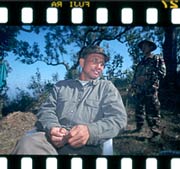
 But for his olive fatigues, you wouldn't take R K Meghen for what he is today.
Soft-spoken, erudite and impeccably mannered, he assumed the ancient Meitei name Sana Yaima in his avatar as an insurgent leader. He is far removed from the image of a gun-totting, fiery revolutionary.
He is extremely articulate, his reasoning convincing, his facts solid. A post-graduate in international relations from Calcutta's Jadavpur University, he had graduated from the Scottish Church College in the same city.
He brings a scholar's approach to insurgency. Also sophistication. His cadres have the best of weapons and equipment, which include laptop computers.
For a quarter of century, he had shunned the media. Now, after over 36 years of its existence (of which he has been associated for 31 years), the United National Liberation Front of Manipur is ready to let the world know what it is all about.
Sana Yaima's upbringing and education in the late 1960s in Calcutta, during the run-up to the Naxalite uprising, have had a lasting affect on his outlook.
He is liberal, given to respect other ethnic groups and their distinct identities. He has been leading the UNLF for the past 16 years, first in the capacity of general secretary between 1984 and 1998 and now as chairman.
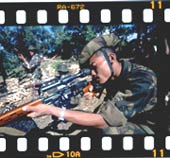 He returned to Manipur in the early 1970s and got married. In 1975, having become an important member of the outfit's think tank, he went underground. Since then, he has remained in the jungles, away from family, meeting them occasionally in hiding.
Sana Yaima's wife and two children have taken his absence in their stride. His wife, he is to tell us later, "keeps busy by teaching in a school while both my sons are pursuing higher studies".
The elder is doing his doctorate in remote sensing application in Manipur University and the younger is in Pune, studying computer science.
Twenty-five years in the jungles have kept the 55-year-old leader fighting fit. For him, this has become a way of life.
Except for making brief forays to Geneva to represent the UNLF to the UN Sub-Commission on Indigenous People, and an occasional trip to South-East Asian countries, Sana Yaima has stayed with his 1,000-strong army, which comprises 100-odd women.
How long does he think his fight will continue? "As long as it takes," he says. "Whether we achieve the objectives that we have set out to fulfil, I do not know. But one thing I am sure: we will get what we want."