



|
|
|
|
|
| HOME | NEWS | SPECIALS | |||
|
ELECTIONS '98
|

|
|
The Rediff SpecialInside the PMO
This is the most powerful Prime Minister's Office in ten years. A definitive guide to how it works.
It was not the first offer but the second that took both ministers by surprise. The principal secretary usually summons, instead of seeking appointments. The meeting took place at Mishra's room in South Block. It didn't matter that the prime minister was tired after one of his election campaigns. He was resting in his cabin on the plane, when his private secretary Shakti Sinha walked in with an armload of files. "Tumhe files ke siva aur kuch soojhta hain? (Do you ever think of anything but files?), " asked the prime minister with a tired but amused smile. "Aap ko pata hai ki bahattar ghante hone vaale hain (But you know that it's going to be 72 hours soon)," said Sinha. Everyone smiled to hear this familiar refrain. For Sinha has set for himself a deadline of 72 hours to clear every file that comes before him.
It is this air of informality, bon homie even, that distinguishes Atal Bihari Vajpayee's PMO from others before him. The snide joke about his office being an extension of his dining table has its advantages. With everyone assured of his place at the table, there is much less bickering and backbiting. Which is why Saikia covers up for Sinha and vice-versa; and despite the fact that he outranks all the other bureaucrats in the government by 11 years, Brajesh Mishra's room is accessible to all officials.
Mishra was not being uncharacteristically modest; he was merely being characteristically wary. In the initial months, the PMO was lampooned as being too weak and effete. Especially when it bungled up something as routine as the transfer of then enforcement director M K Bezbaruah. Later, when the PMO tried to assert itself by setting up various task forces and the advisory council of industrialists, the prime minister was accused of setting up a parallel economic ministry. "This is not true," says Mishra. "For instance, the task force will merely give a plan. It is up to the ministries to implement it, and we will of course monitor it," he added. And before Jaswant Singh took over as external affairs minister, Mishra was accused of acting as a de facto external affairs minister. "At one point there was no external affairs minister," defends Mishra. "And since I know foreign affairs, they (foreign ministry officials) came to me. I did not summon them," he adds. A prime example of PMO officials getting their act together is the eventual transfer of M K Bezbaruah. After making unsavoury newspaper headlines (the first time they tried to ease him out), the second attempt was much more successful. They timed his ouster with a much more newsworthy event: the sacking of the then Chief of Naval Staff, Vishnu Bhagwat. Except for one or two diehard loyalists, most newspaper editorials concentrated on Bhagwat's ouster rather than Bezbaruah's transfer. This is somewhat similar to the manner in which the PMO got rid of the then secretary, personnel Arvind Verma. Right in the middle of the assembly election results, when all the headlines were about the BJP's defeat and Sonia Gandhi's plans to topple the government, the PMO left monitoring results on television to the BJP. Instead it was busy with other things. Verma was transferred out of the personnel ministry with the minimum of fuss and publicity. And before the day was out, a mini Cabinet expansion had already been announced by the PMO. So, although party bigwigs like BJP president Shashikant 'Kushabhau' Thakre and the RSS lobby were against an expansion at that moment, Vajpayee made it clear that he would swear in his friend Jaswant Singh as external affairs minister. He finally did agree to wait, but only for a while. And once the initial shock of the assembly results wore off, he went ahead and swore his team in. Regardless of what the Parivar thought of the whole exercise. The same decisiveness marked his handling of the Insurance Regulatory Authority Bill. And though Mishra says that the only reason that the PMO is proactive is because it reflects the PM's attitude, the compliment works both ways. One reason why Vajpayee can take on both his party and allies like Jayalalitha is that he is sure of his team at the PMO. And for this he needs to surround himself with men he can trust. Such as the troika of Shakti Sinha, Brajesh Mishra and the low-profile Ashok Saikia. In fact, this is one reason why Vajpayee aides scoff at rumours that Indian ambassador in the US, Naresh Chandra, would be brought in as principal secretary to replace Mishra. While admitting to the inherent disadvantage of having an IFS officer at the helm of things, they ask, "Would the prime minister be as comfortable with Chandra as he is with Mishra?" And though Mishra is a recent addition to Vajpayee's extended family (his adopted family -- Namita and Ranjan Bhattacharya -- refer to Mishra as 'uncle'), he has carved a special niche for himself. For one, Vajpayee knows that apart from a weakness for television cameras, Mishra has no hidden agenda. Which makes his advice so much more valuable. In addition, Mishra does not shadow the prime minister. He is not present during most meetings. This, in fact, gave Prabhat Kumar, the Cabinet secretary, some uneasy moments for he did not want to give Mishra the impression that he was dealing with the prime minister behind the principal secretary's back. But Mishra soon dispelled such fears. Neither is Mishra in the habit of dropping into the prime minister's room during the day. (He restricts the interaction to dropping in the PM's residence in the mornings and late in the evenings.) However, all the files that go to Vajpayee are first vetted by his principal secretary. In fact, when Vajpayee sees a file, there is a note attached to it. The note usually has comments from three people: Mishra, Prabhat Kumar and Ashok Saikia. After reading the note, the prime minister then asks Shakti Sinha for his views. It is usually after he has inputs from these four people that Vajpayee takes a decision. Kind courtesy: Sunday magazine |
||
|
HOME |
NEWS |
BUSINESS |
SPORTS |
MOVIES |
CHAT |
INFOTECH |
TRAVEL
SHOPPING HOME | BOOK SHOP | MUSIC SHOP | HOTEL RESERVATIONS PERSONAL HOMEPAGES | FREE EMAIL | FEEDBACK |
||

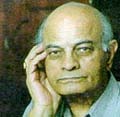 Last month, there was a slight difference of opinion between the petroleum ministry and the finance ministry over the proposed cut in diesel prices. Both ministers got a call from the Prime Minister's Office. Brajesh Mishra, the principal secretary to the prime minister, came on the line. "Let's try and resolve the problem," he suggested. And then added, "would you like me to come over?"
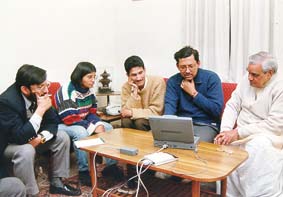
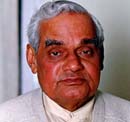 Despite the informal atmosphere, Vajpayee's PMO manages to give the impression of being in control. In fact, when asked whether this PMO was perhaps the most proactive office since Rajiv Gandhi's days, Mishra smiled. And then asked, "Is that criticism or praise?"