

Kaantha is a peculiar love letter to cinema that tries to integrate various genres and craft a riveting central dilemma with great eloquence and clarity, observes Arjun Menon.

Films about films are a tough genre to crack.
As a storyteller, you have to chose sides.
Do you want it to be a love letter to a medium? Or a hate letter that satirises the rot of an art form ruled by capitalistic market forces and personal egos?
Kaantha, directed by Selvamani Selvaraj, chooses to be a composite of these two modes of storytelling.
On one hand, this is a film that is deeply in love and nostalgic about the bygone era of an art form.
But it is also a deeply objective, fun genre piece that tries to tackle human frailties and artistic hubris through framing it around the chaotic behind-the-scenes drama of a 1950s film production.
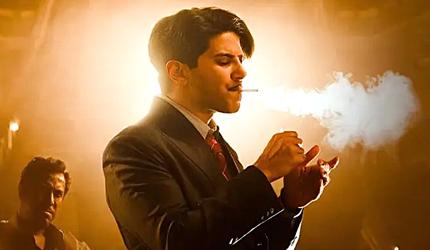
Dulquer Salman plays T K Mahadevan, a Tamil superstar, whose penchant for scenery-chewing performances is met only by his hubris as an artist, who feels he is the most important man walking into a room.
Ayya (Samuthirakani) plays a renowned filmmaking master and the superstar's former mentor, who is clearly not interested in casting the headstrong star in a lead role.
The film proclaimed by the producer of 'Modern Studios' as the 'very first horror film' in Tamil cinema is an assignment that he takes up reluctantly with one weapon in hand, his leading lady Kumari (Bhagyashri Borse).
Conflicting loyalties, messy relationships and withheld secrets become the token for suspense here as the film shoot is constantly disrupted due to ego clashes between the film-maker and star.
There are wounds from the past that are being exposed. Maybe an envious guru who can't fathom his disciple being bigger than him, as Dulquer's character reminiscents at one point, is the core of Kaantha.
It's about two artists mentored by the same master, who end up destroying their lives in mysterious ways.
Add to the mix, a real gun shot on set and a death.
A curiously-animated police officer Pheonix (Rana Dagubatti) enters and havoc ensures as everyone on the film set is a possible suspect.
This is the structural genius of Kaantha, a period drama infused with an Agatha Christie-like whodunnit structure in its later half.
Kaantha belongs to its performers.
No matter how astute the writing proves to be, the act of convincingly pulling off the pathos in their individual arcs is of vital importance here.
These are all sad people, hiding a source of pain under the sheen of show business glitter.
Dulquer Salman is a revelation as the arrogant superstar, who swings back and forth between melancholy and charm with great ease.
He perfectly summons the body language ticks and personality signifiers of a retro superstar (at least one that we have in our heads through decades of film watching and behind the scenes anecdotes) and deconstructs what it must have been to be a young star in that day and age.
Dulquer aces the film within the film scenes, and effortlessly recreates an acting style without mocking or looking down on it. The reverence shows in his cadence and physical agility.
There are moments when you feel the research, and improvisations in the performance crack, not out of a flaw in his interpretation of a star image, but he has personality traits that give away his millenial vibe.
This is just an observation that arises out of years of familiarity with a person's default body language that sometimes peaks through the veneer of an excitingly novel performance.
Bhagyashri Borse delivers a riveting turn as the naive, yet strong-minded Kumari, an actress caught between the ego tussles of two men.
She has to balance her loyalties and appear as a neutral agent that somehow ties the drama together.
She is great in the 'film within film' sequences and looks the part.
Her facial features and soft personality perfectly compliments Dulquer's more bombastic superstar performance.
She also fits right in with the time period in which the film is set and looks convincing as the diva caught between men calling the shots in a still patriarchal industry, with little agency to her own.
Samuthirakani aces the resentment and accumulated contempt for the headstrong superstar.
He is a force of nature with his imposing build and you get instantly why everyone respects him, even though with a tinge of fear.
Rana Daggubati is very effective as the comical investigative officer looking into the murder on the film set.
But the later half becomes a little dramatic by the standards set by the former half.
Kaantha starts to lose focus in some parts, but Selvamani Selvaraj has a clearly formed vision that refocuses the mystery to fit the gravity of the drama of the first half. The revelations are done well and leave you guessing.
Selvamani Selvaraj is assured in the tonal high jinks of his razor sharp screenplay that jumps between important plot beats with confidence.
Dani Sanchez Lopez's cinematography is rich with texture and retro lighting. The camerawork in some of the sequences is astounding.
Jakes Bejoy's beautiful score keeps the visceral charge of scenes flowing and makes the revelations feel monumental.
Kaantha is a peculiar love letter to cinema that tries to integrate various genres and craft a riveting central dilemma with great eloquence and clarity.
The film fuses various genres with a steady hand and never feels underwritten or gimmicky in its use of aspect ratios, colour schemes, visual palette and set design.
Every detail is accounted for and the film tries to paint a cautious yet loving picture of a bygone era of filmmaking that is romanticised, but with much skepticism regarding the way it captures the essence of a human drama that just happens to unfold in the backdrop of that era.











 © 2026