

Mari Selvaraj delivers his most rage-filled film in years, with a superbly cast Dhruv Vikram giving it his all, notices Arjun Menon.

Mari Selvaraj has established himself as one of contemporary Tamil cinema's most urgent and commanding voices, making films in the mainstream with an offbeat sensibility. His films stand out for their relentless dedication to the exploration of societal injustice and caste oppression.
Somehow, he manages to hit the same beats, build on them, and come up with new iterations of stories of oppressed people fighting back with razor-sharp politics each time he makes a film. In Bison, Mari Selvaraj situates his indictment of caste politics within the setting of an ordinary underdog sports biopic.
While this latest outing is notably more conventional and linear than his previous, more experimental works like Vaazhai, Bison is uniquely a brainchild of a filmmaker asking the right questions and pointing out uncomfortable truths.
The core of Bison is not the kabaddi court, but the battlefield of caste prejudice that surrounds it. Bison meticulously illustrates that the privileges often taken for granted by the upper class are for those from marginalised communities, hard-won battles.
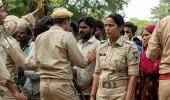
The film's tension is palpable and constant, fueled by people quick to take offence at the slightest provocation, transforming minor scuffles into explosive, often fatal, confrontations. Selvaraj uses this persistent atmosphere of dread and misconceptions of communal lines as the central mechanism framing Kitaan's dilemma.
This is a story about aspiration, yes, but primarily about suffocation.
If Pariyerum Perumal was a painful indictment of hateful oppression and Karnan's rebellion against it, Bison stands out as one of Selvaraj's most rage-filled works to date.
The violence and anguish endured by its characters appear as if they are stuck in a loop beyond their control. The community depicted in the film is constantly on the brink of collapse, perpetually torn apart by generations of caste biases and local politicians who exploit the marginalised for their political gain.
Loosely based on the life and trials of kabaddi player Manathi Ganesan, this is Mari Selvaraj's take on the sports biopic delivered as an exercise in empathy.
In one of the major scenes in the film, a minor argument spirals terrifyingly out of control, culminating in the senseless butchering of a goat intended for a ritual. It is a disturbing image that captures the unpredictability and hostility of such a place, where no one is safe.
Stylistically, Bison employs black-and-white to depict the present timeline, contrasting it with the vibrant colour palette reserved for the past of Kitaan. This choice is more than a mere aesthetic gimmick and blends Kitaan's past and future to a kind of seamless blend, unified by his pain and glory.
Bison is one of Mari Selvaraj's most linear films to date and hence one that is most accessible to common audiences, bereft of metaphors and symbolic imagery.
The film's central anchor is Dhruv Vikram's portrayal of Kitaan. It is a performance that is both stellar and frustrating in equal measure, as Dhurv sacrifices the explosive rage of Kitaan for a sort of meditative quietness. It's as if the actor is afraid to go big in scenes and come off as delivering an over-the-top grumpy sportsman figure.
As Kitaan, Dhruv is remarkably understated, embodying a young man weighed down by a burden that predates him -- the endless cycle of societal oppression.
He is effective in conveying the unspeakable pain and agony of Kitaan, asked to prove his worth and merit every single time, despite being the best at what he does. But sometimes he is too toned down and subtle to make the emotions click as required by the heavy-handed writing.
The only overt symbolism in the movie, other than the Bison head, comes in the form of Kitaan running in scenes. Kitaan is shown to be held back on his path to ultimate redemption or escape by those who obstruct his runs.
The running becomes a metaphor by which Kitaan is grounded in the world of non-stop seclusion. The emotional weight of the film lies in the central dynamic between Dhruv Vikram and Pashupathi, who delivers yet another standout performance.
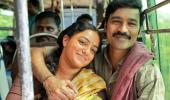
Their relationship provides the necessary warmth and humanism amidst the surrounding chaos and rage. All the tenderness in the harshness of Bison comes through the father, who only wants his son to have a good life.
Beyond the central cast, the side players are also effective in laying out the ground for Kitaan's transformative arc. Lal and Ameer Sultan play the roles of rival political power brokers whose small-town fight becomes the backdrop against which the larger cycles of oppression play out.
However, Mari Selvaraj is careful not to make them one-note villains; the film also shows them being pulled into the rage of their followers, who have forgotten why they began to revolt in the first place.
Equally compelling is Rajisha Vijayan as Kitaan's sister, who has a troubled history of her own. She is not limited to being an emotional support for Kitaan but a genuinely wronged woman, abandoned by her circumstances, who sees her brother's victory as her own. Anupama Parameswaran also makes her presence felt in whatever material is given to her.
Nivas K Prasanna's score almost becomes a character that sustains the momentum of the film even when the storytelling repeats or reclaims points already made earlier on.
Bison is, without a doubt, a quintessential Mari Selvaraj film. It is a work fiercely rooted in political conviction, uncompromising in its portrayal of brutal realities, and luckily, his most accessible feature in recent memory.
While some of the narrative edges may have been slightly softened for the masses in the pursuit of a more commercial structure, the film retains its essential power in the important parts of Kitaan's journey.










 © 2026