
'For OTT platforms, securing dubbed rights often makes greater business sense, enabling them to serve diverse regional audiences more effectively.'
With the rise in prominence of pan-Indian films and streaming platforms focusing on sustaining subscriber stickiness, dubbed rights for South Indian films are expected to rise up to 10 per cent next year as they attract eyeballs beyond their mainstay markets with compelling storylines and talent.
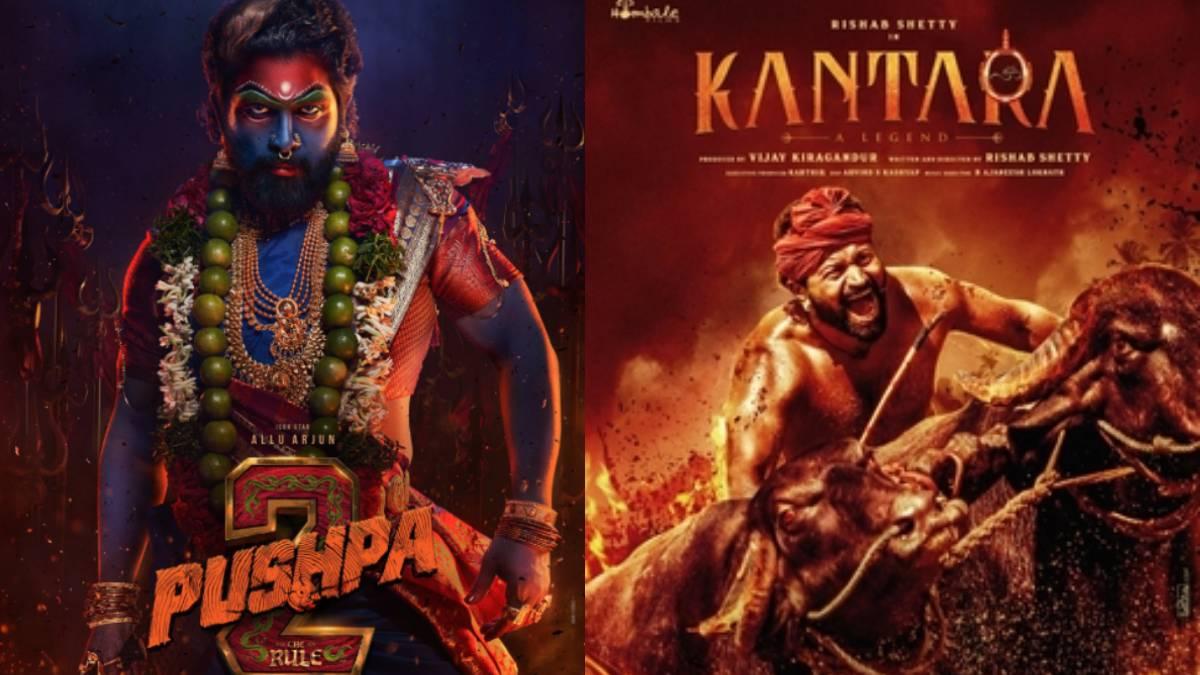
For prominent South films like S S Rajamouli's RRR, Rishab Shetty's Kantara, action-thriller film series KGF, the Allu Arjun starrer Pushpa: The Rise and Pushpa 2: The Rule, the Hindi-dubbed rights are as high as their original-released languages, said a producer on the condition of anonymity.
Apart from major pan-Indian South Indian film releases from prominent actors, the producer expects the general dubbing rights to rationalise, which significantly rose after Pushpa 2: The Rule's release last year.
Earlier, the dubbed rights of South Indian films were considered 'library fillers' or inexpensive content acquired to keep channels running round the clock.
Over the last two to three years, South films have become a mainstream content category in Hindi-speaking markets, as per industry experts.
This has resulted in dubbing rights for South films expected to grow in the range of eight to 10 per cent in 2026, according to an industry expert.
Multi-language packages now routinely see higher value than single-language deals for mid-tier titles and top-tier releases, the industry expert added.
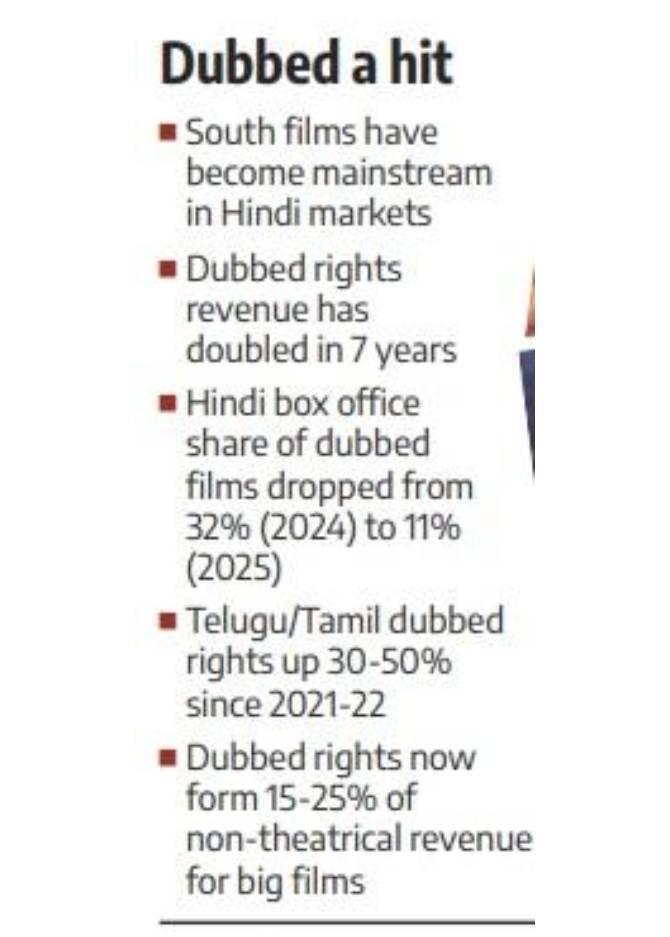
Industry estimates indicate that revenue from the sale of dubbed streaming and satellite rights has more than doubled over the past seven years, said Chandrashekar Mantha, partner, media and entertainment sector leader, Deloitte India.
The surging popularity of South Indian stars has also reshaped production strategies, prompting studios to design slates that pair leading talent from both the South and Bollywood to maximise appeal across a truly pan-India audience.
This also comes at a time when streaming platforms are focusing on the Southern region to attract new subscribers, with a larger content slate for the region.
"For OTT platforms, securing dubbed rights often makes greater business sense, enabling them to serve diverse regional audiences more effectively," said Mantha, adding that the demand for Tamil, Telugu, Malayalam and Kannada-language content continues to grow, driven by compelling storytelling and strong viewer engagement.
"This strategy can lift pricing by 12 per cent to 25 per cent, depending on the strength of the content," Mantha added.
But even as streaming platforms like Prime Video, JioHotstar, and SonyLIV are scaling South-origin content, the contribution of South-language dubbed films has decreased this year compared to 2024.
According to Ormax Box Office Reports, dubbed films accounted for 32 per cent of the overall Hindi box office in 2024, generating a total gross of Rs 1,453 crore (notably, Rs 886 crore of this was contributed by Pushpa 2: The Rule alone).
However, Sanket Kulkarni, head, business development, theatrical, Ormax Media, said that the share of dubbed films in 2025 (up to November 16) has fallen to 11 per cent, reflecting a marked reduction in reliance on dubbed titles as a driver of Hindi box office performance.
Even so, dubbed South films remain a low-risk, high-yield bet for OTTs, with the incremental cost of dubbing being small, and films often seeing higher watch-time per rupee than many originals, said Raghav Anand, partner and leader, media and entertainment, EY-Parthenon.
"OTT platforms, seeking high-repeat and high-completion content, have pushed up dubbing rights values for Telugu and Tamil titles by 30 to 50 per cent compared to 2021-2022.
"Producers increasingly close bundled multi-language rights upfront. For big-budget films, dubbed rights can now contribute 15 to 25 per cent of total non-theatrical revenue," he said.
Platforms like Prime Video and ZEE5 consistently see Hindi-dubbed versions of RRR, KGF, Kantara and similar blockbusters top their most-watched lists in North and West India, in some cases outperforming original Hindi films on completed watch hours and subscriber impact, he noted.
Streaming platforms will still invest in high-impact originals to build brand identity, , he said, while dubbed films offer one of the most cost-efficient return on investment levers for platforms today, on a title-by-title basis.
Feature Presentation: Ashish Narsale/Rediff











 © 2025