

'Sriram Raghavan treats the story leading up to Arun Khetarpal's march at Basantar as an excuse to look closely at the unspoken codes of manhood and patriotism and courage that govern people in the line of fire, topics that cut so close to the marrow that a real soldier could hardly begin to name them let alone talk about them at length, and in documenting all this Raghavan wishes to comment on how these codes have changed with the passage of time, observes Sreehari Nair.

Sriram Raghavan's Ikkis is a decidedly anti-war movie about a boy who desperately wants to go to war.
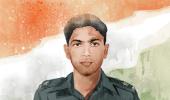
The boy (Second Lieutenant Arun Khetarpal, the movie's ostensible subject) believes that war will help him grow into a man, and Sriram Raghavan is secretly hoping here that his modern audience will be so broadminded as to understand that not so long ago people didn't mind going to war and, in many cases, they even looked forward to getting conscripted.
Yes, there was once a time when war was considered education, when war meant seeing new places and opening up to new experiences, when war was shorthand for testing your limits.
Norman Mailer went to war expecting to find the material for his first novel. Churchill, that world-class depressive, believed that war helped enliven his sagging spirits. And Theodore Roosevelt, when he was denied the opportunity to fight in WW1 because of advanced age, forced his sons to enter the scrimmage in his stead.
Ikkis does not flinch from this historical perspective, and it's a big part of the discomfort of watching the movie as also a key to its eventual greatness. If Raghavan has enough geopolitical ammunition here to annoy the right-wingers, his hero espouses temperaments and attitudes that are unspeakable within the borders of flower-power liberalism.
And yet, it's not just the politically conscious ones who stand to be thrown off from their precepts.
To those of us who were anxious about Sriram Raghavan tackling this particular story, who wondered if the life of Arun Khetarpal made for an unlikely subject matter for Mr Wicked, the movie offers the best possible reply while exposing the chinks in our collective cinephilia.
Ikkis reminds us that all along we were busy working out Raghavan's favourite genre' when we should have been examining his interest in 'character'.

It didn't matter if Johnny Gaddar, Badlapur, and Andhadhun were psychological thrillers or mysteries or something a bit more chic. What mattered was Raghavan's affection for Vikram, for Raghu, for Akash -- young men who went too far in their attempt to put on a façade of toughness in a world of sheer cutthroats. I don't know if there's an easy answer to what Sriram Raghavan's favourite genre is, but 'tender-noir' seems more to his taste.
And now, in Arun Khetarpal, Raghavan draws up the perfect embodiment of a young idealist who spends most of his screen time feeling his oats and growing into his dream role.
During his training days, we see Arun prove himself a pathetic leader when he backs out of a boxing match for fear that he will be knocked down.
Later, in a moment of terrible miscalculation, which he hopes will serve as a primer for his upright spine, he rats on his batch-mates.
Even as a lover, we can sense the medals and the insignias and the standards of army chivalry impeding his best moves.
Sriram Raghavan is a dream director of actors whose actorly egos have not yet been fully formed, actors who tiptoe about their craft gingerly and are unsure of their place as celebrities. Like a seasoned impresario, Raghavan has an instinct for such actors, a Neil Nitin Mukesh, a Varun Dhawan, an Ayushmann Khurrana, actors who can be moulded to explore the follies and excesses of men trying to keep up a macho image.
In Ikkis, Agastya Nanda gets a well-groomed variation of Raghavan's special blend: The Arun Khetarpal of this movie is not so much an idealist as he is an improviser in idealism. And Nanda makes us yield to the soldier every step of the way; we feel with him even as we understand that his drive for glory is a comic passion.
In a scene that should rank among the finest in Raghavan's oeuvre, we catch our young trooper wincing when asked to slaughter a goat after a round of successful reconnaissance. Fidgety Arun nerves himself and goes for the jugular, but his blow comes unstuck. We hear the animal screeching, and Risaldar Sagat Singh (Sikandar Kher, delightfully blurring the line between reprimand and barrel-chested fun) steps in and completes the slaughter, so that the final blow of the sword becomes an act of mercy-killing.
Such an approach to painting a bona fide war hero tells us that Sriram Raghavan's concerns are unique, that this is a war movie that wants to rescue war movies from the trappings of legend-mongering, instant excitements and pyromania, and restore them to a certain 'inwardness'.
What's heartening to observe is how Raghavan goes about achieving this inward quality.
Too proud a craftsman to be piping in messages of pacifism, he plays around with the size and shape of sequences.

For a genre routinely abused by the tyrannies of scale, the tank shots in Ikkis do a wonderful job of conveying the 'solitude of combat'. (To expound this further: The high-tech wizardries typically demonstrated in fighter plane scenes serve to distance us from the action; the tank shots here achieve the exact opposite effect).
There are long silences between cannon blasts, so that battles on the screen begin to resemble live broadcasts, or outtakes from televised army parades, but pierced with the clang of approaching doom.
And in one instance we get the gift of a sudden sepia freeze of our wincing, stumbling, haggling war hero, released from the conventions of dossiers and schoolbooks and floating in intimations of immortality.
'There's no such thing as an anti-war movie,' Truffaut continues to whisper from his grave, and Sriram Raghavan answers the charge with a movie that's anti-all war movies. Take that, French New Wave Ustad!
There are other charges that Raghavan and his writers seem to have anticipated well in advance and refuted with a kind of magisterial hauteur.
To say that Ikkis is ignorant of the geopolitical realities of the 1971 War is a bit like saying Renoir's The Grand Illusion is blind to the underlying forces that led to the First World War.
Renoir had used the First World War as his background to investigate such themes as the illusions of nationalism, the spirit of comradeship that can develop between sparring factions, and the irony of aristocratic officers acting out their noblesse oblige even when they know their way of life is finished.
Sriram Raghavan's is a similar quest. He treats the story leading up to Arun Khetarpal's march at Basantar as an excuse to look closely at the unspoken codes of manhood and patriotism and courage that govern people in the line of fire, topics that cut so close to the marrow that a real soldier could hardly begin to name them let alone talk about them at length, and in documenting all this Raghavan wishes to comment on how these codes have changed with the passage of time.
As it happens, his mission statement is a plague on two churches.
Sure, this is a strange movie to be bringing out in this climate of social media bravado, where the belligerence of the 'Ghar Main Ghuske Maarenge' cult is matched by the belligerence of the 'Humanity & Compassion' bunch. It is in such a climate that Raghavan has elected to make a war movie in which the dominant feeling is that of the plates shifting beneath your feet.
This feeling is what gives genuine depth to the frame story, set in 2001, of Arun Khetarpal's father being serenaded by the Pakistani brigadier responsible for Arun's death -- and the magic kit here is the casting, the jugalbandi of contrasting acting styles.
Playing the father, Dharmendra appears to be on the verge of spilling over and ready to talk to you through the screen, while Jaideep Ahlawat as the brigadier is a master of superbly controlled outer appearances. And yet, each of these characters stands guard to a chest of memories and sentiments.
When Khetarpal the Elder goes mildly cuckoo after a party in Pakistan and says, 'Enemy who?' it works as an elegy to a home world he has lost, and the brigadier sounds this very tune when he pauses at the site of the bloody battle and purrs in a moment of unassuming reflection, 'There used to be a pond somewhere here.'
The free associations of the two officers are like dispatches from an age of analogue pleasures, a far cry from the mass digital nationalism of the present. This is Sriram Raghavan as Proust, in search of lost time, obsessed with how time moved differently in a less technological age and with those mores and customs that the years have since rendered with a new brush.
I found it very interesting that Raghavan keeps the pop-culture talks in the 1970s section down to a few murmurs and titters, never exploiting the era in an obvious sort of way. And the one substantial pop-culture reference we get is woven in so subtly that your ear registers it as 'proper seventies chatter'. This is how it transpires.
We are smack in the middle of the big battle. Vivaan Shah's Captain Malhotra, who is planning a retreat, sees a battalion of Pakistani tanks in the near distance and decides to advance. Resting his binoculars, he celebrates his strategic detour with the line 'Aisa mauka phir kahaan milega??' singing the words as he says them, giving a totally unexpected shout-out to Shammi Kapoor and the opening of An Evening in Paris.
Yes, this is a strange movie, with unconscious material stirring within the format of a traditional narrative, brought to the surface in the little asides and the filmmaker's whole way of seeing. And if you'll be so wise as to look beyond the Dhurandhar mist, the mist that consumed this far superior piece of work, you're sure to discover small surprises here that keep popping up from every corner.
When Khetarpal Senior sets out to visit his childhood home in Pakistan, a kid on a bicycle stops to direct the car around a final bend -- a trivial detail to insert given the context, but it becomes part of the texture, of the movie's poise.
I also loved the running bit about two ISI spooks, sincere yet dull specimens of the bloated bureaucracy, jotting down every back-and-forth between Khetarpal Senior and the Pakistani brigadier, wondering what to do about the breaks in conversation, if they should transcribe the silences as well. There's a weirdly 'Gulzarian' quality about that joke, and I think it offers a clue to the movie's eye.
In the arts, a grand vision is apt to produce works infinitely more 'fascinating' and varied than spectacles, as Ikkis proves, most gallantly, through its failure at the box office.
Here's a movie that dares to not see war and undercover duty and patriotism as sexy things, and instead sees them for what they are -- messy things, rife with redundancies, inconsistencies, disproportions.
Arun Khetarpal was a figure of monumental disproportions, a snag for the well-oiled gears of the biopic machinery.

The movie makes it clear that Arun was killed before he could acquire that understated elegance of speech and manner that military men so dearly aspire for. Compared to men like Lieutenant General Hanut Singh, his commanding officer (played here by Rahul Dev), there was something a little gauche about Arun that never got a chance to develop into something more premium.
I happened to watch an interview of the real Hanut Singh, who, speaking like a silken piece of gathering cloud, lets on that Arun was not meant to be a part of the platoon earmarked for the battle, and that he had begged for permission to go. His exact words, delivered through a veil of tears, were: 'Sir, if I miss out now, I may never see action again.'
Sriram Raghavan has added a post-script scene of Arun declaring to his buddies that he would bring the next Param Vir Chakra for his regiment. It's worth noting that this incident happened at a point in our country's history when eight out of the eleven PVC awardees were posthumous winners.
You can trace a straight line from the Arun Khetarpal who made that declaration and hankered for an opportunity to fight to the Arun Khetarpal who defied his senior's orders and refused to abandon his tank.
Ikkis's sensitivity comes through in the way it chooses to honour the memory of this rather complex boy martyr. The movie does not prettify his death using those standard terms that go with every war hero. After all, how can 'sacrifice', 'selfless love for the motherland', or even 'bravery' compete with an ambition that would stop at nothing less than a shot at immortality?
Raghavan and his writers have structured the story as an exploration, angling it as a response to Khetarpal Senior's pale-mouthed question, 'Why did my son not retreat on that fateful day at Basantar?' Ikkis brings you really close to an answer, without ever spelling it out. Equal parts moving and disturbing, it sticks in your throat and leaves you with an ache.








 © 2026