



|
|
|
|
|
| HOME | MOVIES | QUOTE MARTIAL | |||
|
April 4, 1997
BILLBOARD
|
'Pure art is diluted by compromises'Suparn Verma
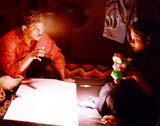
A darkness that is accentuated by a succession of horrific sights and sounds - here a ghost, there a piercing scream, everywhere the feeling of eerie foreboding. "It's RaatPart Two," says Ram Gopal Varma, only half jocularly, as he greets us in the dubbing room where he is busy giving shape - make that sound - to his latest Telugu film, Deyyam. "I am trying to undo all the mistakes I committed with Raat." We sit in the dark, while the dubbing artistes cut loose with ghostly screams and ghouly utterances. And it is quite a while before the graveyard atmosphere lightens enough to permit conversation - which, as it turns out, begins with Varma's earlier - and disastrous - venture into the genre of horror films. "Raat was a really bad film," he tells you. "During its making, I was on my own trip. I had lots of things at my disposal, and I tried to find a place for everything. At that time, I had an exhibitionist streak. "I was an assistant director at the time. While working, I visualised the opening scene of Raat - where Revathi gets out of the bus in a deserted town - and I realised I wanted to become a director. So I tried hawking the script around, but the producer asked me to make a different subject. It was thus that I debuted with Udayam(the Telugu film starring Nagarjuna and Amala, which was later dubbed in Hindi as Shiva. "I was an assistant director for exactly one week," he says, with finality. An achievement to be proud of, I think, in a milieu where assistant directors, like wine, mature into the real stuff only with age. But Varma has a different explanation. "I was fired because I lost the continuity sheets," he grins, putting his brief tenure as assistant director in a different perspective. His debut film, Udayam, was at its core the story of career politicians getting involved in student politics, and unleashing violence on the college campus. And how one young collegian, intolerant of the goings on, decides to reply to brutality with even more brutality. But what remained in the mind, long after the on-screen events were played out and the credits had rolled, was the scenes of violence. Unremitting, frightening, nauseating violence. Not for Varma the standard practise where the hero bops the villain on the nose, and the latter does a back-flip with the grace of an Olympic gymnast. In Udayam, when hero Nagarjuna hit them - and he hit them with a wide assortment of weapons ranging from iron bars to cycle chains - he did so with a sickening finality. When he hit them, they stayed hit. And he hit them in every second scene. "In Udayam one feels the pain of violence," Varma explains. "When violence happens on screen the audience gasps, because it hurts them as much as it hits the screen character. The audience does not enjoy the violence - and that was my intention. To make them abhor, not enjoy, it."
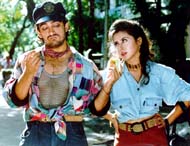
"How do you define a story?" he asks, as he tries to explain this conundrum. "I would define a story as whatever holds your attention. Take the greatest epic, and it could still turn into a lousy film. At the same time, a wafer thin story could still turn into a blockbusting film. See, Hitchcock defined it best when he said that in effect, every film is a suspense film - because the answer to 'what happens next' is what keeps the audiences in their seats. "I don't believe in pure technique - technique, for me, lies in the story and how you narrate it. Look at Sholay, the storyline is nothing new, it has been seen before and since, yet it was told in a way that made it one of the most outstanding entertainers of all time. "Rangeela," says the director, his elaborate explanation itself indicative of how much the criticism has angered him, "is a film which works because of the way it is narrated. I build up the tension, I keep the audience guessing to a point where they have developed an empathy with Aamir Khan and antipathy towards Jackie Shroff - and it is only then that I let them know Urmila's own choice." Having said that, he does not agree with the denouement of the film, with Urmila's decision, in the last scene of the last reel, to throw away nascent fame and fortune for the love of Aamir. Why then, one wonders, did he elect to finish his story that way? "Because, as told, it is Aamir's story. Not Jackie's, not Urmila's. The story is of, and told through the perspective of, Aamir's character. And therefore, the ending I choose was the one that made sense from that perspective."
Besides a seeming penchant to let technique take precedence over content - a criticism he has denied, here and elsewhere - Varma is also accused of being an expensive director, accustomed to thinking only in millions. And again, the director is none too impressed by the criticism. "If a big budget film works, and earns its money back and a profit besides, then what is wrong with it?" he demands. "If a film demands a big budget, then you have to spend the money. And in any event, why single out the film industry? People invest millions in a business, and sometimes it fails. Films are like any other industry, it does have its share of ups and downs," he maintains. Varma is also reputed to get the best out of his cast - much, it must be added, to his own mystification. "I can never figure out what makes one actor great and another mediocre," he smiles. "I have seen dumb people make great actors, and intelligent people act terribly. It never ceases to surprise me. I have realised that in the film industry, it is not intelligence that makes successful people, but spirit. For instance, in my film Kshanam Kshanam (remade in Hindi asHairaan), Sridevi does a scene in a photo studio, and I let her do it extempore. Now, Sridevi has never been in a studio in her life, but she did the scene so convincingly - such things defy explanation." While his films have been invariably dubbed in Hindi, Varma makes no bones about the fact that the southern film industry, of which he is a member in good standing, is far more professional. "The difference between the south and Bombay, as far as film-making goes, is that there we want to finish a film as fast as possible. Here, they are always in a hurry to start new projects but once begun, they don't mind stretching it out for years. Speaking for myself, I cannot make a film that stretches over eight months in the making." He just might find himself doing just that, though, for Varma has begun work on an untitled film starring Sunjay Dutt with Urmila Matondkar - both busy stars, which means that getting them together for the required number of scenes could stretch the schedule out. Varma, though, is optimistic that he will still be able to maintain his rapid pace of work. He obviously loves discussing various aspects of his profession, and no subject moves him more than the question of directorial independence. Is the director a free creative agent, I ask, or is he subject to the demands of producers, stars, and everyone else with a finger in the filmi pie? "It depends," Varma responds seriously, "on the position of the director. I make the kind of films I want to make, the way I want to make them. But yes, there are restrictions. Film-making cannot be independent of commercial considerations, you see - if I spend millions making a film and it flops, other people are affected. So somewhere along the line, pure art is diluted by compromises. "It is easy for people on the outside to say that we should take risks while making a film," he explains, "but when you enter the industry, your entire perspective changes. When you are given 80 million rupees, then you are aware of the responsibility that is on your shoulder, you are trying to ensure that what you make works at the box office." The corporate houses that are entering the film industry in a big way now could, I suggest, be the solution. But Varma isn't having any of that. "Corporate houses won't work in the film scene," he insists."Since, in the ultimate analysis every film is in the hands of the director - not of some company accountant. Corporate thinking is, let's make a small budget film, a neat one, it will be easier to earn back the money that way. The flop of Plus Channel's Papa Kehte Hainproves how stupid that thinking is. See, corporate houses cannot differentiate between good films and bad films, so how can they take decisions?"
Will this change permeate the acting field as well, I ask. "As far as actors go," Varma muses, "we are different from Hollywood. There, it is the character that makes the star, here it is the other way around. There, a Jim Carrey will play a secondary role, if the character is good enough - here, stars still demand only 'hero' roles. Hopefully, this trend too will change in time." Up there on the screen a victim, screaming and wailing, is being eaten alive by a whole cemetery-load of corpses. Hoping that a worse fate does not befall me, I venture to stick my neck out with a personal question. "Er... much has been written about you and Urmila..." For a moment he sizes me up, as though wondering precisely how, in what manner, to drop me dead, then he thinks better of it and smiles. "There is nothing to it," he shrugs wearily. "I have told hundreds of reporters this. I cast her when she wasn't doing too well in her career, so people jumped to the conclusion that it was because we were having an affair. Here, in Bollywood, people only understand two things - money, and affairs. But no, there is nothing between Urmila and me." Varma has obviously decided to leave the hatchet alone. But he cannot resist the temptation to whip out his stilleto for a parting dig: "See? Even you, after asking me so many serious questions, had to ask something silly and personal like that, because your readers demand it. We directors are also like that, we too have the audiences to cater to!"
|
|
HOME |
NEWS |
BUSINESS |
CRICKET |
MOVIES |
CHAT
INFOTECH | TRAVEL | LIFE/STYLE | FREEDOM | FEEDBACK |
|
 He is, at first sight, a dimly perceived smile in the darkness.
 As far as storylines go, Udayam was simplicity
itself. And in fact, Varma has often been accused of skating on
the untenable ice of a wafer-thin storyline, relying on technical
finesse to pull crowds to the theatres. "I have been accused
of not having a storyline in my films," agrees the director,
throwing his hands up in the air with a gesture indicating helplessness.
"And yet Rangeela,which has the least amount
of 'storyline' among my films, wins an award for best story!"
As far as storylines go, Udayam was simplicity
itself. And in fact, Varma has often been accused of skating on
the untenable ice of a wafer-thin storyline, relying on technical
finesse to pull crowds to the theatres. "I have been accused
of not having a storyline in my films," agrees the director,
throwing his hands up in the air with a gesture indicating helplessness.
"And yet Rangeela,which has the least amount
of 'storyline' among my films, wins an award for best story!"
 Varma is enough of a realist to take a long, hard look at his own failings, both as person and as director. And at rock bottom,
he says, both are one and the same."Earlier," he grins,
"I never could take criticism. When someone found flaws in
my films, I thought it was somewhat like someone telling me, your
baby has a long nose, why don't you shorten it? But eventually,"
he says, chuckling, "I realised that I'm making the film
for the other guy, not for myself. So I have to accept his point
of view. If you start defending your work, you fail."
Varma is enough of a realist to take a long, hard look at his own failings, both as person and as director. And at rock bottom,
he says, both are one and the same."Earlier," he grins,
"I never could take criticism. When someone found flaws in
my films, I thought it was somewhat like someone telling me, your
baby has a long nose, why don't you shorten it? But eventually,"
he says, chuckling, "I realised that I'm making the film
for the other guy, not for myself. So I have to accept his point
of view. If you start defending your work, you fail."
 Varma, though, is not a pessimist when it comes to the industry
he so obviously loves. "The good thing is that new directors
are coming up," he says. "The success of Sooraj Barjatiya
and Aditya Chopra, of Mani Ratnam's Bombayand
Rangeela means that more producers will be
willing to give talented new directors a break. I think we will
see a change, for the better, in about four to five years time.
Competent directors will around that time also begin to produce
their own films - and that is the best way to control costs. See,
Barjatiya, Chopra, Mani, myself, we are all producer-directors,
and we have already proved that it works. I see the producer's
role getting diminished, with time."
Varma, though, is not a pessimist when it comes to the industry
he so obviously loves. "The good thing is that new directors
are coming up," he says. "The success of Sooraj Barjatiya
and Aditya Chopra, of Mani Ratnam's Bombayand
Rangeela means that more producers will be
willing to give talented new directors a break. I think we will
see a change, for the better, in about four to five years time.
Competent directors will around that time also begin to produce
their own films - and that is the best way to control costs. See,
Barjatiya, Chopra, Mani, myself, we are all producer-directors,
and we have already proved that it works. I see the producer's
role getting diminished, with time."